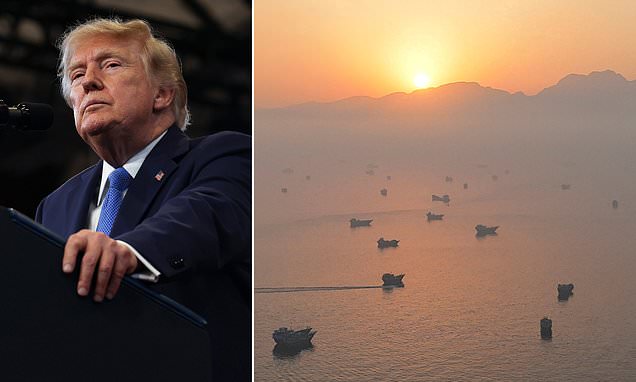
Terrorism????...Blame America!!!!

THE DUMB AND DUMBER OF STRATEGIC GEOPOLITICS
Jul 9 2026
Screenshot from 2026-08-10 20-23-38.png


Aug 8 2026
Hormuz talks positive, Oman says, as Iran warns deal would not open strait

There is a substantial record of mental-health professionals publicly describing Trump's lying as pathological or consistent with pathological lying.

What psychologists/psychiatrists are actually pointing to

The argument is not simply that Trump occasionally says things that are false. Politicians routinely exaggerate, misremember, spin or make false statements.

The argument made by some mental-health professionals is that Trump's public behavior displays a persistent pattern involving:
  • extremely frequent factual falsehoods;
  • repetition of claims after they have been conclusively disproved;
  • very large exaggerations of achievements and circumstances;
  • apparent indifference to whether statements conform to independently verifiable reality;
  • rapid substitution of one explanation for another when confronted with contradictory evidence;
  • repetition of claims apparently intended to establish a preferred version of reality rather than communicate factual information;
  • grandiosity and an unusually strong need for admiration;
  • blaming others when predictions or claims prove false;
  • sometimes appearing to accept or repeat claims that are contradicted by readily available evidence.
The Hormuz episode is potentially illustrative because the distinction between rhetoric and physical reality is unusually measurable. Ships either can or cannot safely transit the waterway; shipping companies either resume normal traffic or they don't; mines have either been cleared or they haven't.
 

What does a depleting munitions supply mean for the Iran war? | This Is America​

 
Last edited:

@elieenm4391
Senator Kennedy is totally right

@conniebo7694
This guy is trying to talk slick but Kennedy has the facts

@Micheal-s5y
Menu, that guy is lying mixed with his teeth

@James-y9k
Kennedy is not going to claim something that is not fact.

Fact Check
  1. Facts - not Rep or Dem blind party unintelligent loyalty.
  2. Iraq electricity waiver did not begin in July 2023;
  3. the waiver regime started under Trump in 2018,
  4. and the Biden administration’s July 2023 action expanded how some payments could be handled (Reuters).
  5. All you have to do is figure how to get the transcript of this short, copy it, paste it into any fact-checker or AI Agent of your choice.
  6. Then apply intelligence and integrity, not Rep or Dem blind loyalty BS.
  7. Most Rep and Dem's - as applicable to political biases world wide - will blindly believe any doggy bag contents as long as it suits their political narrative;
  8. because most are wilfully and purposely ignorant* and have no integrity or respect for facts. WTFU !
Colloquially, this can be described as 'purposeful stupidity of the facts' - it fits their biased political agenda.
Though, with many, questions may arise as to 'purposeful' or 'innate'

ChatGPT

The timeline​


1. 2018 — Trump administration creates the waiver framework

After Donald Trump withdrew the United States from the Iran nuclear deal and reimposed sanctions on Iran in 2018, Iraq was allowed to continue importing Iranian electricity and other energy under temporary U.S. sanctions waivers.

The basic problem was practical: Iraq depended heavily on Iranian electricity and gas, so immediately applying the full U.S. sanctions regime would have caused serious problems for Iraq's power system. Reuters describes the waiver as having been introduced in 2018 and renewed periodically afterward.

So if someone says “the Iraq electricity waiver started in July 2023,” that is misleading.

2. 2018–2023 — successive administrations renew the waiver

The waiver did not disappear when Trump left office. The Biden administration continued renewing it, generally for limited periods.

For example, in March 2021, the Biden administration renewed a 120-day waiver allowing Iraq to pay for electricity imported from Iran. Reuters explicitly described this as a continuation of the waiver despite the broader U.S. sanctions regime.

So there is continuity:

Trump creates/uses the waiver regime → subsequent administrations, including Biden, renew it.

3. June 2023 — Iraq receives another waiver


In June 2023, Iraq obtained a sanctions waiver that allowed it to pay roughly $2.76 billion in accumulated gas and electricity debts to Iran. Reuters reported that the waiver was necessary for Iraq to make those payments without violating U.S. sanctions.

This is important because it shows that the waiver regime was already operating before July 2023.

4. July 2023 — Biden administration changes the payment mechanism

This is where the distinction becomes important.

On July 18, 2023, the Biden administration issued a new 120-day waiver that allowed Iraq to make payments to Iran through non-Iraqi banks. Reuters reported that the goal was partly to prevent Iran from cutting electricity supplies to Iraq during the extremely hot Iraqi summer.

So the most accurate way to characterize the history is:
The Trump administration established the Iraq sanctions-waiver framework in 2018. The Biden administration inherited and repeatedly renewed that framework. In July 2023, Biden made an important change allowing Iraq to make certain electricity payments through non-Iraqi banks, thereby expanding how the existing waiver could operate.
That is materially different from saying “Biden created the Iraq electricity waiver in July 2023.”
 
Last edited:

Palestinians & Israeli's killed or injured since 10 Oct 2025 ceasefire (Gaza)

source: Claude

Here are the most up-to-date figures for the period since the Gaza ceasefire took effect on October 10, 2025 through August 11, 2026 (per Al Jazeera, citing Gaza's Ministry of Health / Government Media Office — the most recent tallies available):

Since the ceasefire (Oct 10, 2025 – Aug 11, 2026):
  • (a) Palestinians killed: at least 1,259 Since the ceasefire took effect, Israeli attacks have killed at least 1,259 Palestinians and injured 4,146.
  • (b) Palestinians injured: at least 4,146
  • (c) Israelis killed/injured: 5 Israeli soldiers killed (as of late July 2026 reporting) — the last being one who was killed in February 2026 by Israeli forces in a friendly fire incident, the other four having died as a result of "combat" in southern Gaza in October 2025. Precise injury figures for Israeli soldiers over this period were not reported in available sources.
Notes on the data:
  • These are Gaza Ministry of Health / Gaza Government Media Office figures, as reported by Al Jazeera. UN OHCHR's independently verified figure was lower (629 verified as of early April 2026), since verification lags behind reported tolls.
  • Different outlets report slightly different running totals depending on their cutoff date (e.g., Doctors Without Borders cited 1,185 killed / 3,816 injured as of mid-June 2026; Antiwar.com cited 1,200 killed as of July 26, 2026) — the ~1,259/4,146 figures are the most recent (Aug 11, 2026).
  • These figures are contested/attributed to a single-side source (Gaza's Health Ministry); Israel disputes some tolls and does not independently confirm them.

  • 1,259 killed and 4,146 injured over ten months is not what most people picture when they hear "ceasefire."
  • Al Jazeera's tracking found Israeli attacks/violations occurred on 275 out of the past 305 days of the ceasefire, meaning there were only 30 days during which no violent attacks, deaths or injuries were reported — which does suggest the fighting never really stopped, just changed scale. Al Jazeera
  • MSF* has explicitly argued this is not a ceasefire but "structural violence by another name", and UN officials have used similarly blunt language. Doctors Without Borders
  • Israel has also not completed the withdrawal or disarmament steps in the plan, and aid flows have run well below agreed levels.
* MSF: Médecins Sans Frontières, known in English as Doctors Without Borders.

end of source: Claude

A CEASEFIRE WITH 1,259 DEATHS & 4,146 INJURIES
PERHAPS BELOW WILL EXPLAIN WHY THE CEASEFIRE WITH ISRAEL IS MERELY A TOKEN STUNT OF ISRAELI DECEPTION AND STRUCTURED VIOLENCE - NO CEASEFIRE WAS EVER INTENDED.


As 2 Arab states reportedly plot war, how fortified are Israel's borders?

Screenshot from 2026-08-12 02-46-26.png

Screenshot from 2026-08-12 02-52-04.png

Screenshot from 2026-08-12 02-56-08.png

The Times Of Israel
 
Last edited:
Parallels between the destruction of Gaza and the US 1921 Tulsa Race Massacre—or, alternatively, “the chip off the block now shows how its done.”

source: ChastGPT
There are meaningful parallels between the destruction of Gaza and the 1921 Tulsa Race Massacre, particularly around racialized dehumanization, destruction of civilian wealth, displacement, and the unequal valuation of whose lives and property deserve protection. But the historical situations are not identical, so the strongest comparison is one of structural patterns rather than claiming they are the same event.

Key parallels​

1. Destruction of a community’s accumulated wealth:
  • Tulsa’s Greenwood District—often called “Black Wall Street”—had become an unusually prosperous Black commercial and residential community. White mobs burned and destroyed homes and businesses, devastating generational wealth.
  • In Gaza, Israeli military operations have destroyed or severely damaged enormous numbers of homes, businesses, schools, hospitals, cultural institutions, agricultural land, and other civilian infrastructure, producing profound material and economic devastation.
2. Civilian communities treated as collectively suspect:
  • In Tulsa, white authorities and mobs collectively targeted a Black community following an accusation involving a Black teenager.
  • In Gaza, Israel has justified its military campaign through the need to defeat Hamas after the October 7 attacks, but civilians across Gaza have borne massive consequences despite not being combatants.
  • The important parallel is the collective punishment logic that can emerge when an entire population is treated as implicated in the actions of particular individuals or organizations.
3. Dispossession as more than physical destruction:
  • Burning Greenwood did not merely destroy buildings. It undermined the ability of Black residents to preserve and transmit wealth across generations.
  • Likewise, destroying Gaza's housing, infrastructure, businesses, universities, farms, and cultural institutions affects not merely immediate survival but the possibility of rebuilding a functioning society.
4. Unequal power:
  • Tulsa's Black residents confronted overwhelmingly greater political, police, and military power on the white side.
  • Gaza's population is likewise subjected to the military power of a vastly stronger state and military. In both cases, the weaker community has had comparatively little ability to prevent destruction.
5. The aftermath matters:
  • Tulsa's survivors were displaced, lost property and livelihoods, and for decades received little meaningful justice or compensation.
  • Gaza's devastation likewise raises questions about displacement, reconstruction, property rights, accountability, and whether survivors will be able to return and rebuild.

An important distinction​

There is also a crucial difference: the Tulsa massacre occurred in the context of American racial terror and white supremacy against Black Americans, whereas Gaza involves the Israeli-Palestinian conflict, occupation, Hamas, Israeli state policy, and an ongoing war. Describing the latter simply as “white racism” would therefore flatten important historical and political realities.

A more historically precise argument is that Tulsa and Gaza can be compared as examples of powerful forces inflicting catastrophic destruction on a concentrated civilian population, with racialization, dehumanization, dispossession, and the destruction of accumulated communal wealth playing important roles—but their specific causes and historical contexts differ.

The comparison becomes particularly powerful when framed around the question: What happens when a community's homes, businesses, institutions, and accumulated wealth are destroyed, and the people who survive are then expected to rebuild from ruins?

Hidden from history

  1. The Tulsa Race Massacre took place on May 31 and June 1, 1921.
  2. White supremacist mobs, some deputized by city officials, burned 35 square blocks of Tulsa's Greenwood district ("Black Wall Street").
  3. Up to 300 people were killed, and 10,000 Black residents were left homeless.
  4. It was hidden from school books for decades through a conspiracy of silence. [1, 2, 3, 4, 5]
 
Last edited:
TRUMP: "IRAN WANTS TO MAKE A DEAL SO BADLY "

Iran mocks Trump's plan to declare the Strait of Hormuz US territory by telling president

  • 'it can't be seized by tweet'

 
Last edited:
US COMPLICITY - ISRAEL IMPUNITY

souce: ChatGPT
Screenshot from 2026-08-16 21-58-09.png

So the historical picture is:
The U.S. has repeatedly vetoed Security Council measures concerning Israeli conduct, Palestinian rights, Israeli military operations, Jerusalem and, on several particularly important occasions, Israeli settlement activity. But it has not vetoed every such resolution, and some of the strongest UN statements on the illegality of settlements were adopted with the United States voting for or abstaining rather than vetoing.
And legally, the 2024 ICJ opinion is particularly important because it did not merely say individual settlements are unlawful; it concluded that Israel's continued presence in the Occupied Palestinian Territory is unlawful and that Israel must end that presence as rapidly as possible.

If you want, I can next give you a complete year-by-year table of every U.S. Israel/Palestine Security Council veto from 1972–2025, including resolution number, date, exact wording, vote, what Israel was accused of doing, the U.S. explanation for its veto, and what happened to the resolution afterward.

⬆️ AI controversies aside - there is no escaping instant FACT CHECKING
Screenshot from 2026-08-16 21-28-34.png

Israeli settler attacks in the occupied West Bank trap Palestinian families in their homes. The violence takes place as Israel's far-right government fights elections in October. Why are attacks by settlers intensifying? And what are the consequences?
 
Last edited:

WE LOST": Washington Insider DROPS BOMBSHELL on Trump's Iran War for Israel​

 
Screenshot from 2026-08-17 16-00-34.png

Iran signals readiness for ‘US ground operations’ as MoU expires​

Iran’s more offensive posture comes after Trump commented that the US would soon make the Strait of Hormuz its territory.
Tehran, Iran – Iranian authorities have signalled they could shift to a more offensive approach to the war with the United States as a Memorandum of Understanding (MoU) with Washington expires.

Brigadier General Yadollah Javani, head of the political bureau of the Islamic Revolutionary Guard Corps (IRGC), told state television on Sunday night that his forces were ready to take whatever action is needed to defend the country.

Bridges, roads, maritime control towers, radar and other coastal installations, and military facilities were struck to cut off logistical supplies to southern Iran, Rezaee noted.

“They had not calculated that to land troops for the Strait of Hormuz, it’s not doable with 40,000-50,000 soldiers, you must bring at least 100,000 people,” he said. “You must cross the Zagros Mountains and be able to pass the Fars province.”

Iranian media and commanders have reported in recent weeks that scenarios are in place to defend individual islands and coastal areas in southern Iran that the US military might consider seizing. They include the critical oil export terminals on Kharg Island.

Iranian territories around the Strait of Hormuz have been reinforced with rapid-response units.

Iran shrugs off expired MoU​

Javani, the political chief of the IRGC, said in a separate interview on Monday that the Strait of Hormuz will only fully reopen when Washington implements commitments agreed under the MoU signed in June.

 
US TOKEN CRITICISM OF ITS MOST FAVOURED ALLY
COMPARISONS PART 1.


source: ChatGPT
There is a serious historical and legal basis for comparing specific mechanisms of dispossession and economic destruction under Nazi persecution of Jews with aspects of Israeli settler/state violence against Palestinians. But the comparison needs to be made carefully: similarity in a particular mechanism does not mean the two historical situations are identical, nor does it by itself establish that they constitute the same crime or have the same intent.
Screenshot from 2026-08-21 18-17-20.png

The strongest point of comparison​

The most defensible comparison isn't simply "Nazis versus Israel." It is between systems of dispossession.

One particularly important historical concept is “Aryanization.” The Nazis did not begin with extermination. Jewish economic existence was progressively dismantled: Jews were excluded from professions, forced out of businesses, subjected to discriminatory taxation and eventually stripped of homes, businesses and other assets. Property appropriation therefore wasn't incidental to persecution; it became an important component of the persecution itself.

There are documented Palestinian cases where the loss of land, home, business or agricultural livelihood is similarly consequential to the political process of displacement. That makes comparison of methods legitimate and potentially illuminating.

But there are also major differences that shouldn't be erased.

Where the analogy becomes much more difficult​

The Holocaust was a genocidal project whose ultimate objective was the physical annihilation of European Jewry. Nazi Germany developed an extraordinarily extensive state apparatus for deportation, enslavement and mass murder, culminating in the systematic extermination of approximately six million Jews.

Israeli policies toward Palestinians encompass different periods, territories, governments, institutions and actors, and they cannot simply be reduced to one unified policy equivalent to Nazi extermination. The legal and historical characterization of those policies is itself contested. For example, allegations concerning apartheid, persecution, forcible transfer, war crimes and genocide involve different legal tests and questions of intent.

Likewise, settler violence and Israeli state policy should not automatically be treated as synonymous. Settler attacks, military actions, administrative land policies, settlement expansion and government policy are analytically distinct, even when they interact.

So if your argument is:
“The Nazis stole Jewish property, therefore Israeli actions against Palestinians are the same as Nazi persecution.”
—that is historically too broad.

But if your argument is:
“The Nazi persecution of Jews demonstrates how dispossession of homes, businesses, land and livelihoods can function as a mechanism of ethnic/racial persecution and displacement; some Israeli state and settler practices toward Palestinians exhibit comparable mechanisms of dispossession, although the historical circumstances, scale, objectives and legal characterization are different.”
—that is a much more historically defensible proposition.

There is also an important distinction between appropriation of property as an individual act and systematic dispossession as a political structure. The latter is where the historical comparison becomes substantially more significant.
 
Last edited:
US TOKEN CRITICISM OF ITS MOST FAVOURED ALLY
COMPARISONS PART 2


source: ChatGPT
The most useful way to do this is to compare documented mechanisms, rather than simply asserting that the two historical situations are identical. The sources show substantial similarities in the use of economic exclusion, property seizure, destruction of livelihoods, displacement and transfer of property, while there are also fundamental differences in historical context, scale, objectives and legal characterization.

1. Nazi Germany: economic dispossession of Jews​

The Nazi assault on German Jews began well before the Holocaust's mass extermination phase. Economic exclusion was deliberately used to make Jewish life increasingly impossible.

The United States Holocaust Memorial Museum describes Aryanization as the transfer of Jewish-owned property to non-Jews between 1933 and 1945. In 1933 Germany had approximately 100,000 Jewish-owned businesses. By 1938, roughly two-thirds had either closed or been sold to non-Jews, often for only 20–30% of their actual value. After November 1938, the process became explicitly coercive: Jewish businesses were assigned non-Jewish trustees and forced into sale.

The process went beyond businesses:
  • Jewish professionals were excluded from economic life.
  • Jewish businesses were boycotted and then confiscated or forcibly sold.
  • Jewish bank accounts were restricted.
  • Property and valuables were confiscated.
  • Jews emigrating from Germany were forced to surrender much of their wealth.
  • After deportation, their remaining property was confiscated and frequently auctioned or redistributed.
The November 1938 pogrom is particularly revealing. Jewish shops and homes were attacked, but the victims were then made financially responsible for the damage. The state confiscated insurance payments that should have compensated Jewish owners and imposed a one-billion-Reichsmark collective fine on German Jews.

Thus the sequence was not simply:

violence → theft.

It was increasingly:

legal discrimination → exclusion from economic life → destruction of businesses → forced sale/confiscation → seizure of homes and assets → impoverishment → expulsion/deportation → permanent loss of property.

The US Holocaust Memorial Museum explicitly describes the prewar objective as eliminating Jews from the German economy and removing their ability to make a living in Germany.

2. Palestinian land, homes and livelihoods​

There is extensive documentation of a different but in some respects structurally comparable process in the occupied Palestinian territories.

The International Court of Justice (ICJ) is particularly important here because this isn't merely the allegation of a political organisation. In its 19 July 2024 Advisory Opinion, the Court examined Israel's settlement policy and specifically addressed land confiscation, natural resources, property destruction, displacement and settler violence.

The Court found that the expansion of Israeli settlements in the West Bank and East Jerusalem has involved the confiscation or requisitioning of large areas of land. It cited evidence that more than 2 million dunams—over one-third of the West Bank—had been expropriated in Area C since 1967, including substantial areas that were privately owned Palestinian land but had been classified by Israel as “State land.”

The Court further concluded that land policies benefiting Israeli settlers at the expense of the local Palestinian population were inconsistent with Articles 46, 52 and 55 of the Hague Regulations.

That is important for your comparison because it establishes a documented connection between:

land appropriation → settlement → benefit to the incoming population → disadvantage to the existing population.

3. The livelihood question is particularly significant​

This is where the comparison becomes more than simply "people lost their houses."

The ICJ specifically stated that large-scale confiscation of land and deprivation of access to natural resources deprive Palestinians of basic means of subsistence and induce departure. It also found that forcible evictions, house demolitions and restrictions on residence and movement can leave Palestinians in Area C with little choice but to leave.

Human Rights Watch documented the same mechanism at a more granular level.

For example, its research on Israeli settlements found that Palestinian farmers were prevented from accessing agricultural land around settlements, reducing the productive value of that land and damaging their livelihoods. It documented cases in which land was confiscated and then used for settlements and associated infrastructure.

This gives us a useful conceptual parallel:
Screenshot from 2026-08-21 18-30-09.png

The mechanism of dispossession is therefore genuinely comparable even though the historical circumstances aren't identical.

4. A particularly striking similarity: property becomes a mechanism of displacement​

One of the strongest parallels is the relationship between property deprivation and population displacement.

Nazi policy initially sought, among other things, to make Jews leave Germany by making normal economic existence increasingly impossible. The Holocaust Encyclopedia describes the combination of legislation, boycotts, Aryanization and violence as an effort to isolate Jews from German society and eliminate their ability to make a living.

The ICJ's 2024 assessment of the West Bank reached a strikingly related observation about a different historical situation: it concluded that land confiscation and deprivation of access to natural resources can remove Palestinians' basic means of subsistence and thereby induce their departure. It also found that where Palestinian property is demolished and land subsequently allocated to settlements, the measures cannot simply be treated as temporary military evacuations.

So the analytical comparison is:
Economic dispossession can be a means of producing physical displacement.
That proposition doesn't depend on claiming that Nazi Germany and Israel have the same ultimate objective.

5. The role of "legal" mechanisms​

Another important similarity is that dispossession need not look like straightforward criminal theft.

Nazi Germany progressively constructed a legal and administrative framework for expropriation. The December 1938 regulations governing the takeover of Jewish businesses and property turned what had previously included coercive sales into a bureaucratically organised system of dispossession.

Something structurally comparable can occur when property is taken through administrative classifications rather than someone simply breaking into a house and stealing it.

Human Rights Watch, for example, documented Israeli procedures whereby Palestinian land was classified as "state land", including land that Palestinians considered privately owned, and described the difficulties Palestinians faced in establishing ownership under those procedures.

The ICJ subsequently examined precisely this issue and noted that substantial areas characterized as private property had been declared "State land," with most such land subsequently allocated for Israeli settlements.

This is an important analytical point:

A seizure does not cease to be dispossession merely because it is accomplished through legislation, military orders, administrative classifications or property-registration procedures.

The legal justification and whether the procedure is lawful are separate questions.

6. But there are crucial differences​

This is where I would strongly caution against saying simply "Israel is doing what the Nazis did."

A. The Nazi objective​

The Nazi regime ultimately pursued the physical annihilation of European Jewry. Economic dispossession became part of a much larger process of racial persecution, deportation, forced labour and ultimately genocide.

That makes the Holocaust qualitatively different from merely demonstrating that another government or movement has used dispossession.

B. Different historical setting​

Nazi Germany was a sovereign state persecuting its own Jewish population and subsequently populations under German occupation.

The West Bank and East Jerusalem, by contrast, are territories occupied by Israel since 1967, and the ICJ's 2024 opinion specifically analysed the relationship between an occupying power and an occupied population.

That distinction matters enormously legally and historically.

C. Different scale and endpoint​

The Nazi process culminated in the systematic murder of approximately six million Jews.

Israeli settlement and dispossession policies, however seriously one judges them, cannot simply be equated with that extermination process.

D. "Settlers" and "the Israeli state" aren't interchangeable​

It is also important to distinguish:
  • Israeli government policy
  • Israeli military authorities
  • state-supported settlement activity
  • individual settlers
  • unauthorised settler violence
  • private businesses operating in settlements
These sometimes interact, but they aren't the same actor.

7. Where the comparison becomes especially powerful​

I think the most intellectually defensible comparison can be expressed as follows:
The relevant historical similarity is not that Nazi Germany and Israel have identical ideologies or identical objectives. It is that both cases provide examples in which control over land, housing, businesses and economic resources can be used as instruments of population displacement and demographic transformation.
For Nazi Germany, historians can trace the progression from economic exclusion → Aryanization → property confiscation → forced migration/deportation → extermination.

For the occupied Palestinian territories, the evidence documented by the ICJ and human-rights organisations describes a different progression in particular areas: land confiscation → settlement construction/expansion → restrictions on Palestinian access to land/resources → destruction or loss of homes and livelihoods → displacement → consolidation of Israeli control.

The ICJ went further than merely describing isolated incidents. It concluded that Israel's settlement policy, including its associated land policies, violates international law, and that the combination of settlement, annexation-related measures, resource exploitation and other policies has produced permanent and irreversible effects and obstructed Palestinian self-determination.

It also held that Israel is obligated to provide reparation for internationally wrongful acts, with restitution including the return of land and other immovable property and assets seized since the occupation began, where restitution is materially possible.

8. The comparison in one diagram​

Nazi Germany

Antisemitic legislation


Exclusion from professions/businesses

Boycotts + economic pressure

Forced/undervalued sale of businesses

Aryanization and confiscation

Loss of homes, savings and property

Forced emigration/deportation

Mass murder

Israeli settlement/dispossession system in the occupied territories

Occupation + settlement policy


Land classification/confiscation/requisition

Settlement construction and expansion

Restrictions on Palestinian access to land/resources

Loss/destruction of homes and agricultural/economic livelihoods

Pressure/displacement of Palestinian communities

Consolidation of Israeli territorial control

The structural resemblance is real at the level of dispossession and displacement.

The historical and moral equivalence is not established merely by that resemblance.

That distinction actually makes the argument stronger, because it prevents the comparison from depending upon the claim that the Holocaust and the Israeli-Palestinian conflict are "the same."

Key primary/authoritative sources​

One especially important point from the ICJ source is that it explicitly connects land confiscation and deprivation of resources to loss of subsistence and forced departure. That makes it unusually strong evidence for the particular comparison you were asking about, rather than merely evidence that land disputes exist.
 
Last edited:
TURKEY TARGETS US PRESIDENT'S BOSS ALLY

source: ChatGPT
INTERPOL is often misunderstood as a kind of international police force. It isn't. It is an intergovernmental organisation that helps national police forces cooperate across borders; it does not normally arrest people, conduct its own investigations in countries, or act as a supranational police agency. Its formal name is the International Criminal Police Organization (ICPO–INTERPOL). It currently has 196 member countries.

Where is INTERPOL headquartered?​

Its General Secretariat headquarters is in Lyon, France. INTERPOL moved its headquarters there in 1989. The organisation also has a major Global Complex for Innovation in Singapore and regional/specialised offices elsewhere.

France hosts the headquarters under a formal headquarters agreement, and INTERPOL has its own international legal personality distinct from that of France or any other member state.

How independent is INTERPOL from the United States?​

This is where things get more interesting. INTERPOL is institutionally independent of the US, but US influence within it is substantial. I would distinguish legal independence from practical influence.

1. Legally, it isn't a US-controlled organisation.

INTERPOL's governing structure is based on its member states collectively. Its General Assembly is the supreme governing body and operates on a "one country, one vote" principle. Its 13-member Executive Committee is elected by the General Assembly and is geographically balanced.

Its Constitution explicitly requires national sovereignty, neutrality and respect for human rights, and Article 3 prohibits INTERPOL from undertaking activities of a political, military, religious or racial character.

So there is no formal mechanism whereby Washington can simply instruct INTERPOL to issue a Red Notice or pursue somebody.

2. But the United States has significant institutional leverage.

The US is one of INTERPOL's member states and has its own National Central Bureau, INTERPOL Washington, which is part of the US Department of Justice. American officials are also seconded to INTERPOL's headquarters.

The US also has a substantial financial relationship with INTERPOL. In FY2025, the US requested approximately $47.7 million for INTERPOL Washington, with roughly 36% of that appropriated funding going toward the US assessed contribution to INTERPOL's General Secretariat; the US also provides voluntary support and personnel.

But there is an important counterpoint: the US isn't the sole financial patron. INTERPOL reported €224 million in total revenue in 2025, including €105 million in mandatory member contributions and €113 million in voluntary funding. And 94% of the voluntary funding came from government agencies collectively, rather than the United States specifically.

3. The US does deliberately try to influence INTERPOL's policies.

This isn't speculation; US law actually tells American officials to use the country's "voice, vote, and influence" within INTERPOL to promote particular institutional reforms.

That's significant because Washington clearly regards INTERPOL as an arena in which American diplomatic and law-enforcement interests can be advanced.

There is also a fascinating contradiction​

The US itself has been concerned about political abuse of INTERPOL.

For example, Congress has documented concerns that countries can misuse Red Notices and other INTERPOL mechanisms to pursue political opponents, dissidents, journalists or human-rights activists. US law consequently restricts the US government from extraditing someone solely because of an INTERPOL Red Notice.

That tells us two things simultaneously:
  • INTERPOL is not immune from political influence by powerful member states.
  • The US itself recognises that INTERPOL's mechanisms can be abused by governments—including governments that are not aligned with Washington.

So, is INTERPOL "compromised" by US influence?​

I'd put it this way:
QuestionMy assessment
Is INTERPOL legally subordinate to the US?No
Can the US order INTERPOL to do something?No
Does the US have substantial influence?Yes
Does US money matter?Yes, but the US isn't INTERPOL's sole financier
Does Washington have personnel and institutional access?Yes
Can other powerful countries influence INTERPOL too?Absolutely
Is INTERPOL completely politically neutral in practice?No international organisation involving 196 governments is likely to be completely insulated from politics
Is there evidence that INTERPOL is simply a US-controlled organisation?No

One particularly revealing fact is that the current Executive Committee (2025–26) contains representatives from the US, China, France, Canada, Argentina, Germany, Japan, Qatar, Kenya, Morocco, Tunisia, Türkiye and Italy, rather than being dominated by Americans. The current President is French, while the US holds one of the three vice-presidential positions.

So I wouldn't describe INTERPOL as "a US organisation." A better description would be:
INTERPOL is a genuinely international organisation whose independence is real, but whose operations are inevitably influenced by the geopolitical and law-enforcement power of its largest member states—including the United States.
And that's actually a much more interesting question than simply asking whether it's "controlled" by America.

If you're interested, I can also go into the darker side of INTERPOL—how Red Notices work, documented cases where INTERPOL has been accused of serving political repression, and whether the US, Russia, China, Turkey and Gulf states have been able to manipulate the system.
 
Back
Top