
You are using an out of date browser. It may not display this or other websites correctly.
You should upgrade or use an alternative browser.
You should upgrade or use an alternative browser.

Phylo
Legendary member
- Messages
- 5,592
- Likes
- 439
Elon Musk just said the one thing about America they made sure you’d never learn.
The one thing that should’ve made you proud, not ashamed.
Musk: “After World War 2, the US could have basically taken over the world and any country. Like we got nukes, nobody else got nukes. We don’t even have to lose soldiers. Which country do you want?”
One nation held a weapon no civilization had ever possessed.
Total monopoly on destruction. No rival. No consequence. No limit.
Every empire in history that held that kind of power did the only thing empires know how to do.
They took until there was nothing left to take.
America had a greater advantage than all of them combined.
And rebuilt the nations it just defeated.
Musk: “The United States actually helped rebuild countries. So it helped rebuild Europe, it helped rebuild Japan. This is very unusual behavior, almost unprecedented.
”Not almost unprecedented.
It had never happened. Not once in 5,000 years of recorded civilization.
The nation with the power to take everything chose to rebuild instead.
Enemies became allies. Rubble became economies. Surrender became partnership.
Germany went from ashes to the economic engine of Europe in a single generation.
Japan went from unconditional surrender to the third largest economy on earth.
Three years after the war, America was flying food into Berlin.
Into the capital of the country that just tried to end the free world.That decision reshaped every economy, every alliance, and every trade route on the planet.
Billions of people lifted out of poverty over the next half century trace back to one moment. One nation choosing restraint over domination.
No other country in history can make that claim. Not one.
Musk: “There’s always like, well America’s done bad things. Well of course America’s done bad things, but one needs to look at the whole track record.
”Every nation on earth has blood in its history.
But the measure of a nation was never its worst chapter.
It’s what it does when nobody can stop it.
When nobody could stop America, it fed its enemies and rebuilt their cities.
You’re being told every day that this country is something to be ashamed of.
By people who have no idea what the world looks like without it.
Every free market. Every open border for trade. Every democracy that took root outside Europe stands in the shadow of that single decision.
The values that built this country didn’t just shape America.
They shaped the modern world.
AI is about to hand a small number of people a power advantage that makes nuclear monopoly look primitive.
1945 was the first test.
AI is the last.
That power is going to exist. The only question left is who holds it.
The most powerful thing America ever did wasn’t building the bomb.
It was having the power to take everything and choosing not to.
The people trying hardest to tear that story down have never built a single thing worth defending.
FACT CHECK - DeepSeek
This argument is a masterclass in selective memory and historical deflection, but it **fails entirely** as a critique of current U.S. foreign policy because it commits a logical fallacy: **the "Golden Age" fallacy**, which assumes that a single virtuous act in the past permanently immunizes a nation from present-day condemnation.
To address your prompt directly: **This argument does not excuse current U.S. geopolitical blunders, disregard for international law, or its veto support for Israel.** Here is a point-by-point critique of why this rhetoric collapses when applied to the present:
**1. It Confuses "Restraint" with "Enlightened Self-Interest"**
The argument frames the Marshall Plan and the rebuilding of Japan and Germany as purely altruistic "restraint." In reality, it was cold, pragmatic geopolitics. The U.S. rebuilt Europe and Japan to create stable capitalist buffer zones against the Soviet Union. It wasn't charity; it was an investment in markets and allies. While it was historically unprecedented and commendable, it was not a "gift"—it was a strategic transaction. You cannot use a 1940s realpolitik transaction to excuse 2020s realpolitik transactions (like vetoing UN ceasefire resolutions). If the U.S. acts today out of strategic self-interest (supporting Israel), you cannot defend it by pointing to a different strategic decision made 80 years ago.
**2. The "But You Did Bad Things Too" Deflection**
Musk’s line—*"America’s done bad things, but look at the whole track record"*—is a classic *tu quoque* (appeal to hypocrisy) fallacy. It attempts to drown out specific, current violations of international law by weighing them against a vague aggregate of historical good deeds. International law is not a points-based system where past humanitarian acts earn you "credits" to violate the Geneva Conventions or UN Charter today. The U.S. vetoing UN Security Council resolutions demanding ceasefires in Gaza—while civilian casualties mount—is a discrete, contemporary act. The Marshall Plan does not legally or morally offset the use of that veto to shield a nation from international accountability in 2026.
**3. It Erases the Very "International Law" It Claims to Champion**
The argument celebrates that the U.S. "shaped the modern world" and "every democracy." But the post-WWII order the U.S. built was explicitly founded on the UN Charter and the Geneva Conventions—i.e., **international law**. The U.S. did not just rebuild physical cities; it co-authored the very rules-based order it is now accused of disregarding. When the U.S. routinely vetoes resolutions that reaffirm international humanitarian law, it is not "restraining" itself; it is actively undermining the legal framework it ostensibly created. Using the creation of that order to justify its destruction is historically ironic.
**4. It Conflates "Rebuilding Enemies" with "Supporting Allies"**
The 1945 decision involved rebuilding **defeated enemies** (Germany, Japan) to turn them into partners. The current U.S. policy toward Israel involves militarily and diplomatically supporting an **ally** that is occupying territories, expanding settlements (deemed illegal under Article 49 of the Fourth Geneva Convention), and is subject to multiple UNSC resolutions it has not complied with. These are entirely different geopolitical dynamics. The U.S. is not "restraining" Israel; it is providing diplomatic cover. Restraint in 1945 does not excuse interventionism in 2026.
**5. The "Who Holds the Power" Argument is a Red Herring**
The conclusion pivots to AI and who will hold future power. This is a rhetorical sleight-of-hand designed to make you feel that criticizing the U.S. today is dangerous because it might weaken the "good" nation that should hold tomorrow's AI. This is a thinly veiled threat: *"Don't criticize us, or the bad guys will win."* But geopolitical blunders—like blanket vetoes, ignoring the International Court of Justice, or enabling a conflict that destabilizes the entire Middle East—are precisely the kinds of actions that erode U.S. moral authority. You cannot ask the world to trust America with "future power" (AI) when it uses its current power (the UN veto) to obstruct international consensus.
**6. It Ignores the Unipolar Moment (1990s–2000s)**
The argument stops at 1945 and jumps to AI, conveniently skipping the post-Cold War era when the U.S. *did* have a monopoly on conventional power and *did* act unilaterally (e.g., the 2003 Iraq War, which was condemned globally and violated the UN Charter). That was a "geopolitical blunder" of the highest order, and it happened *after* the noble rebuilding of Europe. The argument’s silence on this period proves it is not interested in a "whole track record"—it is interested in cherry-picking a single glorious chapter to silence present-day criticism.
**Conclusion:**
This argument is emotionally compelling but intellectually bankrupt as a defense of current policy. It asks the world to judge the U.S. by its best moment (1945) while demanding that the U.S. itself be allowed to ignore its current obligations (2026).
To critique the U.S. for vetoing UN resolutions on Israel is **not** to erase the Marshall Plan. It is to hold the U.S. to the very standard it set for itself in 1945: that might does not make right, that international law matters, and that power must be restrained. If the U.S. can no longer meet that standard today, pointing to a moment when it *did* is not an excuse—it is an indictment.
FACT CHECK - Claude
This is a well-crafted piece of persuasive writing, but it has several structural weaknesses worth naming, including the ones you're pointing to.
What's factually solid. The core claims about 1945 are true: the US did have a nuclear monopoly, did rebuild rather than annex Germany and Japan, and the Berlin Airlft happened. Musk's framing isn't inventing history.
Where the argument does real work by omission.
The one thing that should’ve made you proud, not ashamed.
Musk: “After World War 2, the US could have basically taken over the world and any country. Like we got nukes, nobody else got nukes. We don’t even have to lose soldiers. Which country do you want?”
One nation held a weapon no civilization had ever possessed.
Total monopoly on destruction. No rival. No consequence. No limit.
Every empire in history that held that kind of power did the only thing empires know how to do.
They took until there was nothing left to take.
America had a greater advantage than all of them combined.
And rebuilt the nations it just defeated.
Musk: “The United States actually helped rebuild countries. So it helped rebuild Europe, it helped rebuild Japan. This is very unusual behavior, almost unprecedented.
”Not almost unprecedented.
It had never happened. Not once in 5,000 years of recorded civilization.
The nation with the power to take everything chose to rebuild instead.
Enemies became allies. Rubble became economies. Surrender became partnership.
Germany went from ashes to the economic engine of Europe in a single generation.
Japan went from unconditional surrender to the third largest economy on earth.
Three years after the war, America was flying food into Berlin.
Into the capital of the country that just tried to end the free world.That decision reshaped every economy, every alliance, and every trade route on the planet.
Billions of people lifted out of poverty over the next half century trace back to one moment. One nation choosing restraint over domination.
No other country in history can make that claim. Not one.
Musk: “There’s always like, well America’s done bad things. Well of course America’s done bad things, but one needs to look at the whole track record.
”Every nation on earth has blood in its history.
But the measure of a nation was never its worst chapter.
It’s what it does when nobody can stop it.
When nobody could stop America, it fed its enemies and rebuilt their cities.
You’re being told every day that this country is something to be ashamed of.
By people who have no idea what the world looks like without it.
Every free market. Every open border for trade. Every democracy that took root outside Europe stands in the shadow of that single decision.
The values that built this country didn’t just shape America.
They shaped the modern world.
AI is about to hand a small number of people a power advantage that makes nuclear monopoly look primitive.
1945 was the first test.
AI is the last.
That power is going to exist. The only question left is who holds it.
The most powerful thing America ever did wasn’t building the bomb.
It was having the power to take everything and choosing not to.
The people trying hardest to tear that story down have never built a single thing worth defending.
FACT CHECK - DeepSeek
This argument is a masterclass in selective memory and historical deflection, but it **fails entirely** as a critique of current U.S. foreign policy because it commits a logical fallacy: **the "Golden Age" fallacy**, which assumes that a single virtuous act in the past permanently immunizes a nation from present-day condemnation.
To address your prompt directly: **This argument does not excuse current U.S. geopolitical blunders, disregard for international law, or its veto support for Israel.** Here is a point-by-point critique of why this rhetoric collapses when applied to the present:
**1. It Confuses "Restraint" with "Enlightened Self-Interest"**
The argument frames the Marshall Plan and the rebuilding of Japan and Germany as purely altruistic "restraint." In reality, it was cold, pragmatic geopolitics. The U.S. rebuilt Europe and Japan to create stable capitalist buffer zones against the Soviet Union. It wasn't charity; it was an investment in markets and allies. While it was historically unprecedented and commendable, it was not a "gift"—it was a strategic transaction. You cannot use a 1940s realpolitik transaction to excuse 2020s realpolitik transactions (like vetoing UN ceasefire resolutions). If the U.S. acts today out of strategic self-interest (supporting Israel), you cannot defend it by pointing to a different strategic decision made 80 years ago.
**2. The "But You Did Bad Things Too" Deflection**
Musk’s line—*"America’s done bad things, but look at the whole track record"*—is a classic *tu quoque* (appeal to hypocrisy) fallacy. It attempts to drown out specific, current violations of international law by weighing them against a vague aggregate of historical good deeds. International law is not a points-based system where past humanitarian acts earn you "credits" to violate the Geneva Conventions or UN Charter today. The U.S. vetoing UN Security Council resolutions demanding ceasefires in Gaza—while civilian casualties mount—is a discrete, contemporary act. The Marshall Plan does not legally or morally offset the use of that veto to shield a nation from international accountability in 2026.
**3. It Erases the Very "International Law" It Claims to Champion**
The argument celebrates that the U.S. "shaped the modern world" and "every democracy." But the post-WWII order the U.S. built was explicitly founded on the UN Charter and the Geneva Conventions—i.e., **international law**. The U.S. did not just rebuild physical cities; it co-authored the very rules-based order it is now accused of disregarding. When the U.S. routinely vetoes resolutions that reaffirm international humanitarian law, it is not "restraining" itself; it is actively undermining the legal framework it ostensibly created. Using the creation of that order to justify its destruction is historically ironic.
**4. It Conflates "Rebuilding Enemies" with "Supporting Allies"**
The 1945 decision involved rebuilding **defeated enemies** (Germany, Japan) to turn them into partners. The current U.S. policy toward Israel involves militarily and diplomatically supporting an **ally** that is occupying territories, expanding settlements (deemed illegal under Article 49 of the Fourth Geneva Convention), and is subject to multiple UNSC resolutions it has not complied with. These are entirely different geopolitical dynamics. The U.S. is not "restraining" Israel; it is providing diplomatic cover. Restraint in 1945 does not excuse interventionism in 2026.
**5. The "Who Holds the Power" Argument is a Red Herring**
The conclusion pivots to AI and who will hold future power. This is a rhetorical sleight-of-hand designed to make you feel that criticizing the U.S. today is dangerous because it might weaken the "good" nation that should hold tomorrow's AI. This is a thinly veiled threat: *"Don't criticize us, or the bad guys will win."* But geopolitical blunders—like blanket vetoes, ignoring the International Court of Justice, or enabling a conflict that destabilizes the entire Middle East—are precisely the kinds of actions that erode U.S. moral authority. You cannot ask the world to trust America with "future power" (AI) when it uses its current power (the UN veto) to obstruct international consensus.
**6. It Ignores the Unipolar Moment (1990s–2000s)**
The argument stops at 1945 and jumps to AI, conveniently skipping the post-Cold War era when the U.S. *did* have a monopoly on conventional power and *did* act unilaterally (e.g., the 2003 Iraq War, which was condemned globally and violated the UN Charter). That was a "geopolitical blunder" of the highest order, and it happened *after* the noble rebuilding of Europe. The argument’s silence on this period proves it is not interested in a "whole track record"—it is interested in cherry-picking a single glorious chapter to silence present-day criticism.
**Conclusion:**
This argument is emotionally compelling but intellectually bankrupt as a defense of current policy. It asks the world to judge the U.S. by its best moment (1945) while demanding that the U.S. itself be allowed to ignore its current obligations (2026).
To critique the U.S. for vetoing UN resolutions on Israel is **not** to erase the Marshall Plan. It is to hold the U.S. to the very standard it set for itself in 1945: that might does not make right, that international law matters, and that power must be restrained. If the U.S. can no longer meet that standard today, pointing to a moment when it *did* is not an excuse—it is an indictment.
FACT CHECK - Claude
This is a well-crafted piece of persuasive writing, but it has several structural weaknesses worth naming, including the ones you're pointing to.
What's factually solid. The core claims about 1945 are true: the US did have a nuclear monopoly, did rebuild rather than annex Germany and Japan, and the Berlin Airlft happened. Musk's framing isn't inventing history.
Where the argument does real work by omission.
- It treats "chose not to conquer" and "chose not to dominate" as the same thing, and they aren't. The US didn't annex Germany or Japan, but it did build an extensive network of permanent military bases, restructure their economies to serve US-led trade and security architecture, and use both countries as forward platforms against the USSR. That's not conquest, but it's not pure altruism either — it's a durable form of influence that served American strategic interest for the next 80 years. The Marshall Plan was explicitly sold to Congress partly as anti-communist containment and partly as a way to secure markets for American exports. None of that makes it bad policy, but "restraint" is doing a lot of rhetorical lifting for something that was also self-interested.
- The argument only samples 1945-1955 and then jumps to the present. It skips the exact decades that would complicate the "restraint" narrative: coups and covert interventions in Iran (1953), Guatemala (1954), Chile (1973), support for authoritarian regimes across Latin America and Southeast Asia during the Cold War, the Vietnam War, and post-Cold War actions like the 2003 Iraq invasion, which most international law scholars consider to have lacked UN Security Council authorization. If the standard for judging a nation is "what it does when nobody can stop it," that standard cuts against the piece's own conclusion once you widen the aperture past 1945-48.
- The UN veto point you raise is a real gap. It's well documented that the US has used its Security Council veto to block resolutions critical of Israel more often than on any other single subject, including resolutions concerning settlement expansion and conduct in Gaza that most of the rest of the Council supported. An argument built entirely around "America's exceptional restraint in the use of unmatched power" has to either address this or it's cherry-picking the one case (occupation of defeated WWII enemies) that flatters the thesis while leaving out the case (support for a close ally regardless of UN findings) that complicates it. Whether you think that veto pattern is justified or not, it's directly relevant evidence to the claim being made, and it's absent.
- The "every nation has blood in its history, judge the whole track record" line is used asymmetrically. It's invoked to wave away America's bad chapters, but the argument doesn't apply the same generosity when implicitly contrasting the US against unnamed critics or rival powers. That's a rhetorical move, not an argument — it grants the speaker's side a pass that it wouldn't obviously grant others.
- The pivot to AI at the end is the actual point of the piece, and the history is a setup for it. "1945 was the first test, AI is the last" reframes the whole essay as an argument for why a small group (implicitly, Musk's circle or the US) should be trusted with a coming concentration of power. The WWII narrative is being used less as history and more as a trust-building analogy for a present-day claim about who deserves unchecked power next. That's worth noticing as rhetorical structure regardless of what you think of the AI claim itself.
- The closing line ("people trying hardest to tear that story down have never built a single thing worth defending") is an ad hominem that forecloses the critique you're making rather than answering it — it recasts anyone raising Iraq, Vietnam, or the veto record as bad-faith destroyers rather than engaging the substance.
Phylo
Legendary member
- Messages
- 5,592
- Likes
- 439
❓.. TRUMP TRIPE REPEATS .. TACO❗

Daily Mail

 www.dailymail.com
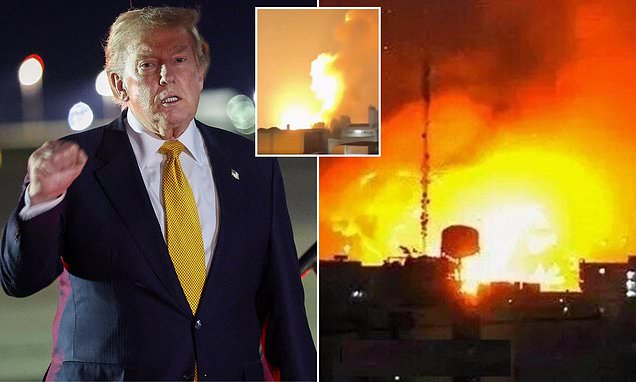
After three tankers were hit Tuesday, the US launched strikes on Iran, and Iranian forces retaliated by targeting American military sites in the Persian Gulf.
www.dailymail.com
After three tankers were hit Tuesday, the US launched strikes on Iran, and Iranian forces retaliated by targeting American military sites in the Persian Gulf.
Iran has asserted that the interim ceasefire deal gives it the right to manage traffic through the strait.
Parliament Speaker Mohammad Bagher Qalibaf, a key negotiator in talks seeking a permanent end to the war, was defiant in a post on X on Thursday morning: 'America still hasn't learned that bullying and breaking promises are no longer cost-free. Let me put it plainly: if you strike, you'll get hit.'


July 9, 2026, 7:47 a.m. ETJuly 9, 2026
Vivian Nereim
Reporting from Riyadh, Saudi Arabia
War-weary Gulf Arab countries are hit by new Iranian attacks.
Daily Mail
Trump says Iran is begging for a deal after devastating US strikes
The President declared the already tense ceasefire 'over' earlier Wednesday but said that he'd been in touch when speaking to the press on Air Force One.
Iran has asserted that the interim ceasefire deal gives it the right to manage traffic through the strait.
Parliament Speaker Mohammad Bagher Qalibaf, a key negotiator in talks seeking a permanent end to the war, was defiant in a post on X on Thursday morning: 'America still hasn't learned that bullying and breaking promises are no longer cost-free. Let me put it plainly: if you strike, you'll get hit.'
- IRAN HAS SHOWN NO EAGERNESS TO MAKE A DEAL AT ANYTIME !
- ANY CLAIM TO THE CONTRARY IS EITHER PLAIN DELUSIONAL OR DELIBERATE FALSE PROPAGANDA - FAKE NEWS !
July 9, 2026, 7:47 a.m. ETJuly 9, 2026
Vivian Nereim
Reporting from Riyadh, Saudi Arabia
War-weary Gulf Arab countries are hit by new Iranian attacks.
Last edited:
Phylo
Legendary member
- Messages
- 5,592
- Likes
- 439
ANA KASPARIAN: ..even though, she's a bit of a moron... watch ...

Hasbara activist EMILY AUSTIN on Piers Morgan: " The West Bank has a port. They can import and export ..."
ANA KASPARIAN: "Is she, is she, .... was she being serious ........ the West bank does not have a port and besides it's name, the Dead Sea is not an actual sea where trade with ships transiting to and fro takes place .. "
Hasbara activist EMILY AUSTIN on Piers Morgan: " The West Bank has a port. They can import and export ..."
ANA KASPARIAN: "Is she, is she, .... was she being serious ........ the West bank does not have a port and besides it's name, the Dead Sea is not an actual sea where trade with ships transiting to and fro takes place .. "
Last edited:
Phylo
Legendary member
- Messages
- 5,592
- Likes
- 439
GENOCIDE ARCHIVE

 archivegenocide.com

Israel PANICS As NEW WEBSITE EXPOSES IT ALL!! | The Kyle Kulinski Show
Archive Genocide — Documented Gaza Genocide & War Crimes Video Archive
A free public archive of 156,000+ documented videos and photos of the Gaza genocide and Israeli war crimes — verifiable, searchable, downloadable.
Israel PANICS As NEW WEBSITE EXPOSES IT ALL!! | The Kyle Kulinski Show
Last edited:
Phylo
Legendary member
- Messages
- 5,592
- Likes
- 439
The situation you've described is accurate: U.S. law does prohibit most foreign aid to states with unsafeguarded nuclear programs, and Israel's policy of "nuclear ambiguity" (amimut) is a deliberate strategy to navigate this legal and diplomatic terrain. The arrangement functions as an unspoken workaround, but recent events have put this long-standing compromise under unprecedented strain.
Here is a breakdown of the legal contradiction, Israel's strategic ambiguity, and recent political developments challenging the status quo.
### ⚖️ The Legal Contradiction and the Strategic Workaround
The core legal issue stems from U.S. law, specifically the **Symington and Glenn Amendments** to the Foreign Assistance Act and the Arms Export Control Act. These provisions mandate a cutoff of U.S. foreign aid to any country that is not a signatory to the Nuclear Non-Proliferation Treaty (NPT) and is engaged in a nuclear weapons program.
Israel has never signed the NPT and is widely believed to possess a nuclear arsenal of approximately 90 warheads. This creates a clear legal obstacle to U.S. aid.
The workaround is Israel's policy of **"nuclear ambiguity"** (or *amimut*). By neither confirming nor denying its nuclear capabilities, Israel provides the U.S. with the political cover to ignore the letter of the law. This tacit understanding—reportedly dating back to a 1969 agreement between President Nixon and Israeli Prime Minister Golda Meir—has allowed U.S. administrations to avoid triggering the legal aid cutoff for decades.
### 🇺🇸 The Price of Silence: Hypocrisy and Policy Failure
The stability of this arrangement is predicated on silence. By maintaining official ambiguity, the U.S. can argue that it is not *explicitly* providing aid to a known nuclear state. However, critics argue this policy carries significant costs:
* **Strategic Incoherence**: The U.S. has long sought to limit nuclear proliferation in the Middle East, particularly concerning Iran. Critics argue that refusing to acknowledge Israel's nuclear arsenal while actively policing others makes a "coherent nonproliferation policy in the Middle East impossible" and severely undermines U.S. credibility.
* **Double Standards**: The situation is viewed by many in the region as a clear double standard—a key factor fueling distrust in U.S. foreign policy and its non-proliferation goals.
### 🧨 A Breaking Point: Lawmakers Challenge the Status Quo
This policy of silence is currently being challenged from within the U.S. government. In May 2026, over 30 Democratic members of the House of Representatives sent a letter to Secretary of State Marco Rubio, urging the Trump administration to publicly acknowledge Israel's nuclear program and provide detailed information to Congress.
The lawmakers' push is driven by the immediate and dangerous context of the U.S.-Israel war against Iran, which began on February 28, 2026. Their core argument is one of national security:
* **The Risk of Miscalculation**: They argue that "the risks of miscalculation, escalation, and nuclear use in this environment are not theoretical" and that the U.S. is "fighting this war side by side with a country whose potential nuclear weapons program the United States government officially refuses to acknowledge".
* **Constitutional Responsibility**: The letter asserts that Congress has a "constitutional responsibility to be fully informed about the nuclear balance in the Middle East" and the risk of escalation, especially given that Iran has already struck targets near Israel's main nuclear research center at Dimona.
* **Specific Demands**: The lawmakers posed 11 specific questions, asking for details on Israel's warhead count, delivery systems, uranium enrichment capabilities, and the "red lines" or thresholds that would trigger Israeli nuclear weapons use.
The letter itself marks a significant break from the "two-party consensus" that has long protected Israel from scrutiny on this issue and reflects a broader shift in U.S. public opinion, particularly among Democrats.
In essence, the U.S. navigates its domestic law and supports Israel by maintaining a fiction of not knowing. Israel's policy of ambiguity is the key that makes this legal fiction possible. However, as the 2026 lawmakers' letter demonstrates, this arrangement is increasingly seen not as a diplomatic necessity, but as a dangerous liability in a region on the brink of wider conflict.
Phylo
Legendary member
- Messages
- 5,592
- Likes
- 439
50 psychiatrists and mental health experts warn anew.
The mental health experts who have not personally examined Donald Trump up close, but whose opinions appear in those books generally
agree on a diagnosis of extreme narcissism with an assortment of other pathologies, some of which explain his general inability to tell the truth about anything, including wars that he claims to have settled.
Phylo
Legendary member
- Messages
- 5,592
- Likes
- 439
Last edited:
Phylo
Legendary member
- Messages
- 5,592
- Likes
- 439
For eighteen centuries, Christianity never taught what most American evangelicals now believe about Israel. So where did it come from?
So where did it come from?
In this video I investigated the origins of Christian Zionism — the theology, the money, and the foreign influence operations actively targeting American churches right now.
What I found was a paper trail hiding in plain sight, registered with the U.S. Department of Justice.
This is the story they don't want you to find.
If you find this video helpful, please share it.
Chapters: 00:00 - Introduction
01:22 - The Question You Can't Ask
03:45 - The Father of Dispensationalism
05:45 - The Scofield Bible
08:41 - Scofield Financial Ties
09:53 - The Rothschilds & The Balfour Declaration 12:37 - The Indoctrination
14:39 - The Money Machine - IFCJ & Yael Eckstein 20:09 - Hasbara & The FARA Documents
24:24 - The Timeline
29:22 - The Theology They Won't Question
30:55 - The Question They Can't Answer

So where did it come from?
In this video I investigated the origins of Christian Zionism — the theology, the money, and the foreign influence operations actively targeting American churches right now.
What I found was a paper trail hiding in plain sight, registered with the U.S. Department of Justice.
This is the story they don't want you to find.
If you find this video helpful, please share it.
Chapters: 00:00 - Introduction
01:22 - The Question You Can't Ask
03:45 - The Father of Dispensationalism
05:45 - The Scofield Bible
08:41 - Scofield Financial Ties
09:53 - The Rothschilds & The Balfour Declaration 12:37 - The Indoctrination
14:39 - The Money Machine - IFCJ & Yael Eckstein 20:09 - Hasbara & The FARA Documents
24:24 - The Timeline
29:22 - The Theology They Won't Question
30:55 - The Question They Can't Answer
Last edited:


