
You are using an out of date browser. It may not display this or other websites correctly.
You should upgrade or use an alternative browser.
You should upgrade or use an alternative browser.

Phylo
Legendary member
- Messages
- 5,592
- Likes
- 439
Short answer: there is some truth mixed with exaggeration and misinformation.
What
- Iran has targeted U.S. and allied radar / early-warning systems in the Middle East.
- Multiple credible reports say several radar sites were hit or damaged early in the conflict. (ABC News)
- Iran also destroyed a key airborne radar platform (an AWACS plane), which is a major surveillance asset. (The Guardian)
- Experts agree that damaging these systems can reduce detection capability and reaction time.
What’s
- The specific claim that warning time went from “20 minutes to 1 minute” is not confirmed by reliable sources.
- There’s no credible reporting giving exact before/after warning times like that.
- Real-world warning time varies a lot depending on:
- launch distance
- missile type (ballistic vs cruise)
- sensor coverage at that moment
What experts actually suggest
- Damage to radar systems likely degrades coverage, not eliminates it.
- The U.S. uses layered detection, including:
- satellites
- ships (Aegis systems)
- aircraft
- multiple radar sites
- reduces redundancy
- may create gaps or delays
- but doesn’t usually drop warning time to near zero
Bottom line
- ✔️ Iran has successfully hit some U.S. radar/surveillance assets
- ✔️ This likely reduced effectiveness of early warning
- ❌ But the dramatic claim of 20 minutes → 1 minute warning is not supported by solid evidence and is likely exaggerated or from unreliable sources
Phylo
Legendary member
- Messages
- 5,592
- Likes
- 439
Inside the Islamic Revolutionary Guard Corp death cult: How henchmen brainwashed in 'violent and extremist' training camps oversee prison rapes and mass executions to maintain Iranian regime's stranglehold
In countless camps deep in rural Iran, gruff military men bark orders at trembling young cadets.Boys as young as 13 are put through their paces by uncompromising tutors, who brainwash their pupils into hating all of Iran's enemies, planting a seed that grows into a fanatical and insular view of the world.
This is the beginning of the journey for the hardened rank and file of Iran's Islamic Revolutionary Guard Corps (IRGC), a nursery where teens learn the ropes and become part of a 125,000-strong death cult.
Their job as adults is to keep a stranglehold on the 92 million people of Iran at the behest of the country's Supreme Leader. A function, rights groups say, that involves mass torture, execution and merciless repression of anyone who dares question the regime.
Testimony from within the ruthless organisation, which was created as the principal defender of Iran's 1979 revolution, is rare.
But beyond the victims that have tasted their notorious brutality, some voices have emerged.
Reza Kahlili, the pseudonym of a former IRGC officer who turned on Iran and spied for the CIA, revealed in an autobiography, as well as subsequent interviews, that he had witnessed countless horrors while working for the Iranian military.
'I witnessed the torture and the horror that this new regime was inflicting on Iranian citizens.'
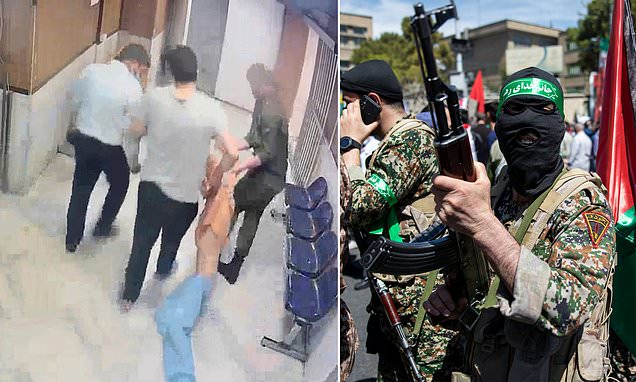
Inside the Islamic Revolutionary Guard Corp death cult
In countless camps deep in rural Iran, gruff military men bark orders at trembling young boys.


