A Professional Approach to Trading Futures

We will provide this information on a one time basis
----------------------

The importance of the 17 Week Bill Auction

*While secondary to the FOMC minutes, poor demand for the 17 week Bill (Auction) at 10am ET, has the potential to significantly move
the market. If demand is seen to be low, it will likely cause a spike in yields, which would then result in immediate selling pressure
on the Nasdaq and S&P 500 futures. The move lower would occur within a few minutes after the result is released (and we would "go with")
 
Last edited:
Thanks TuscanSun for checking in (and of course for the "like")

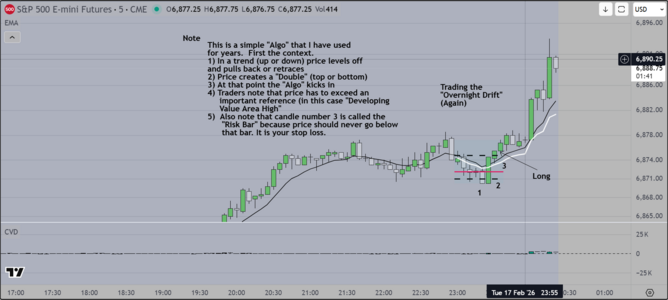
Here is an interesting fact (for everyone). It is about a phenomenon known as
the "Overnight Drift" as researched by the New York Fed.

So first a professional note, for those who might want to become profitable traders
this game (and it is a competition) is all about finding and learning to make use of,
any and all, tradeable edges. This is ONE. There are others, and I am always searching
for these.

Making use of the tendency is up to the trader. I discovered that this algo works, not only
for this tendency but for many of the tradeable edges that form the basis of my hopefully
sustainable trading business.

I received a couple of skeptical comments saying that this is just a "statistical anomaly"
no kidding? I teach statistics, so for me this comical. I am not going into detail, but I can
tell you that it has survived the test of time. I will keep trading it (until it doesn't work).

Good luck
 

Attachments

  • Trading the Overnight Drift Feb 18.PNG
    Trading the Overnight Drift Feb 18.PNG
    121.8 KB · Views: 31
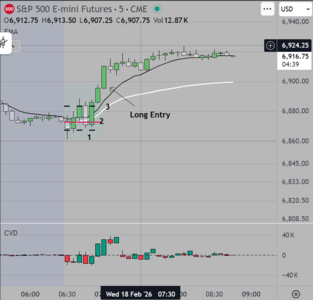
Early trading was positive and the 17 week Bill Auction was well received so the market
moved up. We attach a chart showing the early move. Readers should see a familiar pattern as we
continue to use the Algo that has worked well for us in the past and continues now. As always the risk bar
is the third bar, and entry on the open of the next bar, then you hold and manage the trade.

Now the wait until FOMC minutes at 2pm ET
and we have our scenarios ready as shown below
----------------

Dovish ShiftHeavy focus on labor "downside risks" & dissenters' views.Rally toward 6,950+
Hawkish PauseEmphasis on "solid" growth & tariff-driven inflation.Sell-off toward 100-day MA
Status Quo"Meeting by meeting" approach; no new timeline.Chop within existing range
[th]
Scenario​
[/th][th]
Fed Language​
[/th][th]
Likely ES Response​
[/th]​
Data as of February 18, 2026. The 10-year Treasury yield currently sits at 4.08%
 

Attachments

  • Feb 18.PNG
    Feb 18.PNG
    60.7 KB · Views: 12
Thanks Again TuscanSun

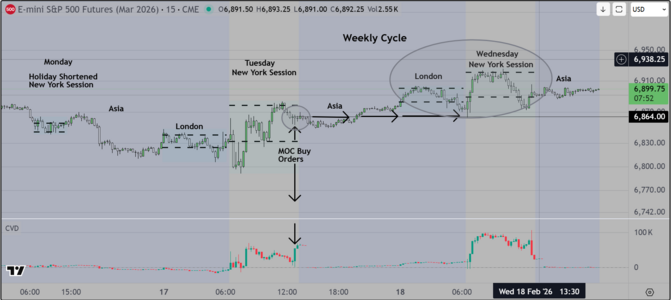
Our chart frames the market referencing the MOC orders that occur at the same time
every (NY) session. For the broader market, those MOC "D orders" as they are known in
the industry) are reported at 3:50pm ET. IF the imbalance is significant, it signals that
price is likely to move in a specific way during the sessions that follow. Rather than rattle
on about this I will simply say that skilled professionals know this and use it to obtain an edge

The advantage we have is as follows.

1) Prior to the NY open of the S&P 500 Futures, we can (if the evidence is there) figure out
who is trapped and where the vulnerable inventory is staged
2) From this, we can guess which side is comfortable (in the money), which side is leaning
the wrong way and has to manage inventory that is losing money (losing more with each point
price moves away from their positions). At some point the losses trigger what we call a "give up"
bar. Its not a sudden move, rather it is a steady consistent move with similar volume or slightly
increasing volume bar after bar.
3) Traders familiar with this can spot it and they know (when) it is safe (low risk) to get on board and hold

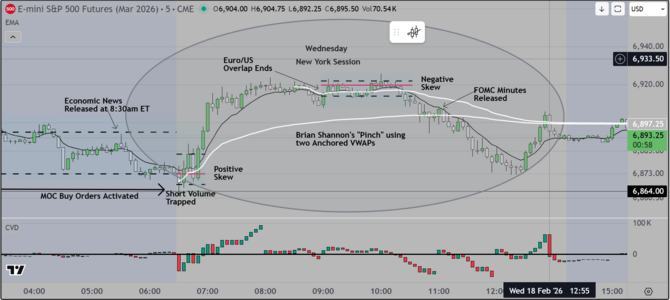
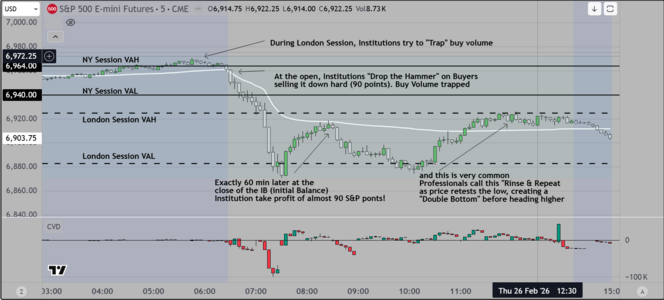
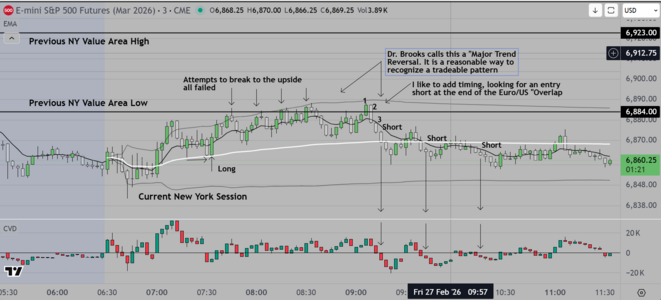
New York Session Summary

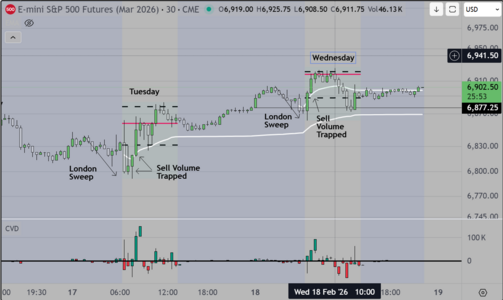
On the first bar of the NY session, price dropped, convincing traders to sell. Sell volume was trapped early.
Near the end of the Euro/US Overlap, institutions moved the "Marked Up" inventory back down to retest the lows,
making a profit both ways. Institutional traders call this a "Round Trip". This basic "Wholesale/Retail" model is in
common use, where participants attempt to buy cheap inventory, mark it up and sell higher at a profit, and vice versa.

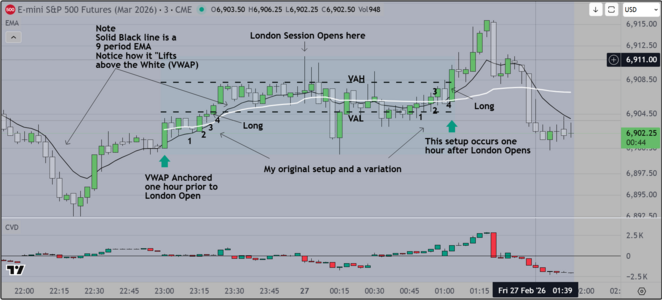
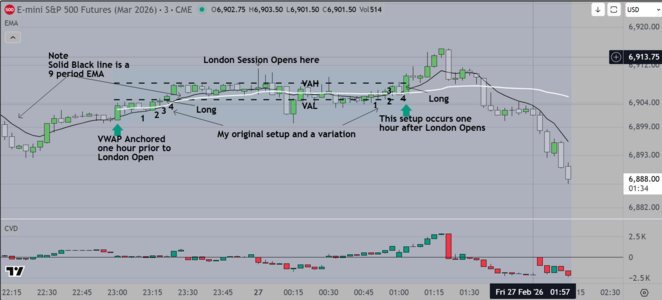
On the Third Chart, we show a process called the "London Sweep". Simply put, during the London Session, price sweeps
or reverses previous price action, which changes the status of the inventory. If the direction of the market continues
it creates a way for institutions to trap volume, and reverse at (or near) the open of the next session (usually the NY session).
So the bottom line for traders, is that when you see a "sweep" in the context of the London Market, be careful not be
on the side that gets "liquidated" if price reverses

We attach a second chart showing the New York Session in greater detail

Good luck
 

Attachments

  • Two Session Markup.PNG
    Two Session Markup.PNG
    121.2 KB · Views: 10
  • Wed 18th.PNG
    Wed 18th.PNG
    162.4 KB · Views: 10
  • Tues Wed Markup.PNG
    Tues Wed Markup.PNG
    95.7 KB · Views: 11
Last edited:
And now we "Start all over again" with our list of high impact reports scheduled for
release to the public tomorrow prior to the open of the New York Session of the
S&P 500 Futures
----------------------

8:30am ET Initial Jobless Claims...............................Consensus is 225K
Philly Fed Manufacturing Index..........Consensus is 12.1
10:00am ET Jan Pending Home Sales.......................No Consensus Available

-----------------------

Scenarios by Time Segments (That I trade)

9:30 to 10:30am ET

If Jobless Claims come in significantly higher than 225K, expect a knee-jerk bid in bonds and a "bad news is good news" rally in ES futures as the market prices in Fed dovishness. Conversely, a beat (lower claims) could trigger a sell-off as yields spike. The open will likely involve a "test" of the pre-market high or low established immediately after the 8:30 AM release.

11:00 to 12:30am ET

After the first hour (Initial Balance) is set, the market often seeks "value." With Pending Home Sales at 10:00 AM, any deviation from the trend could provide the momentum needed to break the IB high or low. Look for institutional "stacked imbalances" on the tape to confirm if the morning move has "legs" or if we revert to the daily VWAP (Volume Weighted Average Price).

12:30am to 1:30pm ET

As London traders wrap up their day, expect a brief surge in volume followed by a significant drop-off. If the morning trend was strong, we often see a "counter-trend profit-taking" move here. This is typically where "trapped" retail traders get chopped up in sideways action. Institutional desks often use this window to execute larger block orders with minimal slippage.

3pm to 4pm ET (Last Hour)

The final hour will be driven by the MOC imbalance and institutional position squaring ahead of the weekend. If the S&P 500 is trading near its session highs, expect a "gamma squeeze" or a late-day chase. Given the current 2026 bull market context (target 7,500), the bias remains "buy the dip" unless the 8:30 AM data fundamentally breaks the labor market resilience narrative.

Good Luck
 
From a trading desk perspective, the MOC imbalance from Wednesday tells us where the "smart money" finished their day, but the Overnight Low (6,866.25) is the more critical pivot for the open. If the market fails to hold the 6,870 level at the bell, expect a test of 6,824 as the momentum from Wednesday's buy imbalance has been neutralized by the overnight retreat.

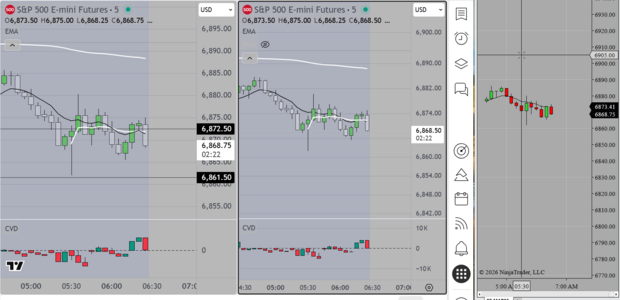
We noticed that several student expressed in interest in trading prior to the open, saying they
believed the market would test lower. Unfortunately they took shorts, and were chopped up
a bit. One hopes the lesson (do not trade prior to the open on a day when economic news has
not been fully incorporated into the market) has been learned). We continue to monitor until we
see a "real" opportunity.

We attach a shot of our screen just prior to the open

Here we go (5 minutes to the open)
and

Good Luck
 

Attachments

  • At the Open.PNG
    At the Open.PNG
    161.7 KB · Views: 11
Once again for the Next New York Session of the S&P 500 Futures
we provide a list of high impact economic reports scheduled for
release prior to the open
-------------------------

High-Impact U.S. Data (Friday, Feb 20)
All times are 08:30 AM ET unless otherwise noted.
  • Core PCE Price Index (Jan): This is the Federal Reserve's primary inflation gauge. Given the current backdrop of "sticky" service inflation (around 3.0% y/y), any beat on the 0.2% m/m consensus will likely spike Treasury yields and the USD while weighing on risk assets.
  • GDP (Q4 2025, Final Estimate): Expectations are for a moderation toward 3.5% following the Q3 boom of 4.4%. Institutional participants will scrutinize this for the impact of the late-2025 government shutdown.
  • Personal Income & Spending (Jan): These metrics provide a real-time pulse of consumer resilience. Spending rose 0.5% in late 2025, but a declining savings rate (currently 3.5%) suggests this tailwind may be fading.
  • New Home Sales (Jan): Scheduled for 10:00 AM ET. Coming off a strong December (+5.1% m/m), this is a key indicator of whether lower mortgage rates are successfully unlocking housing demand.
-----------------------------

Absent any questions, we will provide a less detailed comment regarding how the Futures
MAY trade tomorrow during the 1) IB (Initial Balance or first hour) and 2) The Euro/US Overlap
as follows.

The Initial Balance (09:30 AM – 10:30 AM ET)
  • Volatility Context: Given the 08:30 AM data dump, the market will likely open with a significant gap (up or down).
  • Trading Behavior: This hour is crucial for setting the tone. Statistical data suggests that a "single break" of the Initial Balance occurs in over 82% of sessions. Traders look for the IB to define the day's range; a failure to break the IB high or low often leads to a "fading" strategy where price oscillates between these boundaries.
  • Institutional Positioning: Desks will be "price-finding" based on the PCE and GDP prints. If PCE is hot, expect a heavy sell-side imbalance during the IB as funds de-risk.
Euro/US Overlap (10:30 AM – 11:30 AM ET)
  • Market Dynamics: This is often the most liquid period of the day as European traders close their books while U.S. participants are in full swing.
  • Trend Confirmation: Once the IB is established at 10:30 AM, institutional traders watch for a breakout or breakdown from that range.
  • The 10:00 AM Catalyst: The New Home Sales report at 10:00 AM serves as a secondary "bump." If the 08:30 AM data was ambiguous, this report could provide the final push needed to break the IB range during the overlap.
  • Overlap Exit: Toward 11:30 AM ET (the London fix), expect a potential "pause" or reversal in trend as European liquidity exits the market. If the 08:30 AM data was a major surprise, the trend established during the overlap may persist into the New York afternoon.
Good luck
 
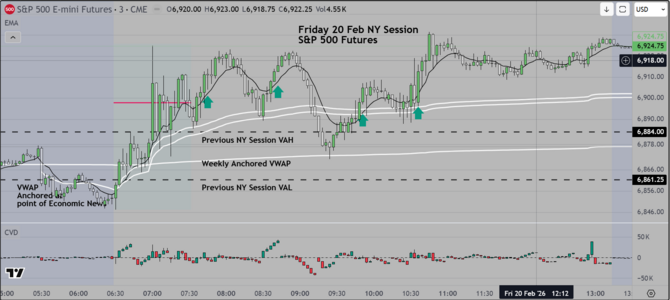
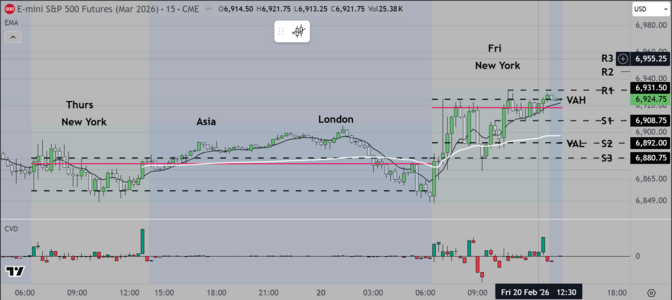
Posting our markup chart for today Friday 20 Feb (New York Session of S&P 500 Futures

This is the simplified display that we use (now) and teach to others. These tools (Anchored VWAP/VP and CVD) are all you need visually
THEN the real story begins.

1) We teach a 3 step process that includes analysis of context, understanding the impact of economic news, and creation of scenarios
2) How do you identify whether buy or sell volume is in control.
3) How do you identify what is "Fair Value".
4) At the open, how do you identify whether price is being accepted or rejected above/below previous value.
5) How does a professional trader maintain his business, evaluate his results, and make changes necessary to ensure the business is
sustainable over time.

This is why most businesses fail. The owner of the business doesn't have the skills, OR doesn't want to put in the effort to maintain
the business.

Today was relatively easy. The hard part was the preparation. We listed the economic news previously and outlined the impact that
each report might have on the market. With that knowledge in hand we created a general plan or "scenario" (if A, then B) and we
organize our efforts by time segments, starting with the concept of "initial balance". IF you have read my comments previously you
may understand that we value discipline and intelligent planning. If you have both, you can create the type of advantage necessary to
make money (and keep it).

Each green arrow represents a minimum +10 pt move.

Good luck
 

Attachments

  • Friday 20 Feb.PNG
    Friday 20 Feb.PNG
    145.2 KB · Views: 10
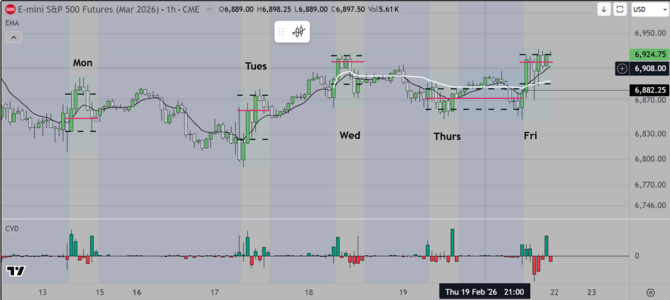
Following are the Economic Reports scheduled for release just prior to and during
the New York Session of the S&P 500 Futures, Monday February 23 2026
--------------------
  • Federal Reserve Policy Insight: Fed Governor
    Christopher Waller

    is scheduled to speak at 8:00 AM ET, just before the New York open. Given that market expectations for a March rate cut have recently dropped to 5% following "hotter-than-expected" PCE data, his remarks on the inflation outlook and the "higher for longer" narrative will likely trigger immediate volatility in S&P 500 Futures and Treasury yields.
  • Manufacturing & Industrial Health: The S&P Global Flash PMI at 9:45 AM ET and Factory Orders at 10:00 AM ET will provide a real-time pulse of the manufacturing sector. Traders will be watching for signs of margin expansion or contraction, as recent strategists have lifted S&P 500 margin expectations for 2026 based on AI-related productivity gains.
  • Regional Economic Activity: The Chicago Fed National Activity Index (scheduled for 8:30 AM ET) offers a weighted average of 85 indicators of national economic activity. A reading significantly above or below the forecast of 0.1 could shift sentiment regarding the "soft landing" narrative currently supporting the index near record high
--------------------------------
From a Trading Perspective

The S&P 500 is currently navigating a period where consumer staples have begun to outperform growth, historically a signal for potential 10% to 20% pullbacks. Monitor the 9:45 AM PMI release closely; a miss in manufacturing data combined with hawkish commentary from Waller could provide the catalyst for a test of recent support levels. Our approach is to reduce position sizing, trading 3 rather than 6 contracts, AND to be aware of higher
than usual session volatility. "Hot" economic data is currently being interpreted as a negative for equities due to its impact on the Fed's rate path.

Scenarios are data dependent as follows

1) If Economic Reports come in "hot", markets will reprice to the downside as the possibility of rate cuts is lowered
2) If Economic Reports surprise showing less inflation, stronger manufacturing and improved deficits, markets will likely move to a
risk on stance and continue to the upside to test and exceed 7,000
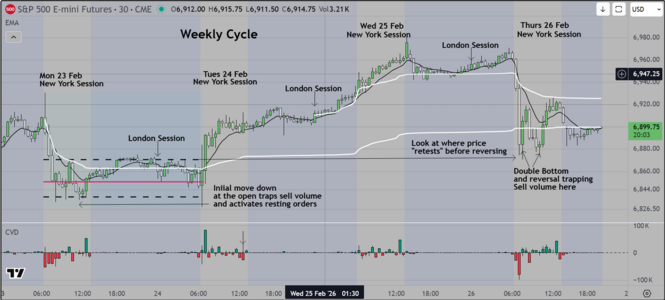
3) The typical price path during the NY Session would be to move lower initially to trap sell volume, then reverse to the upside if data
is strong. If not, price would reverse that pattern and attempt a move to the upside, which would probably fail at or near the end of the
initial balance (first 30 to 60 minutes). Neutral Reports would result in a trading range (sideways price action) throughout the session.

Good Luck
 

Attachments

  • Week of 16 Feb 2026.PNG
    Week of 16 Feb 2026.PNG
    114.5 KB · Views: 7
  • Thurs Fri  Markup.PNG
    Thurs Fri Markup.PNG
    117.4 KB · Views: 9
Last edited:
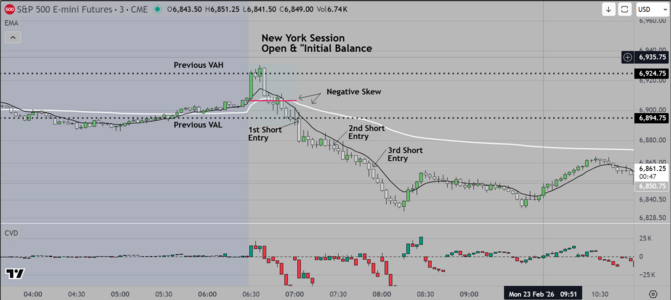
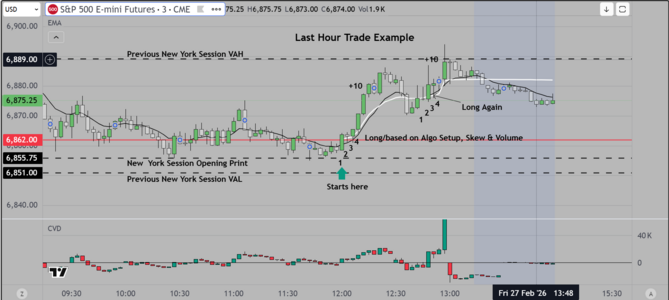
Results of today's New York Session

Fairly easy to trade this session. Once we hit our early profit
targets we shut down for the day.

For those interested (so far, none apparently) we separate the
session into "Legs", and we hope to identify "Leg 2" as the most
potentially profitable leg. If we hit our profit targets during leg 2
we suggest traders avoid or trade small "Leg 3, because that is
where institutions are likely to reverse or stage inventory, which means
that liquidity dries up and the market goes sideways (and Retail Traders
get chopped up, because you are always looking for breakouts). Its
that simple.

Good Luck
 

Attachments

  • Feb 23 New York Session.PNG
    Feb 23 New York Session.PNG
    113.3 KB · Views: 5
Last edited:
Trading Scenarios for Tomorrow 24 February 2026

At the Open (9:30 AM – 10:00 AM EST)
  • The Context: Markets will already be processing the Case-Shiller data (9:00 AM). If home prices exceed the 1.5% consensus, it may reinforce the "sticky inflation" narrative, potentially capping any pre-market rebound.
  • Likely Action: Expect a "bargain-hunting" attempt early on as traders look to recover Monday's steep losses. However, institutional "real money" will likely remain sidelined or trade with light size until the 10:00 AM Consumer Confidence print to avoid being caught in a data-driven reversal.
After Initial Balance (10:00 AM – 12:00 PM EST)
  • The Catalyst: CB Consumer Confidence at 10:00 AM is the primary market mover. While the University of Michigan's preliminary February reading was slightly lower than expected (56.6 vs 57.3), markets are looking for the Conference Board's broader index to show improvement to 86.0.
  • Bullish Scenario: A beat (e.g., >87.0) combined with a less-negative Richmond Fed reading (e.g., >-2) would provide a green light for "risk-on" flows. This could trigger a fast short-covering rally toward Monday's breakdown levels.
  • Bearish Scenario: A miss on confidence (<84.0) alongside another weak manufacturing print would heighten recession fears. In this case, we expect a "failed breakout" of the initial balance, with the S&P 500 Futures testing new year-to-date lows as participants de-risk ahead of further tariff/trade news.
Euro/US Overlap (Final Hour: 11:30 AM – 12:30 PM EST)
  • Dynamics: European desks will be closing out positions. If the 10:00 AM data is decisive, we often see a "trend continuation" move during this window as London and New York align on the day's direction.
----------------------------------------------

KEY LEVELS of Support/Resistance

Based on current market structure and tomorrow's scheduled volatility, here are the KEY LEVELS to watch for the S&P 500 Futures

Primary Resistance: The "Supply Zone"
  • 5,945 – 5,960 (Major Resistance):This represents the "breakdown" point from Monday. For the market to turn tomorrow’s Consumer Confidence beat into a sustainable rally, we need to see price reclaim this zone.
    • The Play: If the 10:00 AM data is a "beat" but price fails to pierce 5,960, institutions will likely use that strength to sell into the rally, viewing it as a "dead cat bounce."
Primary Support: The "Demand Floor"
  • 5,880 – 5,895 (Key Support):This is the psychological line in the sand. Monday’s sell-off tested the resolve of buyers near 5,900 .
    • The Play: If Consumer Confidence misses (<84.0), expect an immediate test of 5,880. If we break below this during the Euro/US overlap, there is very little "structural support" until the 5,820 area, which could lead to a localized liquidation event.
------------------------------------------------
Special Note/Possible attempt to Trap Traders
In this environment, the 9:30 AM Open often features a "fake-out" move.
  1. The Trap: Price may rally toward 5,940 at the open on light volume (bargain hunting).
  2. The Pivot: At 10:00 AM, the Consumer Confidence print acts as the "truth serum."
  3. The Real Move: If the data is weak, the institutions who "faded" the opening rally will push the market back through the open and down toward 5,880.
We suggest traders read this and think through the logic, trying to anticipate what might happen in response to strong or weak economic reports.
Understand that the institutions have already got this planned out in advance, and they will not hesitate. If you are uncertain and you get in late
it means that you are at a disadvantage. If you are struggling, trade a sim account, or stand aside and monitor, comparing what you see with
the commentary we offer (but do not put real money at risk).

Legal disclaimer

Nothing on this thread is meant to be taken as Investment Advice". It is offered for educational purposes only.

Good Luck
 
Last edited:
Back
Top