A Professional Approach to Trading Futures

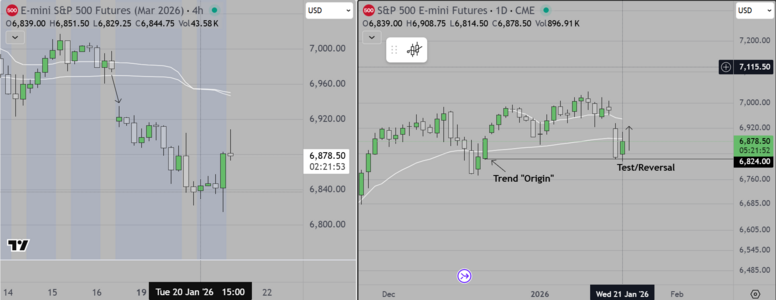
Earlier today we were asked how we integrate higher time frame
charts into our process. This is an important question

We use two time frames, daily and 4 hour charts as shown
We also use a term that (typically) retail traders do not use
called "Trend Origin". This is usually the 2nd candle in a trend
move and it is often re-tested by Institutional algos, that is to say
it acts as a magnet, but also activates automated buy or sell programs
to create reversals trapping the uninformed participants on the wrong
side of a strong move (Professionals call this being "Trapped Out" of a move)
Those trapped on the wrong side, usually wait for a short period of time
to confirm their mistake and then they chase, providing the fuel needed
to keep the move going.

Good luck
 

Attachments

  • Daily & 4 hour Charts.PNG
    Daily & 4 hour Charts.PNG
    112.2 KB · Views: 24
Last edited:
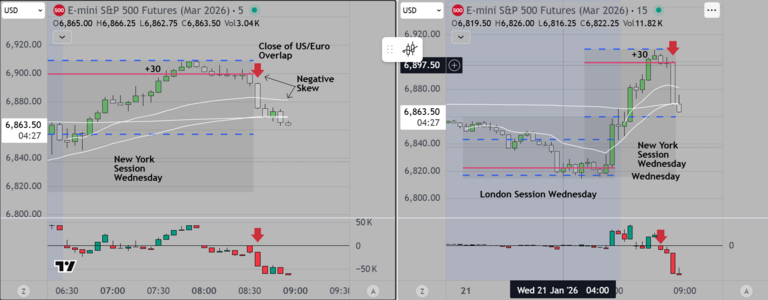
And at the Close of the US/Euro Overlap
we see the anticipated reversal as successful traders
take profits. This is anticipated because of the tendency
for the US president to say things that moves markets.
Traders know this and will take profits, increasingly moving
to cash during the off periods (as a form of protection)

We are into the "Dead Zone" now, until the last hour of the
NY Session. Because we have significant profit, we will not trade
the last hour MOC order candle, which occurs in the evening London
local time. No point really in taking that risk

Good luck
 

Attachments

  • End of US Euro Overlap trade.PNG
    End of US Euro Overlap trade.PNG
    129.9 KB · Views: 13
Last edited:
So ive noticed that you have posted about there being positive and negative skew in price when looking at vwap and VP. How does that work exactly? I know that institutions use vwap as a way of buying or selling at better than average prices and the POC indicates where the most amount of tranactions have taken place. So i suppose if vwap were below the poc and so was price it can be assumed that institutions have sold at above average price, but how can we know if they need to buy or sell inventory at certain levels?
 
Good Questions and the focus (on inventory) is what institutions focus on
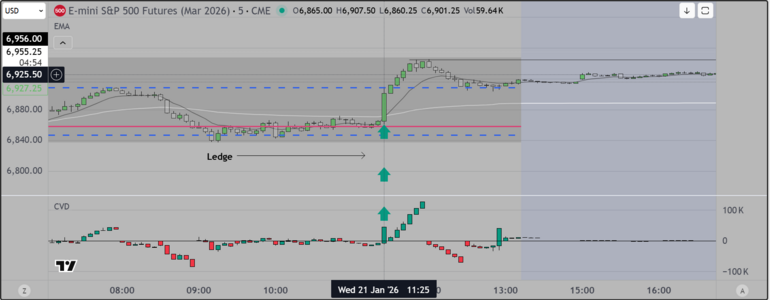
Location of inventory can be seen (if one knows where to look) at places called "ledges" where price
oscillates up and down in a range. This is one (1) area where institutions stage inventory. When you see
one of these ranges, simply follow along to the right until you see the market create a trend move, THEN
you know whether the inventory was long or short. On the institutional side, automated programs monitor
net long and short inventory and wait for specific conditions to occur signaling re-positioning. If you have
S&P 500 charts, look at yesterday's chart and see the Green Candle at 11:25 PST/7:25 PM London. This was
an "impulse move" very quick, indicating that automated orders were executed to buy and buy and buy
all of it to reposition because everybody was short (because of Trumps stupid comments/sorry but that's
the truth as I see it). Attaching the chart below for your reference.

Regarding the use of Anchored VWAP and VP, these tools allow you to estimate that imbalance (long or short)
and after that you can use the slope of the VWAP and the behavior of price at the POC, to figure the odds of
a move higher or lower. Because its a dynamic setup, it is always changing and therefore hard to describe. When I have
been asked in past to provide a rule, I always suggest that traders watch (do not trade on it) until you have experience
because you can be trapped on the wrong side.

The general rule set is
1)VWAP above POC, suggests long skew
2) VWAP below POC suggests short skew

Again please do not trade just on these rules, you have to have other data points in place.
If time permits and I am not conducting a class I will try to explain further.

Good luck
 

Attachments

  • Skew Example.PNG
    Skew Example.PNG
    75.6 KB · Views: 9
Time issues prevent me from explaining more than I just have
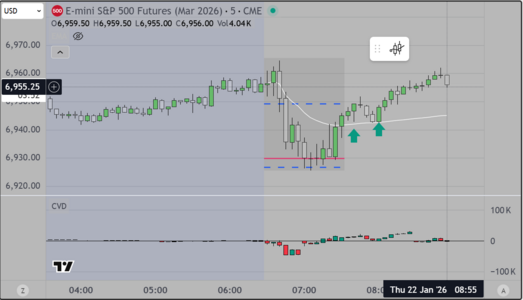
so I will simply post the trades

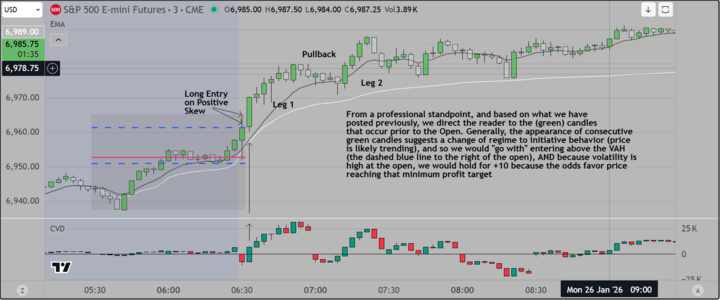
These two longs were counterintuitive meaning that after the economic report
suggesting that inflation remains "sticky" (that's the term everyone is using)
we should have seen the market move lower. Instead they trapped shorts and reversed
and the skew told the more accurate story (if you knew how to read it)

The first of these is what professionals call a "Blind" entry (meaning you enter at a touch of
a specific price or reference). For the second, I was concerned to protect profits, so I waited
a little bit to enter after I saw buy volume enter (using the CVD indicator below).

In terms of price action, we look to identify "legs", and this was a classic Leg 1 pullback leg 2
and Leg 2 is usually the bigger winner.

Good luck
 

Attachments

  • Jan 22 Trades.PNG
    Jan 22 Trades.PNG
    59.3 KB · Views: 11
Last edited:
mtckmeek

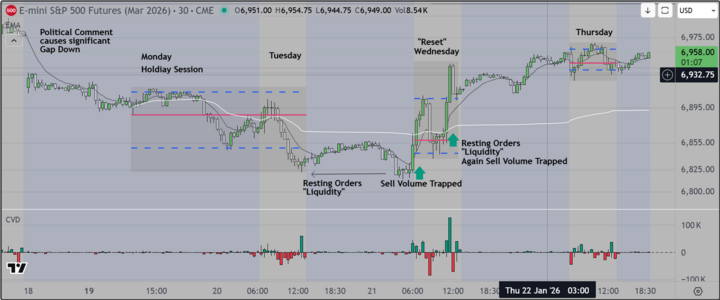
This weekly chart may help to visualize how & why institutions make decisions to adjust inventory. As mentioned, we can't know
the exact details. The attached chart shows the origin of the move lower (a political comment caused an abrupt move) that caused
an imbalance to the sell side. At some point institutional "value at risk (VAR) algos" were activated. Most traders don't understand
that in order to normalize (bring buy & sell inventories back into balance) there has a place where liquidity is available, and that is
usually at extremes. So at several points in time, the algos "execute". Its not coincidence that this happens on a Wednesday. IF you
read my previous comments and look at my charts, you may see the words "Reset Wednesday" appearing several times.

While it is advantageous to understand how the process occurs and in what time frame, to my mind, the more important question
to answer is "Where will the market likely go from here, Why, and under what conditions"? What I teach interested persons to do
is to tease that out in a logical way, and use that to create tradeable scenarios that have an edge.

Postscript

I just revised the chart in an attempt to show the location of liquidity necessary to accommodate the buy algos
For traders looking to improve, the most direct route is to 1) Identify the "regime" (accurately) and then 2) look
at the time based or (using institutional jargon) identify "Time gated" opportunities where the conditions are met
and the algos kick in to "execute". If you known WHEN a move is possible, you have the option of participating (if you
are willing to accept and manage risk).

I hope this helps

Good luck
 

Attachments

  • Revised Weekly Reset Cycle.PNG
    Revised Weekly Reset Cycle.PNG
    134.1 KB · Views: 19
Last edited:
Hello Readers

I have time tonight (I am located in California/US) to provide another example of
the preparation that I teach student traders to embrace as follows
----------------------------------
Friday (Tomorrow, Jan 23) Key Releases
  • Flash Services & Manufacturing PMI — early marker of economic activity (9:45 AM ET)
Macro Implications
  • Thurday's Core PCE & jobless claims that meet or beat expectations reinforced a backdrop of sticky but controlled inflation — keeping the Fed on hold into late Jan and potentially into early Q1 (already priced in by markets) .
  • Friday's PMI figures have the potential to extend today’s trend if above consensus — bulls will take this as growth confirmation.
Macro Tailwinds
  • Relief in geopolitical risk (tariff tensions easing) has already boosted sentiment and equities this session, lowering volatility and supporting equity risk appetite .
Directional Bias = Bullish
  • The reversal from trapped sellers and subsequent accumulation suggests lower tail support and a structural pivot higher.
  • Micro structure shows higher lows and range extension above low-timeframe resistance, signaling continuation if volume/participation confirms.
Scenarios

Scenario 1 Bullish Continuation/Trend Resumption

  • Thursday's releases meet or modestly beat expectations → bullish sentiment persists. Liquidity remains above recent range lows, fueling extension into tomorrow’s New York session.
  • Technical structure supports marginal higher highs, particularly if the market holds above Wednesday’s pivot and short-term EMAs.
Scenario 2 Volatility Reversion
  • If data severely underperforms or surprises to the downside, expect a pullback to prior support (range lows) before re-accumulation — volatility will compress into range boundaries and potentially retest demand nodes.
Risk Management
  • Key support levels to defend (for continuation):
    • Prior lows from range bottom seen on 5-min chart
    • Wednesday pivot and early Thursday micro lows
Entry/Exit Lens
  • Long entries on shallow pullbacks to structural support / liquidity confluence (EMA + prior daily range support) with tight stops below micro-structure lows.
  • Gradual sell/hedge into Friday PMI if surprises materially above expectations.
Economic Report Release Schedule

PMI (Services & Manufacturing)9:45 AM ET
Both the Services PMI and Manufacturing PMI are set to print at 9:45 AM ET and will be the first look at business activity for the month. These are flash/S&P Global PMIs and are market-moving indicators of economic momentum.

Consensus

Services PMI: ~52.9 (previous ~52.5) — expansion above 50 signals continued services growth.
Manufacturing PMI: ~51.9 (previous ~51.8) — expansion in manufacturing as well, albeit modest.

If at or above consensus, (results above 50.0) will indicate ongoing expansion in private sector activity, this could support "risk-on" sentiment (especially equities) especially early during the New York session. A surprise (less than expected) would likely trigger a reversal during the first hour.

For interested readers, THIS is how a professional prepares. We obtain as much information as possible and distill it down
to tradeable Scenarios. Then we adapt and adjust as the Session (in our case the NY session of the S&P Futures) opens

Good luck

 
Last edited:
Hello London & Euro Readers

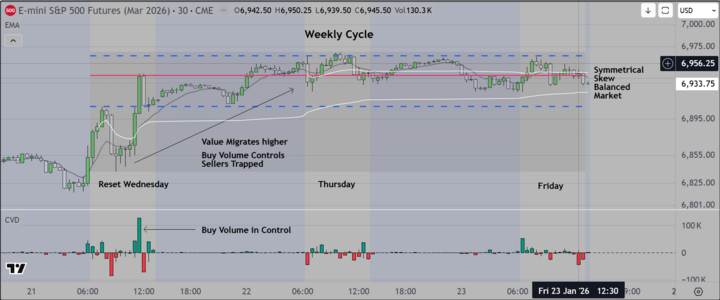
Attached you will find the Weekly Chart using 30 min Candles

The structure is simple. Traders divide the week into front & back half's
and Wednesday is known as the "Reset", because value will often migrate
higher or lower during this session. This chart is considered "Typical

Additionally we incorporate, statistical skew, represented by the relationship
between VWAP and VP. In this case, we see that buy volume migrated higher
on Wednesday, then as often happens, the market settles into a balanced regime
represented by a symmetrical skew (white and red lines close together).

Finally we also add the work of Brian Shannon, using two Anchored VWAPs to create
a "pinch". We encourage retail traders to read his book on the subject.

Where do we go from here

Brian Shannon would suggest that the market will break above or below either Anchored VWAP
AND he prefers to use the 5DMA as his line in the sand before committing to a position
In contrast, we look at several data points as follows

1) Higher Time Frame
2) Previous Session Value
3) Scheduled High Impact Economic Reports & Consensus

Based on this input we create tradeable scenarios, then at the open we read
price action using 3 min or (sometimes) 1 min charts

Good luck
 

Attachments

  • Weekly Cycle.PNG
    Weekly Cycle.PNG
    123 KB · Views: 13
We provide a list of the High Impact Reports for the Week of Jan 26
----------------------------------
  • Monday, January 26, 2026: No major reports are scheduled for release prior to the New York session open at 9:30 AM ET. The Dallas Fed Manufacturing Survey is released later in the morning at 10:30 AM ET.
  • Tuesday, January 27, 2026: No major reports are scheduled before 9:30 AM ET. Significant releases later in the day include Consumer Confidence, New Residential Sales, and the Richmond Fed Survey of Manufacturing Activity, all at 10:00 AM ET.
  • Wednesday, January 28, 2026: The Advance Durable Goods report (for November 2025) is the key report released at 8:30 AM ET, prior to the market open. The FOMC policy statement and Fed Chair Jerome Powell's press conference are scheduled for the afternoon, which are major market-moving events.
  • Thursday, January 29, 2026: The Initial Claims for unemployment insurance are released at 8:30 AM ET.
  • Friday, January 30, 2026: The final University of Michigan Consumer Sentiment survey is released at 10:00 AM ET, after the market open.
Does anyone have an opinion as to the timing of the most important of these reports? Especially as regards the Weekly Cycle?

Let me offer a clue
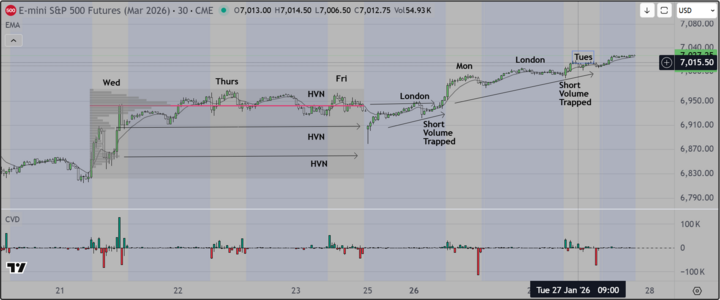
Institutions know (approximately) what to expect when the Advanced Durable Goods report comes out Wednesday. They will start to
position & hedge Monday & Tuesday in the S&P AND using other asset classes, options for example. They will do this by testing value
areas above & below the chart we attach in the previous post
 
Last edited:
Back
Top