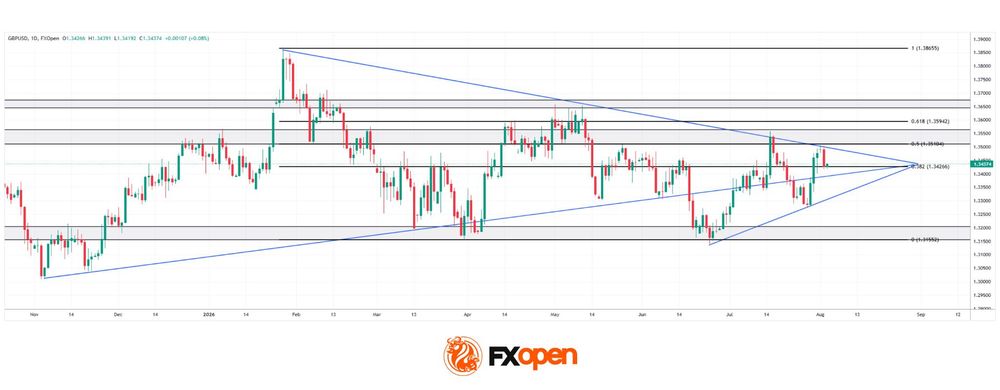
GBP/USD: The Triangle That Could Define the Rest of 2026

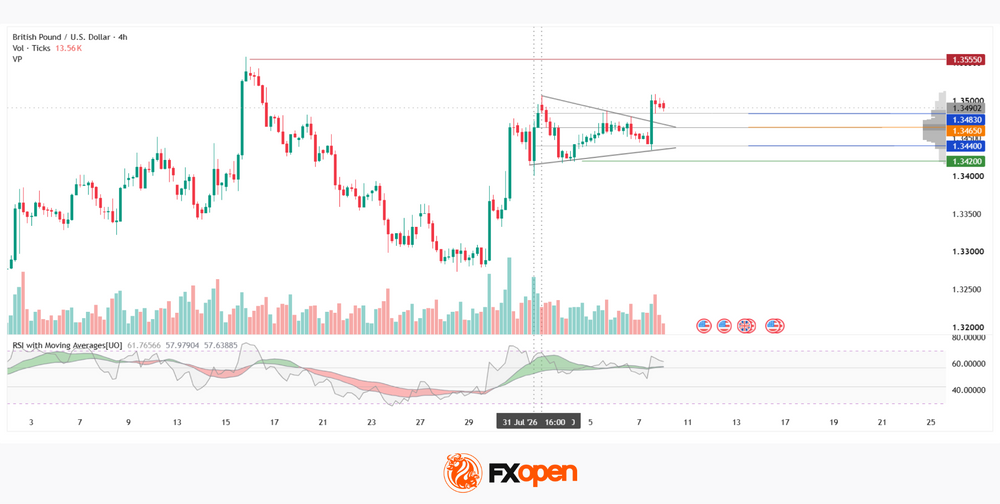
The pound just closed its strongest week against the dollar in months, ending July up more than 1% and holding just below $1.35. Two factors are driving the move. First, political risk has faded: the UK appointed its seventh prime minister in a decade, and the new government's pledge of fiscal discipline has reassured markets. Second, the Bank of England surprised with a more hawkish tone than expected—policymakers voted 6-3 to hold rates steady, but three members pushed for a hike, a stronger signal of resolve than markets had priced in.
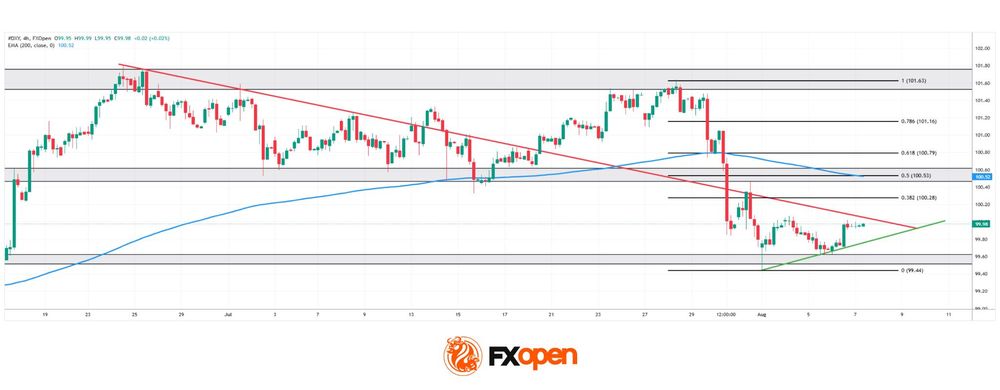
The dollar, meanwhile, has had a rough few sessions. Following the Fed's decision to hold rates for a fifth consecutive meeting, Chair Kevin Warsh offered little clarity on the path ahead, leaving investors questioning whether the central bank is doing enough to bring inflation back to target. The dollar index posted its worst weekly performance in three months as a result, though roughly two-thirds of the market still expects a September hike.
With both central banks striking cautiously hawkish tones but offering little forward guidance, GBP/USD's next move looks set to hinge on incoming US labor data.
TO VIEW THE FULL ANALYSIS, VISIT FXOPEN BLOG
Disclaimer: This article represents the opinion of the Companies operating under the FXOpen brand only (excluding FXOpen EU). It is not to be construed as an offer, solicitation, or recommendation with respect to products and services provided by the Companies operating under the FXOpen brand, nor is it to be considered financial advice.
The pound just closed its strongest week against the dollar in months, ending July up more than 1% and holding just below $1.35. Two factors are driving the move. First, political risk has faded: the UK appointed its seventh prime minister in a decade, and the new government's pledge of fiscal discipline has reassured markets. Second, the Bank of England surprised with a more hawkish tone than expected—policymakers voted 6-3 to hold rates steady, but three members pushed for a hike, a stronger signal of resolve than markets had priced in.
The dollar, meanwhile, has had a rough few sessions. Following the Fed's decision to hold rates for a fifth consecutive meeting, Chair Kevin Warsh offered little clarity on the path ahead, leaving investors questioning whether the central bank is doing enough to bring inflation back to target. The dollar index posted its worst weekly performance in three months as a result, though roughly two-thirds of the market still expects a September hike.
With both central banks striking cautiously hawkish tones but offering little forward guidance, GBP/USD's next move looks set to hinge on incoming US labor data.
TO VIEW THE FULL ANALYSIS, VISIT FXOPEN BLOG
Disclaimer: This article represents the opinion of the Companies operating under the FXOpen brand only (excluding FXOpen EU). It is not to be construed as an offer, solicitation, or recommendation with respect to products and services provided by the Companies operating under the FXOpen brand, nor is it to be considered financial advice.