
You are using an out of date browser. It may not display this or other websites correctly.
You should upgrade or use an alternative browser.
You should upgrade or use an alternative browser.

Phylo
Legendary member
- Messages
- 5,450
- Likes
- 437
Migrants storm EU border: Thousands charge up beaches and climb over fences to force their way into Spanish enclave as it declares 'total emergency'
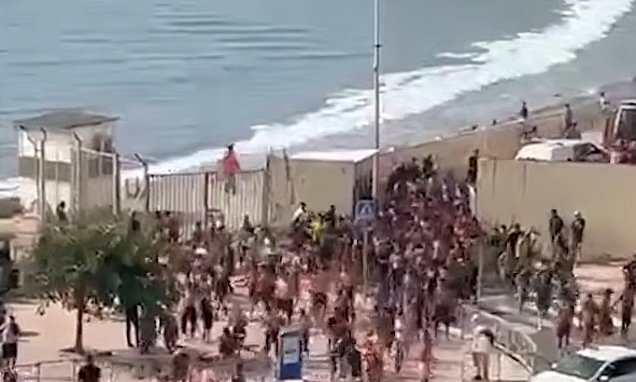
Migrants storm EU border: Moment hundreds charge up beaches
Hundreds of migrants have entered the Spanish north African exclave of Ceuta by sea in recent days, officials said Thursday.
Phylo
Legendary member
- Messages
- 5,450
- Likes
- 437

Visual Capitalist (@visualcap) on Threads
China vs. America: Who the World Trades With Most 🌍 https://www.visualcapitalist.com/mapped-chinas-global-trade-takeover/
 www.threads.com
Phylo
Legendary member
- Messages
- 5,450
- Likes
- 437
Azerbaijan, Kazakhstan and Israel
souce: Google Gemini
Religion and Govenment
The predominant religion in Azerbaijan is Islam (primarily Shia), and in Kazakhstan, it is also Islam (primarily Sunni). Neither religion directly dictates government policy, as both nations feature strong state control over religious life. Both governments maintain an active, restrictive form of secularism to suppress political or radical religious movements. [1, 2, 3, 4, 5, 6]
Azerbaijan
More recent shipment analysis similarly finds Azerbaijan and Kazakhstan together accounting for roughly 70% of crude shipments with regards to Israel's crude supply. With respects to Israels continued attacks on is Islamic Sunni and Shia neighbours in the region it comes across as rather hypocritical that these two countries should supply Israel with 70% of its crude. It appear there is no Sunni on Sunni and Shia on Shia solidarity with respect to Israels attach on Muslim countries and assassination of Muslim countries politicians and scientist.
The phenomenon where Azerbaijan and Kazakhstan supply approximately 70% of Israel’s crude oil highlights a distinct separation between religious solidarity and state-level geopolitical and economic interests. [1, 2]
Independent industry monitoring and shipment trackers confirm that Azerbaijan supplies roughly 40–50% of Israel's crude, with Kazakhstan providing most of the remainder. While this trade arrangement creates a stark contrast against Israel's conflicts with its Muslim-majority neighbours, several structural, strategic, and economic realities drive this policy over religious affinity. [1, 2, 3, 4]
1. Hard Realpolitik and Strategic Reciprocity
souce: Google Gemini
Religion and Govenment
The predominant religion in Azerbaijan is Islam (primarily Shia), and in Kazakhstan, it is also Islam (primarily Sunni). Neither religion directly dictates government policy, as both nations feature strong state control over religious life. Both governments maintain an active, restrictive form of secularism to suppress political or radical religious movements. [1, 2, 3, 4, 5, 6]
Azerbaijan
- Dominant Religion: Islam, with about 96% to 97% of the population identifying as Muslim (roughly 65% Shia and 35% Sunni). [1, 2]
- Government Influence: Low to indirect. Clerics cannot run for political office, and religious institutions have no formal role in shaping policy. The state tightly manages mainstream Islamic leadership through structures like the Caucasus Muslims Office to align messaging with national identity. [1, 2, 3, 4]
- Nature of Secularism: Firmly secular by constitution, but practically restrictive. The state heavily regulates religious literature, bans public religious symbols like hijabs in schools, and closely monitors independent or foreign-backed religious groups to prevent political opposition. [1, 2, 3, 4]
- Dominant Religion: Islam, with roughly 69% to 70% of the population identifying as Muslim (mostly following the Hanafi Sunni school) alongside a substantial Russian Orthodox Christian minority (about 17%). [1, 2]
- Government Influence: Low. Religion does not direct state law, and public support for political sharia law is very low among citizens. The government collaborates with designated "traditional" faiths (such as mainstream Islam and Russian Orthodoxy) to build a multi-ethnic national identity. [1, 2, 3, 5]
- Nature of Secularism: Constitutional secularism modeled after state-controlled frameworks. Rather than keeping a hands-off approach, the state actively intervenes in religious affairs, mandates strict registration for all religious organizations, and bans groups or practices deemed extremist or non-traditional to preserve social stability. [1, 2, 3, 4, 5]
More recent shipment analysis similarly finds Azerbaijan and Kazakhstan together accounting for roughly 70% of crude shipments with regards to Israel's crude supply. With respects to Israels continued attacks on is Islamic Sunni and Shia neighbours in the region it comes across as rather hypocritical that these two countries should supply Israel with 70% of its crude. It appear there is no Sunni on Sunni and Shia on Shia solidarity with respect to Israels attach on Muslim countries and assassination of Muslim countries politicians and scientist.
The phenomenon where Azerbaijan and Kazakhstan supply approximately 70% of Israel’s crude oil highlights a distinct separation between religious solidarity and state-level geopolitical and economic interests. [1, 2]
Independent industry monitoring and shipment trackers confirm that Azerbaijan supplies roughly 40–50% of Israel's crude, with Kazakhstan providing most of the remainder. While this trade arrangement creates a stark contrast against Israel's conflicts with its Muslim-majority neighbours, several structural, strategic, and economic realities drive this policy over religious affinity. [1, 2, 3, 4]
1. Hard Realpolitik and Strategic Reciprocity
For both nations, state partnerships are dictated by national security and strategic balance rather than pan-Islamic solidarity:
- The Weapons-for-Oil Axis: Azerbaijan’s relationship with Israel is highly transactional and deeply militarized. Azerbaijan relies on advanced Israeli military technology—including drones, radar, and precision missile systems—which proved critical in its territorial conflicts. In return, Baku ensures Israel’s energy security. [1, 2, 3, 4]
- The Iranian Factor: Azerbaijan shares a tense border with Iran. Despite both having majority-Shia populations, Baku views Tehran’s regional ambitions and support for local religious movements as a direct national security threat. Partnering with Israel serves as a strategic counterweight to Iran. [1, 2, 3, 4]
Neither Azerbaijan nor Kazakhstan operates their energy sectors as tools of religious diplomacy:
- Pre-existing Commercial Contracts: Oil exports are bound by long-term corporate contracts rather than ad-hoc political decisions. In Kazakhstan, major Western corporations (such as Chevron and ExxonMobil) hold the primary stakes in the largest oil fields. These corporate entities dictate where oil is sold on the global market based on logistics and profitability, not state ideology. [1, 2, 3]
- Reliance on Transit Pipelines: Azerbaijani oil flows primarily through the Baku-Tbilisi-Ceyhan (BTC) pipeline across Georgia to Turkey’s Mediterranean coast. Even when Turkey formally bans direct trade with Israel, international legal treaties governing trans-national pipelines prevent Turkey from blocking oil originating from third parties like Azerbaijan, allowing shipments to continue covertly or through third-party traders. [1, 2, 3, 4, 5]
As highly secularized autocracies, the ruling elites of Azerbaijan and Kazakhstan explicitly reject the idea that religious identity should dictate foreign policy:
- Isolation of Religious Sentiment: Both states actively work to keep pan-Islamic political movements outside their borders. They view calls for "Muslim solidarity" from regional actors like Iran as dangerous attempts at foreign ideological subversion. [1]
- Domestic Public De-politicisation: Because both governments heavily restrict public assembly and state-independent political activism, there is little to no domestic pressure to alter foreign trade policies. State-controlled media limits or frames information about Middle Eastern conflicts to suppress any widespread religious mobilization that could challenge state authority. [1]
Both countries leverage multi-vector foreign policies to build influence across competing global blocs: [1]
- Western and US Integration: Both Azerbaijan and Kazakhstan use their diplomatic and energy ties with Israel to solidify their standing with the United States and European markets. [1, 2]
- Abraham Accords Context: Analysts note that maintaining ties with Tel Aviv positions these Central Asian and Caucasian states to integrate into broader regional security and technology frameworks, valuing economic modernism over historical religious alliances. [1, 2]
Phylo
Legendary member
- Messages
- 5,450
- Likes
- 437
US President Donald Trump says Israel and Hamas have "signed off on the first phase" of his 20-point Gaza peace plan, in a major step towards a permanent end to two years of war.
He unveiled the plan at the White House on 29 September alongside Israeli Prime Minister Benjamin Netanyahu, who said Israel accepted the terms.
On 3 October, Hamas said it agreed to return all 48 remaining hostages being held in Gaza in exchange for Palestinian prisoners in Israeli jails and Gaza detainees, and to the idea of handing over the governance of Gaza to Palestinian technocrats.
But the group did not mention other elements, most notably the requirement that it disarm.
Once the ceasefire takes effect, US, Qatari, Egyptian and Turkish mediators will attempt to get both sides to agree what Trump called a "strong, durable, and everlasting peace".
Here is the full text of the president's plan, as provided by the White House:
1. Gaza will be a deradicalised terror-free zone that does not pose a threat to its neighbours.
2. Gaza will be redeveloped for the benefit of the people of Gaza, who have suffered more than enough.
3. If both sides agree to this proposal, the war will immediately end. Israeli forces will withdraw to the agreed upon line to prepare for a hostage release. During this time, all military operations, including aerial and artillery bombardment, will be suspended, and battle lines will remain frozen until conditions are met for the complete staged withdrawal.
4. Within 72 hours of Israel publicly accepting this agreement, all hostages, alive and deceased, will be returned.
5. Once all hostages are released, Israel will release 250 life sentence prisoners plus 1,700 Gazans who were detained after 7 October 2023, including all women and children detained in that context. For every Israeli hostage whose remains are released, Israel will release the remains of 15 deceased Gazans.
6. Once all hostages are returned, Hamas members who commit to peaceful co-existence and to decommission their weapons will be given amnesty. Members of Hamas who wish to leave Gaza will be provided safe passage to receiving countries.
7. Upon acceptance of this agreement, full aid will be immediately sent into the Gaza Strip. At a minimum, aid quantities will be consistent with what was included in the 19 January 2025 agreement regarding humanitarian aid, including rehabilitation of infrastructure (water, electricity, sewage), rehabilitation of hospitals and bakeries, and entry of necessary equipment to remove rubble and open roads.
8. Entry of distribution and aid in the Gaza Strip will proceed without interference from the two parties through the United Nations and its agencies, and the Red Crescent, in addition to other international institutions not associated in any manner with either party. Opening the Rafah crossing in both directions will be subject to the same mechanism implemented under 19 January 2025 agreement.
9. Gaza will be governed under the temporary transitional governance of a technocratic, apolitical Palestinian committee, responsible for delivering the day-to-day running of public services and municipalities for the people in Gaza. This committee will be made up of qualified Palestinians and international experts, with oversight and supervision by a new international transitional body, the "Board of Peace," which will be headed and chaired by President Donald J. Trump, with other members and heads of state to be announced, including Former Prime Minister Tony Blair. This body will set the framework and handle the funding for the redevelopment of Gaza until such time as the Palestinian Authority has completed its reform programme, as outlined in various proposals, including President Trump's peace plan in 2020 and the Saudi-French proposal, and can securely and effectively take back control of Gaza. This body will call on best international standards to create modern and efficient governance that serves the people of Gaza and is conducive to attracting investment.
10. A Trump economic development plan to rebuild and energise Gaza will be created by convening a panel of experts who have helped birth some of the thriving modern miracle cities in the Middle East. Many thoughtful investment proposals and exciting development ideas have been crafted by well-meaning international groups, and will be considered to synthesize the security and governance frameworks to attract and facilitate these investments that will create jobs, opportunity, and hope for future Gaza.
11. A special economic zone will be established with preferred tariff and access rates to be negotiated with participating countries.
12. No one will be forced to leave Gaza, and those who wish to leave will be free to do so and free to return. We will encourage people to stay and offer them the opportunity to build a better Gaza.
13. Hamas and other factions agree to not have any role in the governance of Gaza, directly, indirectly, or in any form. All military, terror, and offensive infrastructure, including tunnels and weapon production facilities, will be destroyed and not rebuilt. There will be a process of demilitarisation of Gaza under the supervision of independent monitors, which will include placing weapons permanently beyond use through an agreed process of decommissioning, and supported by an internationally funded buy back and reintegration programme all verified by the independent monitors. New Gaza will be fully committed to building a prosperous economy and to peaceful coexistence with their neighbours.
14. A guarantee will be provided by regional partners to ensure that Hamas, and the factions, comply with their obligations and that New Gaza poses no threat to its neighbours or its people.
15. The United States will work with Arab and international partners to develop a temporary International Stabilisation Force (ISF) to immediately deploy in Gaza. The ISF will train and provide support to vetted Palestinian police forces in Gaza, and will consult with Jordan and Egypt who have extensive experience in this field. This force will be the long-term internal security solution. The ISF will work with Israel and Egypt to help secure border areas, along with newly trained Palestinian police forces. It is critical to prevent munitions from entering Gaza and to facilitate the rapid and secure flow of goods to rebuild and revitalize Gaza. A deconfliction mechanism will be agreed upon by the parties.
16. Israel will not occupy or annex Gaza. As the ISF establishes control and stability, the Israel Defense Forces (IDF) will withdraw based on standards, milestones, and timeframes linked to demilitarization that will be agreed upon between the IDF, ISF, the guarantors, and the United States, with the objective of a secure Gaza that no longer poses a threat to Israel, Egypt, or its citizens. Practically, the IDF will progressively hand over the Gaza territory it occupies to the ISF according to an agreement they will make with the transitional authority until they are withdrawn completely from Gaza, save for a security perimeter presence that will remain until Gaza is properly secure from any resurgent terror threat.
17. In the event Hamas delays or rejects this proposal, the above, including the scaled-up aid operation, will proceed in the terror-free areas handed over from the IDF to the ISF.
18. An interfaith dialogue process will be established based on the values of tolerance and peaceful co-existence to try and change mindsets and narratives of Palestinians and Israelis by emphasizing the benefits that can be derived from peace.
19. While Gaza re-development advances and when the PA reform programme is faithfully carried out, the conditions may finally be in place for a credible pathway to Palestinian self-determination and statehood, which we recognise as the aspiration of the Palestinian people.
20. The United States will establish a dialogue between Israel and the Palestinians to agree on a political horizon for peaceful and prosperous co-existence.
Phylo
Legendary member
- Messages
- 5,450
- Likes
- 437
The right to peaceful protest in the United States is protected under the First Amendment to the United States Constitution, which states:
According to this framework, the legal and social systems protect ruling-class interests, and change occurs through mass political mobilization, exposure of structural inequalities, and the eventual transition of state power to the working class. [1, 2, 3, 4, 5]
In a Marxist-governed society, these working class protesters would have been ruthlessly suppressed, removed, and, if not shot, destined to languish forgotten in a merciless penal system.
- "Congress shall make no law respecting an establishment of religion, or prohibiting the free exercise thereof; or abridging the freedom of speech, or of the press; or the right of the people peaceably to assemble, and to petition the Government for a redress of grievances."
According to this framework, the legal and social systems protect ruling-class interests, and change occurs through mass political mobilization, exposure of structural inequalities, and the eventual transition of state power to the working class. [1, 2, 3, 4, 5]
In a Marxist-governed society, these working class protesters would have been ruthlessly suppressed, removed, and, if not shot, destined to languish forgotten in a merciless penal system.
Last edited:
Similar threads
- Replies
- 0
- Views
- 939
- Replies
- 0
- Views
- 467
- Replies
- 0
- Views
- 378