
World Politics

Phylo

Veteren member
Messages
4,946
Likes
416

Iran unveils new map of Strait of Hormuz to show its ‘control’ over expanded stretch of waterway​

hor_1.png

https://www.dailymail.com/news/arti...ntrol-expanded-stretch-waterway.html#comments
Iran has unveiled a new map of the Strait of Hormuz which it says shows the area of the vital waterway under its control.

Iran has placed the strait under a stringent blockade since late February, following the US and Israel's attacks on the nation.

That blockade on the waterway, through which one-fifth of the world's oil used to flow, has resulted in a massive spike in the price of oil, gas and energy across the globe.

Despite repeated efforts to get Tehran to relent, the regime has not loosened its iron grip on the Strait of Hormuz.

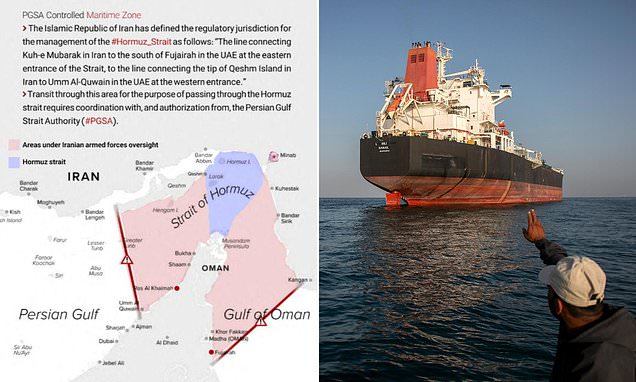
Today, the Persian Gulf Strait Authority (PGSA) - an Iranian body set up earlier this month to control marine traffic in and out of Hormuz, announced Iran was placing the region under the 'oversight' of its armed forces.

The 8,800 sq. mi. area extends into the territorial waters of Oman and the UAE, the latter of which denounced Iran's claims of control as 'nothing but fragments of dreams.'

Iran's claimed lines of influence run from Kuh-e Mubarak to just south of Fujairah, in the UAE, on its eastern line, while the western line runs from the western tip of Iran's Qeshm island to Umm Al Quwain - again, in the UAE.

The PGSA claimed that any 'transit through this area for the purpose of passing through the Hormuz strait requires coordination with, and authorisation from the PGSA.'
 
The Strait of Malacca is one of the most important maritime chokepoints in the world. It lies between the Indonesian island of Sumatra and the Malay Peninsula, linking the Indian Ocean with the South China Sea and the Pacific.

Image

Why it matters​

Around 22–30% of global seaborne trade passes through the Strait of Malacca, making it one of the busiest shipping routes on Earth. More than 94,000–102,000 ships per year transit the strait, carrying goods worth several trillion dollars annually. (Strait of Malacca)
The strait is the shortest sea route connecting:
  • East Asia ↔ Europe
  • East Asia ↔ Middle East
  • East Asia ↔ Africa
  • South Asia ↔ Northeast Asia
Without it, ships would need to divert through the Lombok or Sunda Straits in Indonesia, adding distance, time, fuel costs, and freight expenses. (Global Sitrep)

Major trade flows through the Strait​

Cargo TypeImportance
Containerized goodsElectronics, machinery, consumer products, textiles
OilCrude oil from the Middle East to East Asia
LNGLiquefied natural gas shipments to Asian economies
Bulk commoditiesCoal, iron ore, grain, palm oil
The route is especially important for the manufacturing economies of:
  • China
  • Japan
  • South Korea
  • India
These countries depend heavily on imports of energy and raw materials that arrive via the Malacca route. (Strait of Malacca)

Energy trade​

The Strait of Malacca is the world's largest maritime oil transit chokepoint.
  • About 23.2 million barrels of oil per day moved through the strait in the first half of 2025.
  • This represented roughly 29% of global maritime oil trade.
  • Large volumes of LNG also transit the route. (Visual Capitalist)
Image


Image

Key ports connected to the strait​

The strait serves some of the world's most important ports, including:
  • Singapore
  • Port of Singapore
  • Port Klang : formerly known as Port Swettenham, is Malaysia’s principal maritime gateway and largest container port, located in Selangor about 38 km southwest of Kuala Lumpur.
  • Port of Tanjung Pelepas : a major transshipment and container port located in Gelang Patah, Johor, Malaysia, near the Strait of Malacca.
These ports function as major hubs for global container shipping and transshipment. (Strait of Malacca)

Strategic risks​

Because so much trade is concentrated in a narrow passage, the strait is considered a global chokepoint. Risks include:
  • Ship collisions and congestion
  • Piracy and maritime crime
  • Oil spills and environmental accidents
  • Regional military tensions
  • Natural disasters affecting navigation
Any major disruption could increase shipping costs worldwide and delay deliveries of energy, food, and manufactured goods. (Reuters)

Share of world trade through the Strait of Malacca​

MeasureApproximate Share
Global seaborne trade22–30%
Global maritime oil trade~29%
Annual vessel transits94,000–102,000+
Annual trade value$3–5+ trillion
These figures vary slightly by source and year, but all confirm that the Strait of Malacca is one of the most critical arteries of the global economy. (Strait of Malacca)
In simple terms: roughly one-quarter of all goods moved by sea—and nearly one-third of seaborne oil—passes through this narrow waterway, making it arguably the most important trade corridor in the world. (Strait of Malacca)
 
Last edited:
Back
Top