Elina Ward
Member
- Messages
- 86
- Likes
- 1
Thursday 4 June 2026
Brent Crude Oil Turned Volatile as Hormuz Risk Clashed With Ceasefire Hopes
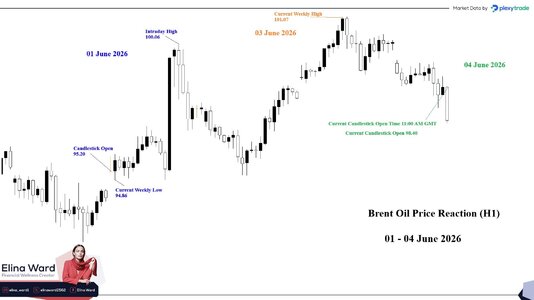
Analysis | 1–4 June 2026 | Brent Crude Oil (1-Hour Chart)Brent Crude Oil Price Reaction: 1–4 June 2026
The chart shows Brent Crude Oil moving through a highly volatile structure between 1 June and 4 June 2026.According to the provided 1-hour chart, Brent opened at 95.20 on 1 June, briefly slipped to 94.86, then rallied sharply to an intraday high of 100.06 later that day. The bullish momentum extended into 3 June, when Brent reached a higher peak of 101.07, before pulling back toward the 98.40 area by 4 June.
From the 1 June open at 95.20 to the 3 June high at 101.07, Brent gained approximately 6.17%. From the 3 June high at 101.07 to the 4 June level of 98.40, it declined around 2.64%. Measured from the 1 June open to the 4 June level, Brent remained higher by approximately 3.36%.
What Caused the Move?
The first major driver was renewed geopolitical risk around Iran, the United States, Israel, Lebanon, and the Strait of Hormuz.On 1 June, oil prices rose sharply after reports that Iran had halted indirect message exchanges with the United States. This damaged confidence that a quick diplomatic agreement could reopen or normalize flows through the Strait of Hormuz. The market had already been pricing severe supply disruption risk, but the breakdown in communication reduced hopes that a near-term deal was close.
Reports indicated that Brent settled more than 4% higher on 1 June, at 94.98, after Iran’s Tasnim news agency said Tehran had stopped indirect negotiations with Washington and that plans were being discussed to block the Strait of Hormuz and disrupt other shipping routes. That official futures settlement level is separate from the higher intraday level shown on the provided chart.
The second driver was renewed military escalation. On 3 June, Middle East hostilities flared again, with reports of Iranian missile activity toward Kuwait and Bahrain and U.S. strikes near Iran’s Qeshm Island. This added another layer of supply-risk buying because the market was already sensitive to any headline involving Hormuz, Gulf shipping lanes, or direct U.S.-Iran escalation.
The third driver was tightening U.S. crude supply. The EIA reported that U.S. commercial crude inventories fell by 8.0 million barrels in the week ending 29 May, leaving stockpiles at 433.7 million barrels, about 3% below the five-year average for this time of year. This crude draw was larger than analysts had expected and supported the bullish move. However, the inventory report was not entirely bullish across all petroleum products, because gasoline inventories rose by 3.4 million barrels and distillate inventories rose by 1.5 million barrels.
Why Brent Pulled Back on 4 June
The pullback on 4 June was mainly caused by partial risk-premium unwinding after Israel and Lebanon agreed to implement a ceasefire. That headline raised hopes that broader regional tensions could ease and that diplomacy involving Iran and the United States could regain momentum.Brent therefore moved lower from the 3 June high, but the decline was limited rather than a full reversal. The market still faced unresolved supply concerns, including restricted Hormuz flows, fragile diplomatic conditions, and the recent large U.S. crude inventory draw.
Weak Chinese demand also helped cap the rally. Reports indicated that Iranian oil was being offered at discounts and Russian crude premiums were easing as sellers competed for Chinese buyers. This suggested that demand-side support was not strong enough to keep Brent firmly above the 101 area shown on the chart.
Final Takeaway
Brent’s move from 95.20 to above 101.00 on the provided 1-hour chart was mainly driven by the re-pricing of geopolitical risk after Iran-U.S. talks stalled, Hormuz reopening hopes weakened, and fresh regional hostilities revived supply-disruption concerns.The large U.S. crude inventory draw added fundamental support, while the 4 June pullback toward 98.40 reflected partial risk-premium deflation after the Israel-Lebanon ceasefire headline. Overall, Brent’s movement was not caused by one single factor. It was driven by a clash between supply-risk buying and ceasefire-related selling pressure.
Price Action Summary
| Movement | From | To | Point Move | % Move | Visual Move |
|---|---|---|---|---|---|
| Open to 4 June Price | 95.20 | 98.40 | +3.20 | +3.36% | 🟢 +3.20 ↗ / +3.36% ↗ |
| Period Low to Period High | 94.86 | 101.07 | +6.21 | +6.55% | 🟢 +6.21 ↗ / +6.55% ↗ |
| Period High to 4 June Price | 101.07 | 98.40 | -2.67 | -2.64% | 🔴 -2.67 ↘ / -2.64% ↘ |
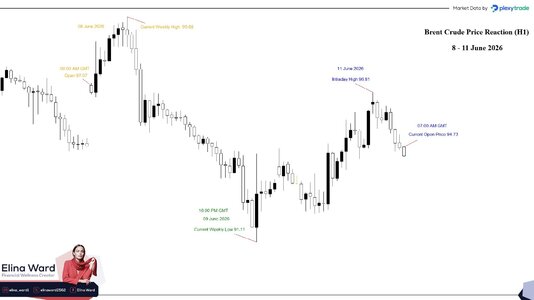
The chart below illustrates the movement of Brent Crude Oil on a 1-hour timeframe from 1 June to 4 June 2026.