
You are using an out of date browser. It may not display this or other websites correctly.
You should upgrade or use an alternative browser.
You should upgrade or use an alternative browser.

Phylo
Legendary member
- Messages
- 5,590
- Likes
- 439
The six used cars that dealers won't touch because they're too expensive to fix - you might already own one
When shopping for a second-hand car, one of the biggest concerns for buyers is whether it might be riddled with problems and become a drain on their finances.The reliability of any vehicle - new or old - ultimately comes down to how well it has been cared for throughout its life.
That's why we always recommend avoiding cars with no service history, patchy maintenance paperwork, and any signs of modifications or prolonged abuse at the hands of former owners.
But there are some models that are notorious for having the same recurring problems that are almost always bank‑busting to fix.
Used car dealers have outlined six they won't add to their stock for this reason alone. This is due to fears they might go wrong and cost an arm and a leg to put right, or that they'll encounter disgruntled customers demanding to return vehicles.
Having spoken to a number of UK dealers, automotive trade title Car Dealer has listed which brands, engines and gearboxes might be worth steering clear of - and why.
And we can tell you which models these issues affect.

The six used cars dealers avoid because they're too expensive to fix
When shopping for a second-hand car, one of the biggest concerns for buyers is whether it might be riddled with problems and become a drain on their finances.
Phylo
Legendary member
- Messages
- 5,590
- Likes
- 439
Taliban recognises child marriage under new rules, with specific guidelines for 'virgin girls'
The Taliban has formally recognised child marriages under a sweeping new family law regulation that sets out rules for marriages involving minors and establishes specific guidelines governing 'virgin girls'.
The 31-page article regulation called 'Principles of Separation Between Spouses' outlines rules governing the dissolution of marriages under an endless list of religious and legal conditions.
These include child marriage, breastfeeding relations, forced separation, missing husbands, apostasy and accusations of adultery.
Significant attention is given to the section on 'khiyar al-bulugh' ('option upon puberty'), an Islamic legal provision that allows for the annulment of a marriage contracted during childhood once the person reaches puberty.
According to Article 5, if a child's marriage is arranged by relatives other than their father or grandfather, it is legally valid provided the spouse is socially compatible and the dowry is appropriate.
The regulation states that the child may later seek annulment after reaching puberty, but only through a court order, according to independent Afghan outlet Amu TV.
The rules also grant familial patriarchs wide authority over child marriages, but state that marriages may be invalidated if guardians are considered abusive, mentally unfit or morally corrupt.
Several provisions uphold strict guardianship, notably Article 7, which establishes a double standard for marriage consent.
The document states that the silence of a 'virgin girl' is interpreted as consent to marriage, whereas the same silence from a male or previously married woman is not.
And in Afghanistan, where women and girls are unlikely to speak out for fear of punishment, the new legislation risks leaving many girls trapped.
The regulation also gives Taliban judges broad powers to intervene in marital disputes regarding issues such as apostasy, 'turning away from Islam', prolonged absence of a husband and accusations of adultery.
It specifically mentions 'zihar', a classical Islamic concept where a husband compares his wife to a forbidden female relative.
Under this section, judges can force husbands to fulfil religious penalties or grant divorce. They may use imprisonment and physical punishment to enforce compliance.
The text also covers marital restrictions under Islamic law regarding 'milk kinship'.
Because children breastfed by the same woman are considered siblings, regulations permit judges to annul marriages if this relationship is discovered between spouses.
The regulations also outline procedures for cases where husbands are missing for extended periods, enabling court intervention under certain conditions.
The new rules come as the Taliban continue to impose oppressive restrictions on women and girls since returning to power in August 2021.
Since regaining control, the Taliban have banned girls from studying beyond sixth grade and imposed extensive restrictions on women’s work and movement.
Earlier this year, the Taliban introduced a new penal code creating a caste system which puts women on the same level as 'slaves'.
As part of the new law, husbands are permitted to beat their wives as long as there is no serious bodily harm.
Article 32 states that only if the husband beats the woman with a stick and this act results in severe injury such as 'a wound or bodily bruising', and the woman can prove it before a judge, will the husband be sentenced to fifteen days' imprisonment.
However, the contradiction lies in that a woman must remain fully covered while simultaneously proving her injuries to a judge.
She is also required to be accompanied by a male chaperone, which is usually the husband himself.
The new code also does not condemn or prohibit sexual or psychological violence against women.
In addition, the code stops women from seeking refuge with their family to escape violence at home.
Article 34 of the code states that a woman who repeatedly goes to her father's house or that of other relatives without the permission of her husband and 'does not return home despite her husband's request' faces three months in prison.
Her family and relatives would also face punishment.
Islamic laws in Afghanistan have become so restrictive that even barbers are facing detention for cutting men's beards too short.
In January, the Ministry for the Propagation of Virtue and Prevention of Vice said it was now 'obligatory' to grow beards longer than a fist, doubling down on an earlier order.
Minister Khalid Hanafi said it was the government's 'responsibility to guide the nation to have an appearance according to sharia', or Islamic law.
Officials tasked with promoting virtue 'are obliged to implement the Islamic system', he said.
In an eight-page guide to imams issued in November, prayer leaders were told to describe shaving beards as a 'major sin' in their sermons
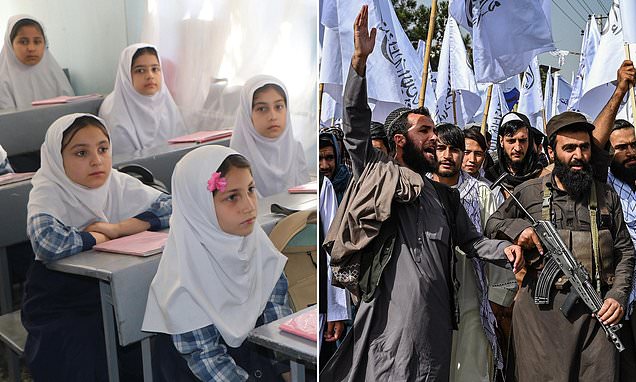
Taliban recognises child marriage under new rules
The 31-page article regulation outlines rules governing the dissolution of marriages under a wide range of religious and legal conditions.
Similar threads
- Replies
- 2
- Views
- 3K


- Replies
- 7
- Views
- 3K


- Replies
- 1
- Views
- 5K