A Professional Approach to Trading Futures

Hello London & Euro Traders
Currently it is just after 5pm in The City

We woke feeling a bit off, and so did not trade
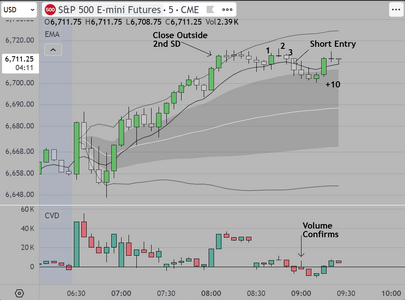
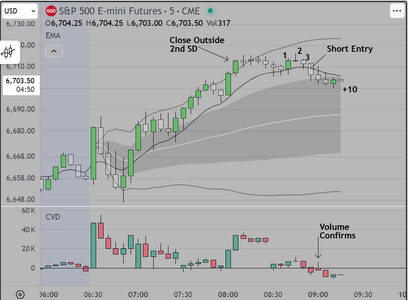
Reviewing the charts we saw several setups, the most recent
is shown on the attached chart and if I had been trading I
would have taken it for the following reasons

1) The setup occurs after the end of US/Euro Overlap
2) The setup is a reversal which is common at this point in time
3) It is a Mean Reversal Setup, and so we might have taken profit
already (at 8 or perhaps 9 points)

Also the setup was confirmed by CVD (which is in "Test Mode" currently
meaning that it resets hourly.

Here is the chart. The next possible setup would normally occur in about
three (3) hours. We have a doctor's appt and so will not be posting again
today

Good Luck
 

Attachments

  • Trade Setup.PNG
    Trade Setup.PNG
    79.4 KB · Views: 44
and here is an update on that trade

As can be seen the market reversed and is now exhibiting
"Trading Range Behavior"
The trade if taken would have resulted in a possible profit of
+9 if one were to have the ability to see the future and know
that it would reverse. I do not have that ability, however I DO
have considerable experience and would have been maintaining
a watch over this trade, knowing that a reversal was possible
( I have seen this before). I can only imagine that I would have
exited at or about +6 to perhaps +8 at best.

And again the next "Statistically Preferred" setup is at the "Power Hour"
(Last hour of the session).

Chart attached below

Good Luck
 

Attachments

  • Trade Update.PNG
    Trade Update.PNG
    78.6 KB · Views: 27
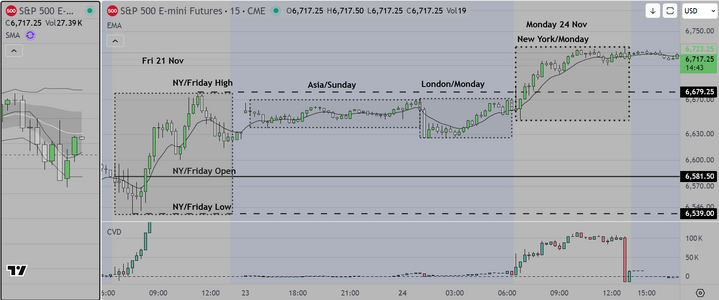
Posting this Weekly Chart using 15 min bars

This chart starts the previous Friday and shows the progression from Asia
to London, and into the NY session earlier today. IF we only look at Price Action
it is clear that a consensus was in, and that was based on news that the US Fed
is considering Interest Rate Reduction. That is why early in today's session, the
markets move strongly to the upside, not much hesitation.

An easy day to trade if you were able to recognize the signs
1) Strength early in the session
2) Minor pullbacks
3) Price staying above Key References

Then during the "Power Hour", institutions place sell orders (look at the CVD
at the end of the session.
 

Attachments

  • Weekly Chart Nov 24.PNG
    Weekly Chart Nov 24.PNG
    117.5 KB · Views: 28
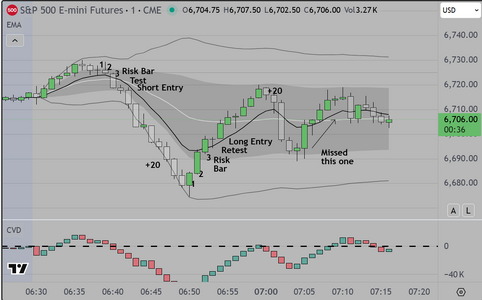
Good Afternoon London & Euro Traders

Late to get up frankly and had to push to get everything in place
Happened to see this setup and was able to take it
Happily a good result. Not one that I recommend for beginners
If you are late to rise it makes more sense to take your time, monitor
and journal your entry (as if you were properly prepared).
 

Attachments

  • Tues 25 Nov.PNG
    Tues 25 Nov.PNG
    55.6 KB · Views: 26
Trade #2

Again, feeling unprepared however my experience carries me this time
as I monitor news, and volume AND based on what I know of the volatility
I held this one for a "round trip" (a type of trade mentioned several times
in previous posts. Again happily it is a winner +20

And now we wait for the end of the US/Euro Overlap

Good Luck
 

Attachments

  • Trade #2 Nov 25th.PNG
    Trade #2 Nov 25th.PNG
    66.2 KB · Views: 25
And a third trade setup that I missed completely
Why? Busy posting Oh Well
Still a reasonably good day for me and there is more to come
(possibly). We wait, monitor news and drink tea
Some traders may ask, "Why tea and not coffee", and the answer is
that there are certain chemicals in tea that provide alertness without
the jittery feeling that coffee seems to have on me. To each his own of course


Good Luck
 

Attachments

  • Missed Entry.PNG
    Missed Entry.PNG
    86.8 KB · Views: 22
Hello Traders

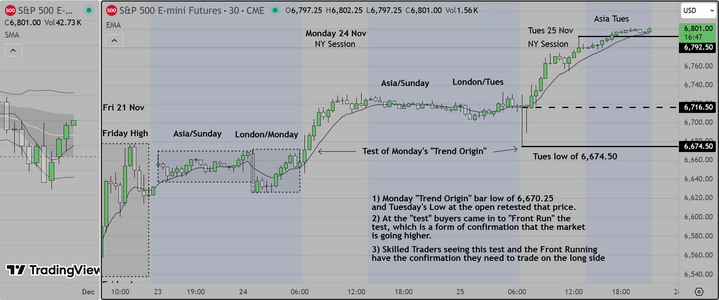
Attaching a Weekly Chart and please make note of the following;

1) I was taught by a skilled person, that "There is usually a way to
determine which way the market is leaning" BEFORE the open.

2) Also, either prior the open, or shortly after, there is usually a "Test" of
a "Key Reference" (a price, a moving average, VWAP, etc) and the market's
reaction to that test, tells us which side is in control (buyers or sellers)

3) We teach retail traders to look carefully at higher time frames down to 15 min
charts in order to identify the following

a) Which way is the market leaning based on higher time frame and economic news
b) Which side is in control (buyers/sellers)
c) Which side is trapped (before the open) or could be trapped after the open,
after a "Test" of a "Key Reference" (See the attached chart)

Once they do the analysis, and have the facts in hand, when the market opens, they can focus
on what is really important, and (usually) figure out whether to trade the long or short
side AND whether to look for Momentum (Trend) entries or Mean Reversion (scalping
and short term trades.

Today, after the initial test of the previous "Trend Origin", SKILLED traders knew the odds favored
the long side, because institutions came in early to lift the market higher.

Ultimately Traders who excel at doing their homework and interpreting the data, make money.
Those who don't bother. Not so much.

Good Luck

PostScript

We attached a revised chart. On the left side, notice the Daily bars and "The Test" of the EMA
The lesson to be learned from this, is to pay attention to the Daily chart. It can tell add valuable info
helping to confirm directional bias.
 

Attachments

  • Revised Weekly.PNG
    Revised Weekly.PNG
    165.7 KB · Views: 18
Last edited:
Good Morning London & Euro Traders where the
current time is 10am

We provide a summary of our pre-open trading plan, hoping to provide struggling traders
with a bit of relief. Please take all of this comment to heart. Of course we could be wrong but
in general, what we are stating reflects common sense.
---------------------------------------------------------------------

AMH suggests that market efficiency varies over time as investors adapt to changing conditions using heuristics like "fear" and "greed". In the context of a holiday-shortened week, a common behavioral pattern (or "heuristic") is reduced participation as traders leave early, leading to the following expectations:
  • Low Volume: Expect lighter trading volume compared to a regular session, as many institutional and retail traders anticipate the holiday closure and take an extended break.
  • Reduced Liquidity: The lack of participation often results in lower liquidity, which can sometimes lead to wider bid-ask spreads and potentially choppy, rather than trending, price action.
  • Challenging Momentum Trades: Given our previous observation of an existing inefficiency toward momentum and trending behavior, the low liquidity environment may exacerbate this. The typical "trend" needs consistent volume to sustain itself; in a low-volume environment, trends may be harder to establish and are susceptible to sudden, sharp reversals or "whipsaws" as small orders have a larger price impact.
Bottom line, is that skilled professionals can (of course) trade the NY Session and make money, but generally speaking, they do not
I can tell you that my colleagues both here in the US, and overseas, are standing down today and getting an early start on "Thanksgiving"

We will not be trading or posting today

Good luck
 
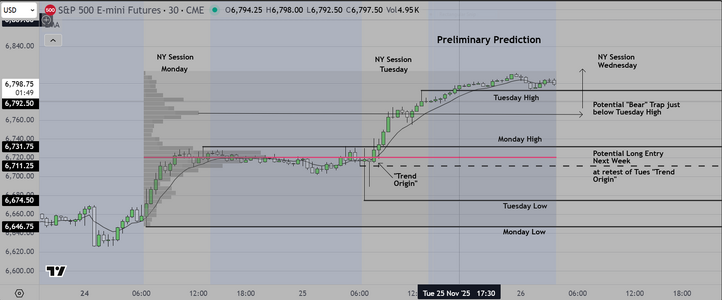
Here is our Preliminary Prediction prior to the NY Open at 2:30pm Local Time

Although we continue to practice our discipline, we do not intend to trade this session
and will not trade until after the Holiday Weekend.. We have however marked a location
for a long entry based on the premise that 1) an inefficiency exists and that 2) momentum based
trades are to be preferred (looking for trend behavior). The problem today is that 3) volume
is likely to be too low to sustain a trend move. Time will tell of course.

And as before we suggest traders stand aside for this period of time.
 

Attachments

  • Pre Holiday Prediction.PNG
    Pre Holiday Prediction.PNG
    117.5 KB · Views: 20
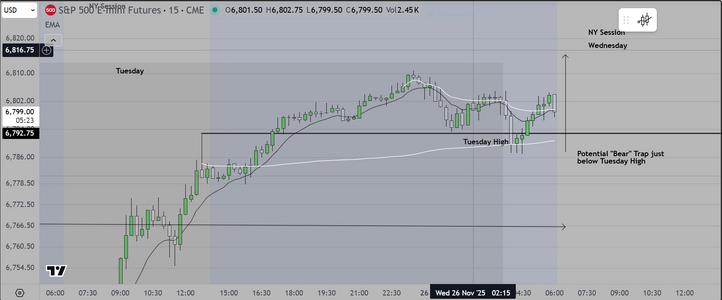
Here is a follow-up to the previous post

On that chart (above) we suggest that short volume (sellers)
could be trapped just below Tuesday's high. That is what happened

The White lines are Anchored VWAPs and we show a technique called
"The Pinch". Traders interested in learning more about this can google it,
or watch Brian Shannon's videos, or buy his book. We also cover this in
our class.

Good Luck
 

Attachments

  • Shorts Trapped.PNG
    Shorts Trapped.PNG
    107.1 KB · Views: 21
Good Afternoon London & Euro Traders
where the local time is 8:30am approximately

Normally this Weekly Markup Chart is completed on a Friday
however, because of the American Holiday (Thanksgiving),
US Markets will be closed.

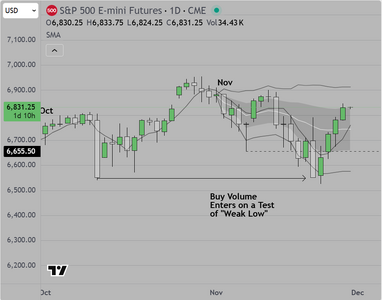
Evaluation Step 1 Daily Chart

Traders who wish to improve their skills should begin by taking a look
at the Daily Chart, where we use a VWAP envelope to frame Price Action
Specifically, we show price in the area that we (and most commercial traders)
call the "Buy Zone". Our basic setup is to wait for price to close outside the
2nd Standard Deviation, then to enter on the next close inside the envelop

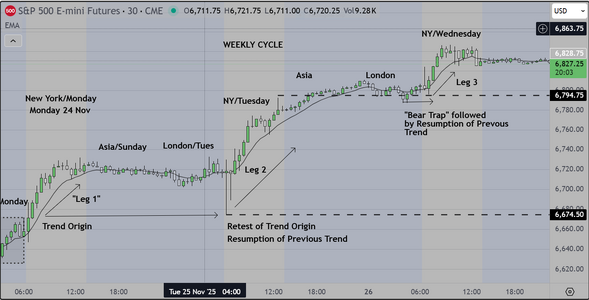
Evaluation Step 2 Weekly Cycle

As mentioned, this chart is abbreviated because of the Holiday. The broad
strokes are as follows

1) We evaluate the Market periodically using a protocol called "Adaptive
Market Hypothesis". It was clear that the market favored Momentum based
approach (looking for "Trend Behavior")

2) In order to create trend behavior, one side (buy or sell volume) has to be "trapped"
and our chart shows how that was done.

3) Finally, referring back to the Daily Chart, we can see the probable price "Target" above
AND we show the price action divided into "Legs", with "Leg 1" starting on Monday
followed by "Leg 2" (Tues) and finally "Leg 3" (Wed).

"Leg 2" Strategy for Retail Traders

In our class we outline a "Leg 2 Strategy", which takes advantage of the tendency
for "Leg 2" to be the most profitable trend move during this (Weekly) period of time.

Evaluation Step 3 Creating a New Plan

And now we "reset" (See previous posts) where we outline the process of creating
a new trading plan.

Good Luck
 

Attachments

  • Daily Pre-Holiday Chart.PNG
    Daily Pre-Holiday Chart.PNG
    61.1 KB · Views: 15
  • Pre-Holiday Markup.PNG
    Pre-Holiday Markup.PNG
    120.7 KB · Views: 24
Last edited:
Over the past week we have published quite a lot of content, most of which
is not available anywhere else. In addition, because it is so different than
the popularized versions one sees on the Internet, it will surely take a while
for traders to "digest" and evaluate. So in future we will continue to recover
from the flu and reduce our workload a bit
 
Last edited:
Hello London & Euro Traders

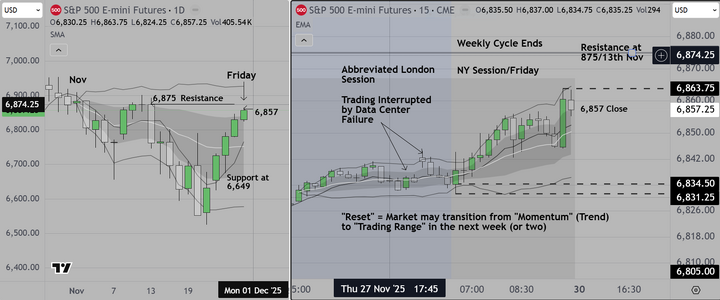
The attached chart provides the longer time frame basis for our Weekend Preparation Process

Quite a lot to learn from this chart as follows

1) Buy volume (Buyers) in control
2) Seasonal Bias (refer to previous year's price action/following post) to the upside
3) Completion of "3rd Leg" (to the upside) on Friday, and continuation likely
however, it is also likely to "Reset", changing from Momentum to Trading Range
if "Leg 3" is complete within the next two (2) weeks, providing opportunities
both long & short intraday.

Preliminary Prediction

Continue to look for Momentum based entries (long side preferred initially)
unless or until buyers are "trapped" on the higher time frame charts.
 

Attachments

  • Weekly (Seasonal) Reset Chart.PNG
    Weekly (Seasonal) Reset Chart.PNG
    182.8 KB · Views: 13
Last edited:
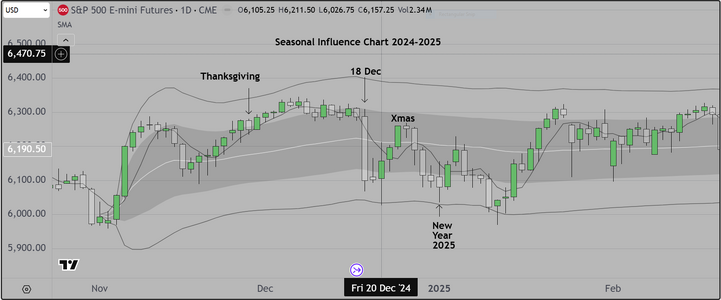
This next chart shows price action last year at this time.
From this chart we can determine possible Seasonal Influences
that could shape the days ahead

If you look closely you can see that last year, price continued higher
for several days after the American Thanksgiving Holiday, however
shortly thereafter the character of the market changed from Momentum
(Trend) to Trading Range.

Will that happen again this year. We can't know precisely however we can
anticipate that it might and prepare if it is (similar).

Good luck
 

Attachments

  • Seasonal Chart.PNG
    Seasonal Chart.PNG
    113.6 KB · Views: 13
Last edited:
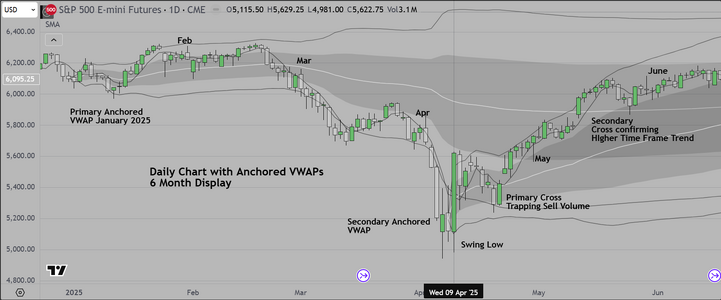
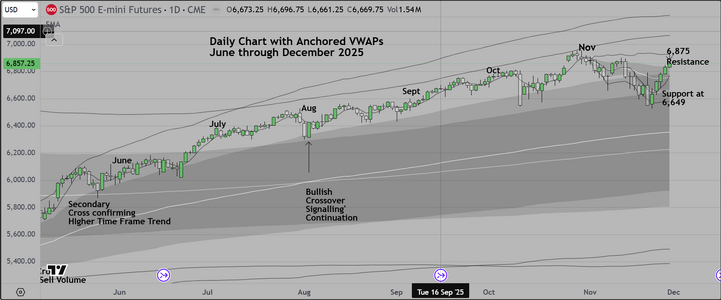
Before we go further, we want to let interested traders know
how we process price action on higher time frames

We work with Daily Charts only, and the purpose is

1) To confirm (Daily) Market Bias
2) To confirm Control (when possible)
3) To provide tradable "granularity" (possible points of entry)
for Swing Trades

To accomplish these objectives, we apply and maintain anchored VWAPs,
Time based labels, and usable signals (places where VWAPs cross, and places where
price moves above or below VWAPS, which is a type of divergence). Any of these signals
can create tradable opportunities, IF you can learn to identify and interpret them.
THIS is an important part of what I train traders to do.

We attach below, our Daily Charts, as maintained from the beginning of the year
The full year can usually be displayed on two (2) charts, each one covering six (6) months.

Good luck
 

Attachments

  • Daily Chart w Anchored VWAPs.PNG
    Daily Chart w Anchored VWAPs.PNG
    142.8 KB · Views: 16
  • Daily Chart Anchored VWAPs Part 2.PNG
    Daily Chart Anchored VWAPs Part 2.PNG
    146.4 KB · Views: 18
Last edited:
A final note as regards the importance of learning to use
Daily Charts

1) If you take time to study those two charts (above)
you may notice that I use not only the VWAP (the central white line) but also
an "envelope" consisting of "bands" (also shown as lines) above and below the central (white) line.
2) Those lines represent the 1st and 2nd Standard Deviations from the VWAP
and without going into all the math, it means that as price extends away from
the central VWAP (white line), one of two things is likely to happen
3) Either price is going to continue to move along one of the "bands" (Trend)
or price will reverse back toward the central VWAP (Trading Range/Mean Revision).
4) The opportunities come from a) accurate recognition (which one is it?)
and then, b) applying and managing the right strategy.
5) Traders who learn these skills can structure trades in such a way that
(statistically) they are likely to have more winners than losers, thus creating a viable business
model. Its that simple
 
Last edited:
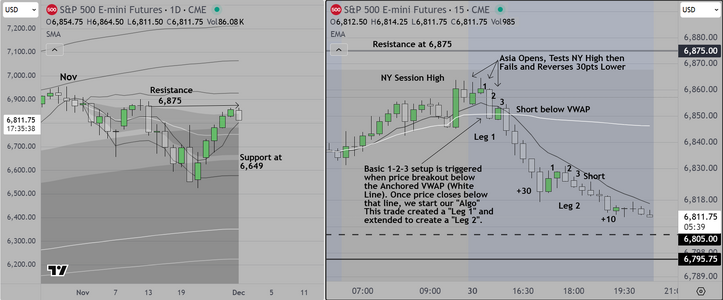
Posting a chart showing the Asia Open at about 11am London time

Start with the Daily Chart (left side), and you can see "Primary" resistance at 6,875
and the previous (Fri) New York Session high just below that (at 6,863.25). When Asia Session
opens, it tests the previous NY high and fails. A skilled trader observing this (test/fail at a previous
session high), would start to be interested especially at this time of year.

1) The initial "Test of the Previous High" (They would make note of the failure at that high)
2) Wait for price to "Take Out" or Fall Below a "Key Reference" (Anchored VWAP and EMA).
3) On Retest of those "Key References" they would start the Algo (1-2-3) entering short at the open
of the next candle
4) Management of this trade would depend on the skill level of the trader. A professional would probably
take partial profit at about 5 pts (this is called "buying a stop" a common practice).
5) Then you simply watch & wait to see what level of volatility develops (we use RelVol for this purpose
on a shorter time frame chart). As long as the RelVol shows a reading +2 or better, AND price does not
close at or above the EMA we would hold. The rules are simple, following them however is not easy.
IF the trader is unable to control their emotions (afraid to accept risk), they will usually take profit prematurely
leaving money on the table. In our class, we talk about how to view risk in order to maximize results. For
amateurs who trade occasionally, this probably does not matter, however if this is your business (your
source of income) over a period of a year, making a few extra points on every trade can make a significant
difference.

We do not usually trade Asia and so did not take this trade
Also please note that we edited the chart to make it easier to add text for the reader's benefit

Good Luck
 

Attachments

  • Asia Open Legs 1 & 2.PNG
    Asia Open Legs 1 & 2.PNG
    177.3 KB · Views: 17
Last edited:
Preliminary Prediction for the NY Session at 2:30 London Time

We start our data gathering by reviewing the previous year's price action as follows
-------------------------------------
Previous Year's Pattern

"On Monday, November 25, 2024, the S&P 500 futures experienced a strong and decisive upward movement during the first hour of the New York trading session. Opening in the green, the market saw continued strength, building on positive sentiment from the previous week and fueled by the anticipation of the critical holiday shopping season"
-------------------------------------

We notice that current conditions (see previous posts) suggest the possibility of a similar
open later today. As always we will look for "Tells" during the overnight (from our perspective
in the US). There will be no further posts until after the IB (initial balance) of the New York
Session is completed.

Good luck
 
Last edited:
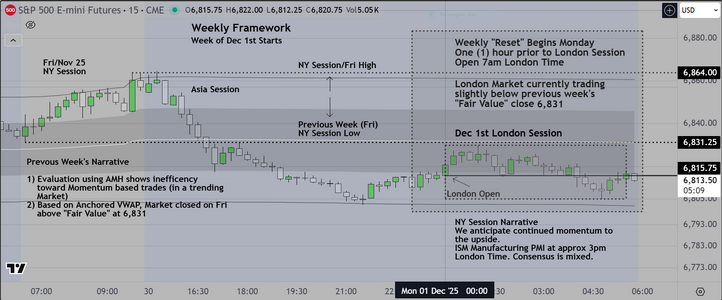
We will go ahead and release this chart ahead of completion of the NY session IB

We create this for students prior to the open for reference, as it shows our basic
orientation as we transition to the new week and holiday season.

Good luck
 

Attachments

  • Week of Dec 1st Framework.PNG
    Week of Dec 1st Framework.PNG
    165.7 KB · Views: 15
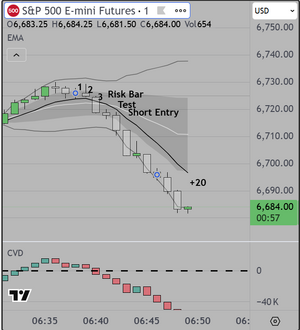
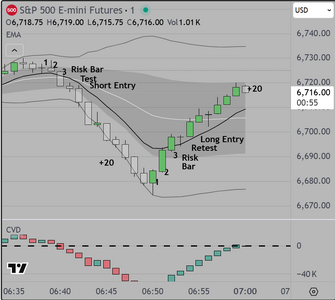
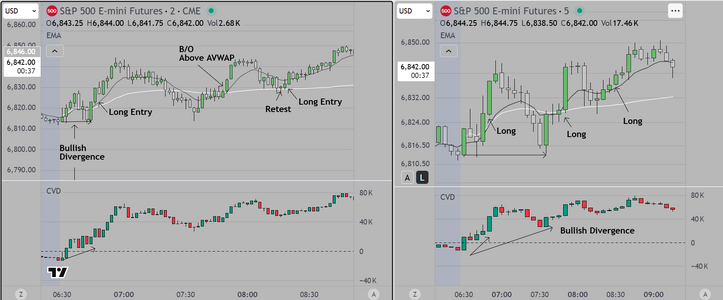
Attaching a couple of example charts showing today's trades

While they may be interesting, what is much more valuable is
the process of learning to direct your focus during the session
to the following elements

At the open

1) Price relative to VWAP (above or below "Fair Value")
2) Creation of tradeable patterns during the first 15 minutes (Double Tops/Bottoms, Wedges, etc)
3) Creation of successive highs or lows
4) Breakouts above/below the VWAP (followed by retest)
5) Divergences between price and CVD
6) Time of day

Most retail traders cannot direct their attention to these things for long (try it yourself with a common
kitchen timer). We teach traders to scan for these elements and make notes at intervals. Eventually
if the motivation is significant, they learn to extend their attention, in order to catch the setups that follow.

We split the session into three (3) parts.

1) The IB (for us) is the first 15-30 minutes
2) The "Turnaround", which for NY session traders is 10am EST
3) The last hour (also known as the "Power Hour")

*There are two (2) additional opportunities that we cover in our class, and they are
A) Gap opens and B) the Pre-Market Open (and subsequent) Close of the US/Euro "Overlap".
We address those opportunities toward the end of the class.

We suggest that struggling traders consider only trading these time based opportunities
until they can demonstrate consistency (and of course, make money). Once that goal is met
they are on their own.

Good Luck
 

Attachments

  • Today's Trades.PNG
    Today's Trades.PNG
    129.3 KB · Views: 18
Last edited:
Back
Top