One amazing rule to become a profitable trader.

  • Thread starter Thread starter AriaS
  • Start date Start date
  • Watchers Watchers 4

AriaS

Well-known member
Messages
367
Likes
122
The rule: find a strategy that makes more than it loses: PF>1 + yearly RF>1.5.
With a smaller RF you will be better off simply investing long-term in large-cap stocks.

Someone might say: "What kind of advice is this? Everyone knows a profitable strategy is the key to success". And they are right.
But what if I told you that the important word is not "strategy", it is "find"?

Yes -- find.
You can only do this by trying and discovering what really works.

Sounds too trivial, but most people don't do this. They trust some gurus, YouTubers, or course sellers -- people whose goal is different from yours.
Your goal is a profitable strategy, and the only way do that is to try and see what works.

And what is the fastest way to do it?
 
The rule: find a strategy that makes more than it loses: PF>1 + yearly RF>1.5.
With a smaller RF you will be better off simply investing long-term in large-cap stocks.

Someone might say: "What kind of advice is this? Everyone knows a profitable strategy is the key to success". And they are right.
But what if I told you that the important word is not "strategy", it is "find"?

Yes -- find.
You can only do this by trying and discovering what really works.

Sounds too trivial, but most people don't do this. They trust some gurus, YouTubers, or course sellers -- people whose goal is different from yours.
Your goal is a profitable strategy, and the only way do that is to try and see what works.

And what is the fastest way to do it?
There is no "Fast way". OK you may see a presentation online or at a Trader show that suggests that it only takes 5 mins a day but they are just there to grab your money. Watch a series of assets on a daily basis. Daily???? Does that mean you have to sit and stare at the markets all day?????? YES. Learn the process for trading these assets and have them ingrained. Very basically don't place a trade using some AI Master trading smart super dooper platform then after trade work how to set Targets and Stop losses. Basics perhaps. Get a piece of paper , draw a line down the middle. On the right side , write down your good points. Such as "I am well admin organised". Then write down on the left side all of your Bad points. Such as : "I am Greedy, Lazy, want to be right all the time, self centered, get angry if the markets don't do what I want , also I am a p1ssheas gets up with a hangover and have to watch TV in the the morinings. If you are honest, the bad points will outweigh the good points 10 times over. If you don't have bad points then you are a [comment removed]. Great to learn the trading abbreviations and fancy names for Charting patterns but they will only assist you to get laid at a Traders Social party . Unless you can read and understand price action then they are a fantasy. There you have it; a few Monday morning considerations thoughts. If you want anymore in depth information PM (private message) me and we can have a chat.
 
Last edited by a moderator:
There is no "Fast way". OK you may see a presentation online or at a Trader show that suggests that it only takes 5 mins a day but they are just there to grab your money. Watch a series of assets on a daily basis. Daily???? Does that mean you have to sit and stare at the markets all day?????? YES. Learn the process for trading these assets and have them ingrained. Very basically don't place a trade using some AI Master trading smart super dooper platform then after trade work how to set Targets and Stop losses. Basics perhaps. Get a piece of paper , draw a line down the middle. On the right side , write down your good points. Such as "I am well admin organised". Then write down on the left side all of your Bad points. Such as : "I am Greedy, Lazy, want to be right all the time, self centered, get angry if the markets don't do what I want , also I am a p1ssheas gets up with a hangover and have to watch TV in the the morinings. If you are honest, the bad points will outweigh the good points 10 times over. If you don't have bad points then you are a [comment removed]. Great to learn the trading abbreviations and fancy names for Charting patterns but they will only assist you to get laid at a Traders Social party . Unless you can read and understand price action then they are a fantasy. There you have it; a few Monday morning considerations thoughts. If you want anymore in depth information PM (private message) me and we can have a chat.
"Your goal is a profitable strategy, and the only way do that is to try and see what works.

And what is the fastest way to do it?"

What is the fastest way "to try and see what works"?
 
As with so many posts on this site, the original author
has made assumptions that are erroneous
Finding a strategy that makes more than it loses is not difficult
however, executing that strategy can be problematic, for a variety of reasons
including

1) Insufficient capital
2) Size of drawdowns
3) Technical issues as regards speed of execution for Entry and/or Exit
4) Seasonal Influences
5) Inability to deal with periodic adverse news

These are but a few of the challenges facing traders.

Also interesting that the post then goes on to ask what the fastest route
to success might be. Speed is antithetical to the process, it simply creates
more opportunity for error.

As regards solving the problem, the first step should be finding a theoretical basis
that is effective and can be implemented by a reasonably skilled Retail Trader. I like an
approach by Andrew Lo, called "Adaptive Market Hypothesis". I use it to Identify market
inefficiency and after that I identify the type of inefficiency and the "setups" that work
in that environment. The process is repeated on a weekly basis, and the result is a systematic
approach that can be adapted to any market. I discuss some of the details on my
thread "A Professional Approach to Trading".

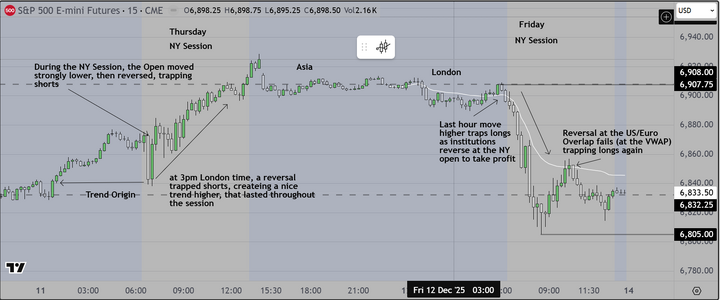
Attaching a chart that is part of my process.

I was taught that success takes work and commitment. To those who want to obtain it
"fast", I wish you

Good luck
 

Attachments

  • 30 Min Example.PNG
    30 Min Example.PNG
    100.3 KB · Views: 17
As with so many posts on this site, the original author
has made assumptions that are erroneous
Finding a strategy that makes more than it loses is not difficult
however, executing that strategy can be problematic, for a variety of reasons
including

1) Insufficient capital
2) Size of drawdowns
3) Technical issues as regards speed of execution for Entry and/or Exit
4) Seasonal Influences
5) Inability to deal with periodic adverse news

These are but a few of the challenges facing traders.

Also interesting that the post then goes on to ask what the fastest route
to success might be. Speed is antithetical to the process, it simply creates
more opportunity for error.

As regards solving the problem, the first step should be finding a theoretical basis
that is effective and can be implemented by a reasonably skilled Retail Trader. I like an
approach by Andrew Lo, called "Adaptive Market Hypothesis". I use it to Identify market
inefficiency and after that I identify the type of inefficiency and the "setups" that work
in that environment. The process is repeated on a weekly basis, and the result is a systematic
approach that can be adapted to any market. I discuss some of the details on my
thread "A Professional Approach to Trading".

Attaching a chart that is part of my process.

I was taught that success takes work and commitment. To those who want to obtain it
"fast", I wish you

Good luck
How do you decide which setups to focus on each week?
 
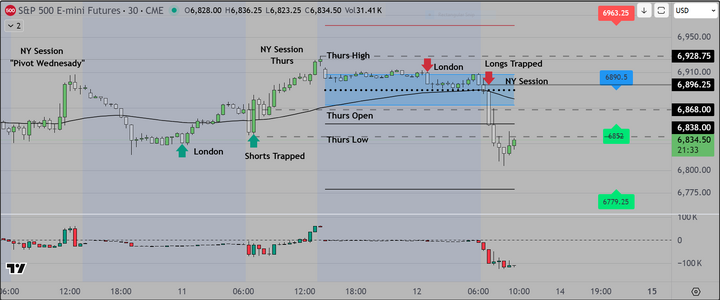
Referring back to my Weekly Chart, and my comment about analysis using
the work of Andrew Lo (Adaptive Market Hypothesis), on a Saturday or Sunday
I review the previous week's price action and characterize it. For example on Monday
was the price action at the open trending or did it form a trading range? After that
I look at the time period from the open to the close of the US/Euro Overlap, and
characterize it as well. I do the same with each successive time period until the last
hour (also known as the "Power Hour"). Same analysis for that last trading opportunity.
however in this period of time I make note of the MOC imbalance orders placed by
Institutions, because it may indicate an opportunity during the London Session.
In my most recent posts I showed that institutions decided to repeat a specific pattern
trapping traders, then reversing to create a trend in the opposite direction. I think the
posts are clear. The institutions do this because it allows them to make money both long
& short. Attaching a chart that displays my analysis of the the price action Thursday and
Friday. I don't have time to review the entire week, however the process is similar
The accounting is simple, how much of the time did the market spend trending vs in a trading
range?
 

Attachments

  • End of Week Analysis Example.PNG
    End of Week Analysis Example.PNG
    142 KB · Views: 15
Last edited:
Finding a strategy that makes more than it loses is not difficult
however, executing that strategy can be problematic, for a variety of reasons
“Finding a strategy that makes more than it loses is not difficult” is an assertion, not a fact. In practice, it is exactly what most traders fail to achieve.
Executing is not a problem at all, because thanks Universe it is the 21st century and any strategy can be easily automated

Also interesting that the post then goes on to ask what the fastest route
to success might be. Speed is antithetical to the process, it simply creates
more opportunity for error.
You completely misunderstood the last question "And what is the fastest way to do it?", because you simply didn't read the previous several words. The fastest way to try and see what works is BACKTESTING.

I like an
approach by Andrew Lo, called "Adaptive Market Hypothesis".
The Adaptive Market Hypothesis is a descriptive framework for why edges evolve; it does not make finding a durable, implementable edge trivial for retail traders.

As with so many posts on this site, the original author
has made assumptions that are erroneous
As you can see from one of the replies above, you're having a bit of a problem understanding the written text, so highly likely that the same happened to you when you read my other many posts.

***

The bottom line: None of this invalidates the original question, which is about how traders bridge the gap between theory and something that survives real conditions: they backtest, tweak, optimize, validate out-of-sample, and find something that really works, instead of dwelling on some illusive market hypotheses.
 
First your assertion that it is easy to automate is simply wrong
Skilled persons are paid well and even then they often fail to automate
accurately and have to repair and maintain code. This is well known
(except apparently on your planet.)

Item 2. I have understood your comment. When done correctly backtesting is
not fast. It requires quite a bit of preparation of raw data, and the evaluation process
when done correctly also requires significant time. From your comment it seems
likely that doing anything in a rigorous fashion is beyond your ability.

Item 3 Andrew Lo's Hypothesis was a starting point for the development of my own system
I make that system and the logic it incorporates, available to persons who then choose how to implement
it. Again your comments are ignorant and add no value to the the subject.

Item 4 I am a native speaker of the English language. I have not read any other posts of yours
and will be ignoring them in future. Suggest you do the same for me and my posts since I find
you to be condescending.

I think that covers everything I wished to say

Thanks for wasting my valuable time

Good luck
 
Item 2. I have understood your comment. When done correctly backtesting is
not fast.
And you are failing once again to read correctly. Have I said that it's fast? No. You seem to not see the difference between "fast" and "the fastest". And it is indeed the fastest way to try and see what works. No one can deny this ridiculously simple truth (except apparently on your planet.).
First your assertion that it is easy to automate is simply wrong
Skilled persons are paid well and even then they often fail to automate
accurately and have to repair and maintain code. This is well known
(except apparently on your planet.)
It's correct, people pay for the work that is done for them. But there's no other choice. That's the best investment in their business. What is $500 for anyone whose goal is to make tens thousands? A good EA can be ordered for less than that. Besides, LLMs are getting better at coding everyday. It took me 2 days to get Claude to code my Stock Trading EA. It works exactly as was intended.
 
Last edited:
Back
Top