June 19, 2026
Markets are navigating a sharp divergence this week as the Federal Reserve's hawkish signal and a landmark US-Iran peace agreement reshape the outlook for currencies, commodities, and equities. While the dollar surges to multi-month highs, gold and oil are under intense selling pressure, and Australian equities are pulling back after a strong rally.
At its June meeting, the Fed kept rates unchanged at 3.50-3.75%, as expected, but the dot plot turned decisively hawkish. Nine of 18 officials now expect at least one rate hike this year, while the median end-2026 rate projection was raised to 3.8% from 3.4% in March. Fed Chair Kevin Warsh did not push back against this hawkish message, delivering a clear signal that the central bank is prioritizing inflation control.
For gold, this is a double blow. A stronger dollar makes gold more expensive for foreign buyers, while higher Treasury yields increase the opportunity cost of holding the non-yielding metal. Support is now seen at $4,100-4,000, but the trend remains bearish. Any relief rally is likely to face resistance near $4,400 and $4,464 (the 200-day moving average). Traders should wait for clear reversal signals before stepping in.
The memorandum of understanding, expected to be signed in Geneva, includes the lifting of sanctions on Iranian oil exports and the restoration of free passage through this critical waterway, which carries roughly 20% of global oil supply. While physical restoration may take several weeks, the market is already pricing in a supply-return logic, unwinding the geopolitical risk premium that had supported prices above $100 earlier this year.
Technically, WTI remains below key moving averages, and bearish momentum remains dominant. Resistance is at $76.72 (150-day MA) and $80.00, while support lies at $73.50 and $72.76. Each rebound is likely to attract selling pressure, with a potential target of $70.00 if the agreement holds.
Key resistance lies at 101.00 and 101.50, while support is at 100.00 and 99.57. With half of FOMC members now expecting at least one rate hike this year, the dollar's bullish momentum appears intact. Any disappointment in upcoming data could trigger a pullback, but the overall bias remains higher.
Sector performance was mixed. Gold miners and technology stocks led gains, while energy stocks slumped on the sharp decline in crude prices. The broader market remains supported by the RBA's pause at 4.35%, but hawkish signals from the Fed and lingering Middle East uncertainty have dampened sentiment.
Technically, support is seen at 8,860-8,800, with resistance near 8,930-8,940. A break below 8,860 could open a deeper pullback toward 8,800, while a recovery above 8,940 would signal renewed bullish momentum.
Three narratives are driving markets this week:
Markets are navigating a sharp divergence this week as the Federal Reserve's hawkish signal and a landmark US-Iran peace agreement reshape the outlook for currencies, commodities, and equities. While the dollar surges to multi-month highs, gold and oil are under intense selling pressure, and Australian equities are pulling back after a strong rally.
Gold – Pressure Mounts as Dollar Strengthens
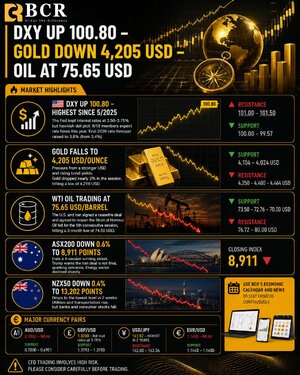
Gold has fallen sharply this week, dropping nearly 2% in a single session and trading near $4,205 per ounce after hitting a low of $4,219. The primary driver? A hawkish Federal Reserve.At its June meeting, the Fed kept rates unchanged at 3.50-3.75%, as expected, but the dot plot turned decisively hawkish. Nine of 18 officials now expect at least one rate hike this year, while the median end-2026 rate projection was raised to 3.8% from 3.4% in March. Fed Chair Kevin Warsh did not push back against this hawkish message, delivering a clear signal that the central bank is prioritizing inflation control.
For gold, this is a double blow. A stronger dollar makes gold more expensive for foreign buyers, while higher Treasury yields increase the opportunity cost of holding the non-yielding metal. Support is now seen at $4,100-4,000, but the trend remains bearish. Any relief rally is likely to face resistance near $4,400 and $4,464 (the 200-day moving average). Traders should wait for clear reversal signals before stepping in.
Oil – Extending Losses on Supply Hopes
Crude oil has extended its decline for five consecutive sessions, with WTI trading near $75.65 per barrel after briefly touching $74.50 – a three-month low. The catalyst? A preliminary US-Iran peace agreement that could reopen the Strait of Hormuz.The memorandum of understanding, expected to be signed in Geneva, includes the lifting of sanctions on Iranian oil exports and the restoration of free passage through this critical waterway, which carries roughly 20% of global oil supply. While physical restoration may take several weeks, the market is already pricing in a supply-return logic, unwinding the geopolitical risk premium that had supported prices above $100 earlier this year.
Technically, WTI remains below key moving averages, and bearish momentum remains dominant. Resistance is at $76.72 (150-day MA) and $80.00, while support lies at $73.50 and $72.76. Each rebound is likely to attract selling pressure, with a potential target of $70.00 if the agreement holds.
US Dollar – Rallying on Hawkish Fed Signals
The US Dollar Index (DXY) rose to 100.80, its highest level since May 2025, as investors increased bets on a rate hike later this year. The Fed's hawkish hold – combined with upward revisions to inflation forecasts – has fully priced in a 25-basis-point rate hike by October.Key resistance lies at 101.00 and 101.50, while support is at 100.00 and 99.57. With half of FOMC members now expecting at least one rate hike this year, the dollar's bullish momentum appears intact. Any disappointment in upcoming data could trigger a pullback, but the overall bias remains higher.
Australian Equities – Pulling Back After a Strong Run
The ASX 200 fell 0.6% to 8,911 on Thursday, ending a four-day winning streak. The pullback was driven by profit-taking after the index reached a two-month high, as well as renewed caution after President Trump warned that the new ceasefire agreement with Iran was not a final deal.Sector performance was mixed. Gold miners and technology stocks led gains, while energy stocks slumped on the sharp decline in crude prices. The broader market remains supported by the RBA's pause at 4.35%, but hawkish signals from the Fed and lingering Middle East uncertainty have dampened sentiment.
Technically, support is seen at 8,860-8,800, with resistance near 8,930-8,940. A break below 8,860 could open a deeper pullback toward 8,800, while a recovery above 8,940 would signal renewed bullish momentum.
Three narratives are driving markets this week:
- A hawkish Fed – raising the dollar and pressuring gold.
- A US-Iran peace deal – weighing on oil prices.
- Profit-taking in equities – after a strong rally.
- Gold: Bearish below $4,400. Wait for clear reversal signals.
- Oil: Bearish below $80. Sell on rebounds.
- Dollar: Bullish above 100.00. Watch for resistance at 101-101.50.
- ASX200: Correcting, support at 8,860-8,800.