The EV Charging Sector is a CAPEX Trap. Why the market is fundamentally mispricing the "Mobile Charging" arbitrage model

CHcapital

Newbie
Messages
3
Likes
0
If we look at traditional EV charging stocks (like $CHPT, $BLNK), we know the business model is brutal. It’s a low-margin CAPEX trap plagued by poor utilization rates, real estate constraints, and massive grid upgrade costs.

However, we have been researching a structural pivot in the industry that the market is currently mispricing: Mobile Charging Robots (MCRs). Most investors look at these and see a "hardware manufacturer." That is a fundamental misvaluation. The actual business model here is high-margin Energy Arbitrage, Virtual Power Plants (VPP), and SaaS.

Here is a breakdown of the unit economics and why the valuation multiples in this sub-sector are about to expand dramatically:


1. The Arbitrage Engine (Shifting from Cost Center to Profit Center)

A traditional fixed charger only makes money when a car is plugged in. MCRs are essentially mobile battery energy storage systems (BESS). According to a recent structural/economic analysis formally indexed on the CERN-backed OpenAIRE/Zenodo database (DOI: 10.5281/zenodo.19220627), these units charge at night during off-peak valley hours (e.g., $0.05/kWh) and sell that power during peak hours (e.g., $0.20/kWh). The economic model shows that this peak-valley arbitrage can reliably contribute 40%-60% of the daily revenue per unit.


2. The VPP and B2B Upside

These fleets don't just charge cars. The real alpha is routing them to commercial buildings during peak load times to discharge power (V2B), saving businesses massive peak-demand charges. By aggregating these mobile units via a Cloud AI-EMS, operators can participate in grid demand-response markets as a Virtual Power Plant (VPP), unlocking a completely separate, subsidized revenue stream.


3. Software-as-a-Service (SaaS) Margins

The moat isn't the wheels; it's the Spatiotemporal Forecasting algorithms predicting demand heatmaps. Companies operating in this space (like $MAAS) are licensing out their dispatch platforms and Energy Management Systems (EMS) as a SaaS subscription. We are looking at software margins layered on top of infrastructure arbitrage.


4. CAPEX Efficiency & ROI

Because MCR fleets are modular and actively hunt for demand rather than waiting for it, their asset utilization rate destroys fixed chargers. This pushes the payback period (ROI) down to a highly commercializable 3-5 years. With a projected TAM hitting the $100B - $140B range globally by 2030, the scalability is massive.


The Valuation Play:

If we evaluate an MCR player as a hardware OEM, they look expensive. If we evaluate them correctly as a distributed energy asset operator + SaaS platform, they are trading at a massive discount.

If anyone wants to look at the raw economic models and grid interaction topologies, the OpenAIRE working paper we mentioned is here: $MAAS Mobile Charging Robot Industry Whitepaper

What are your thoughts on VPPs replacing static infrastructure? Is the market too focused on legacy charging networks?
 
Last week Tesla enabled 212 Superchargers in Chongqing, China.

From China Daily: Equipped with Tesla's latest V4 Supercharger technology, the 55 Supercharger stations, including a total of 212 charging stalls, enable users to initiate charging via a WeChat mini-program by simply scanning a QR code.

I have always had a question for those who buy electric cars: I feel that no matter how fast the charging is, it doesn't compare to how quickly you can refuel a gasoline car. If you're in a hurry and don't have time to charge, or if you run out of battery halfway, what should you do?

This reminds me of a mobile EV charging company called Maase because I came across a post about it weeks ago in r/ChinaStocks


So basically from what I learned, they have mobile charging robots, and they managed to build an AI-powered system that can help how these robots delivery their power during rush hours.

I googled $MAAS stock reddit, and found many people mentioned it. Someone even yoloed his 118k into this stock.


I am not sure if he's an insider or reckless. But I am not that rich. I only bought 500 shares of $MAAS along with $TSLA puts.

If $MAAS have some breakthroughs in the future, its price will soar, and $TSLA will drop.

Remember when DeepSeek came out, $NVDA plunged? I think it would be similar.
 
In today’s increasingly heated U.S.-China AI competition, our headlines are bombarded daily with reports on top tech companies and their massive models. However, if you’re an investor who truly cares about commercial monetization, it’s time to shift your focus away from the "race of big models" spotlight.

In the deep end of the commercial world, most ordinary enterprises or institutions don’t need an all-knowing, infinite-power "Einstein-level" AI that consumes vast computational power. What they need is a "golden assistant"—an AI that doesn’t leak data, is cost-effective, and can help improve daily work efficiency by doing the grunt work.

This is the massive discrepancy in expectations within current AI, and it’s exactly the blue ocean market that MAAS, a company I’ve recently been watching, is quietly capitalizing on. Let’s break down the economics of large models in simple investment terms.


Understanding What Kind of AI Is the Most Profitable​

To understand which AI is the most profitable, we need to first grasp the concept of "parameter scale." You can roughly classify large models into a few tiers:

● Top players (>100B/Trillions of parameters): Models like GPT-4 are incredibly powerful, but their reasoning (day-to-day use) costs are astronomical. Running them requires massive A100/H100 compute clusters—essentially "money-burning machines."

● Lightweight and practical models (7B-13B parameters): The "B" here stands for Billion. A 7B model means a model with 7 billion parameters.

Why is the 7B model considered the "king of cost-effectiveness"?

The answer is simple: it has a very low hardware threshold and the "just right" level of ability. To deploy a trillion-parameter model, companies might need to spend hundreds of thousands or even millions on servers. But a 7B model, after compression and quantization, can run smoothly on a regular A100 graphics card—or even on a consumer-grade RTX 4090-equipped PC.

For businesses, what truly matters isn’t how smart the model is, but the Cost per Task (the cost of completing a task) and stability. The reason the 7B model has commercial value isn’t because it’s "strong enough" but because it’s "good enough" and can scale to a cost-effective deployment range.

More importantly, there’s a consensus in the industry: "Fine-tuning > Parameters." The fundamental reason is that large models' general capabilities come from pretraining, while what enterprises need are highly structured, clearly defined, 'domain-specific knowledge'." In these scenarios, high-quality data and fine-tuning are often more effective than blindly increasing parameters.

Don’t underestimate the 7B model. As long as it’s fed high-quality vertical industry data (e.g., government documents, financial reports, medical guidelines) and finely tuned, it can perform just as well or even outperform a giant model that hasn’t been properly tuned. This is the perfect balance of "good enough + low cost."

The 'Lingyan Miaoyu' large model developed by Huazhi Future, a subsidiary of MAAS, precisely targets this 7B sweet spot. It doesn’t aim for the illusory "omniscient" AI, but instead focuses on achieving the highest return on investment in specific scenarios such as government affairs, urban management, and security.


Data Security: The Biggest Obstacle​

In addition to cost, what is the biggest stumbling block for the widespread adoption of large models? It’s data security.

Two years ago, the departure of Ilya Sutskever, co-founder and former chief scientist of OpenAI, sent shockwaves through the tech world. He went on to create a new company, SSI (Safe Superintelligence), with a core belief: before pursuing more powerful AI, its absolute security must be guaranteed.

Today in China, AI development is embraced by all, but for large state-owned enterprises and local governments that control critical national resources, their biggest concern before using AI is data security.

For public security systems, public hospitals, and major state-owned enterprises, data sovereignty is a non-negotiable red line.

These entities would never dare upload sensitive data like citizens' privacy, city surveillance, or financial flows to public cloud-based large model APIs. Their core demand is very clear: the model must be safe and controllable, and it must support fully localized "private deployment"—that is, it must work even offline, and data must never leave the premises.

This immense "security + intelligence" demand from government and enterprise customers has given rise to a batch of AI application companies that specifically serve the G-side (government) and B-side (large enterprises), focusing on "strong data security and private delivery." MAAS’s acquisition of Huazhi Future is a key player in this market.

1775647998512.png
1775649635545.png


"Lingyan Miaoyu" and Its Competitive Edge​

Huazhi Future’s fully self-developed "Lingyan Miaoyu" large model not only enables low-cost local private deployment for clients but, more crucially, it has high official compliance credentials. It was officially approved by China’s National Internet Information Office (Cyberspace Administration) in November 2025 and is the first large model approved in the Yuzhong District of Chongqing.

For the B2G (government) market, these security compliance credentials are a thousand times more important than ranking on performance leaderboards.


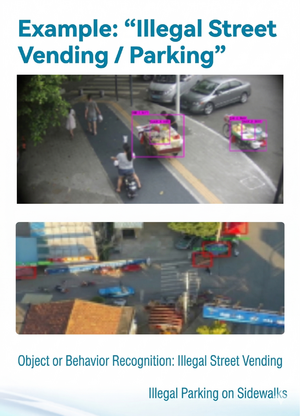
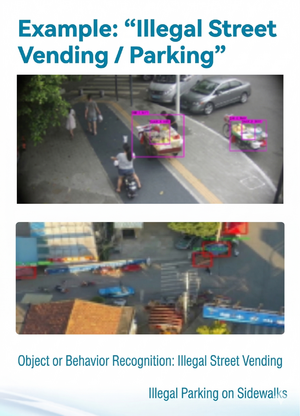
Currently, Huazhi Future’s AI system is helping local public security departments in certain cities monitor video footage 24/7, accurately identifying and flagging various violations. Whether it's illegal parking, improper bicycle parking, illegal outdoor advertisements, drying clothes on the street, or overflowing trash cans, the system can instantly recognize violations, issue alerts, and send work orders to nearby law enforcement.

This system no longer relies on traditional, human-monitored 'video surveillance', but a "visual + language model" multi-modal intelligent agent with logical reasoning and event classification capabilities.


In terms of public safety and security, Huazhi Future’s system is being applied to detect abnormal behavior in special scenarios: for example, identifying illegal gatherings or disruptive personnel near government buildings, detecting dangerous weapons near schools, or identifying intoxicated or fighting individuals near entertainment venues. The system can even issue early warnings of abnormal groupings of people involved in drug or sex-related activities.

These systems turn massive unstructured video data into structured intelligence on public safety and urban management, greatly improving the efficiency of grassroots governance for the government.

The key takeaway is that the B2G market isn’t about technology competition, but rather "credentials + relationships + project experience" as a combined barrier. Once a company enters the local government system, it gains a significant first-mover advantage and strong customer stickiness.

1775649730097.png


The Future AI Competition​

From ChatGPT, Gemini, and Claude to DeepSeek, Kimi, and Qwen, these are the well-known large models for consumer market. In the future, AI competition will clearly take on a tiered structure:

● The Consumer market determines the breadth of adoption.

● The Enterprise market/Government sector determines the depth of AI penetration into the real world and its potential to reshape national competitiveness.

And in this "deep water" space, what’s truly needed isn’t a super-powerful model but a set of secure, controllable, and deployable intelligent infrastructure. This is precisely the capability boundary MAAS is trying to build.

If we compare top-tier models like GPT to expensive "large computers," then Huazhi Future’s "Lingyan Miaoyu," a 7B secure model, is more like a "personal computer" deployed across thousands of industries, government departments, and even grassroots units.

AI’s first phase was a race for "capability limits," but the second phase will inevitably evolve into "engineering competition under cost and security constraints."

The models that will truly translate into tangible productivity and generate stable cash flow are not the smartest, but the most deployable.

Once you understand this, the significance of MAAS’s acquisition of Huazhi Future becomes crystal clear: they didn’t just acquire an experimental algorithmic capability, but a "security pass" to enter the government and enterprise market, along with a scalable, tested AI implementation system.


Reference:

1. The Small Model Revolution: When 7B Parameters Beat 70B - Stabilarity Hub

2. The Rise of Small LLMs: Why Companies Prefer 3B–7B Models in 2026

3. Transformer Architecture Explained (7B Parameters) | RAGyfied | RAGyfied

4. Small language models learn enhanced reasoning skills from medical textbooks
 

Attachments

  • 1775648150907.png
    1775648150907.png
    6.1 MB · Views: 4
  • 1775649424452.png
    1775649424452.png
    6.1 MB · Views: 4
Let me start with some background: I mainly focus on small- and mid-cap growth stocks, occasionally dabbling in options. Over the past two years, I made good money riding the AI wave, but since February this year, my account curve has looked even uglier than the Nasdaq. It’s not that my stock-picking skills suddenly deteriorated—it’s that the market’s underlying logic has changed, while I was still using an old map.

The last two months of trading have taught me three painful lessons: AI’s “efficiency curse,” the “TACO rule” for oil prices, and a little-known stock called MAAS. This isn’t a research report—just a casual chat about what I’ve learned from three months of losses.

1. AI’s “Efficiency Curse”: Why I’m Moving Away from Pure-Play Software Stocks

Let me start with a lesson that cost me 15%.

At the end of January 2026, ServiceNow, a leader in IT service management, reported what looked like a stellar quarter. Q4 revenue hit $3.57 billion, up 20.5% year-over-year, beating expectations of $3.53 billion; non-GAAP EPS was $0.92, also above the $0.87 estimate. The CEO touted the company’s AI platform, Now Assist, which doubled its annual contract value (ACV) to over $600 million. The AI story was compelling.

Yet the next morning, ServiceNow’s stock plunged nearly 10% to a 52-week low.

r/MAASstock - Trading note... when the market stops believing stories, I just want something tangible.

Why? Because the market no longer cares what you’ve already achieved—it only cares about what you can do next. ServiceNow guided for 18.5%–19% organic subscription revenue growth in 2026. In any normal year, that would be excellent. But at the time, ServiceNow traded at 79 times earnings—a valuation that had already priced in “AI-driven high growth.” And 18.5% growth wasn’t enough to support a 79x multiple.

That’s when I realized something I had overlooked: AI is fundamentally an “efficiency amplifier.” When everyone uses AI, your differentiation disappears. Writing one high-quality article a day used to be productive; now writing five a day is just meeting the baseline. This is Jevons’ paradox playing out in the business world: higher efficiency leads to more competition, squeezing profits.

Worse, ServiceNow’s crash triggered a chain reaction. Salesforce fell over 6% in a day, Adobe dropped nearly 4%, and the entire SaaS sector got dragged down. The market was sending a clear signal: investors are no longer willing to pay an infinite premium for “AI stories.” They want real cash flow generated by AI.

So now I’m cautious about pure-play AI software companies. They face three pressures:

Clients are also using AI, eroding service premiums.

Giants (Microsoft, Google) keep bundling AI features into their basic packages, making life hard for independent SaaS.

Massive capital expenditures lead to negative free cash flow.

I’ve started looking for assets that are immune to internal competition, positioned in the physical world, and have inelastic demand. In other words, I don’t want to buy companies that “help others become more efficient”—I want to buy the physical infrastructure that others must use to become efficient.

That’s how I first noticed MAAS—a company making mobile charging robots. At first glance, its business model seemed “clunky”: selling hardware, collecting service fees, building a charging network. But upon reflection, that clunkiness is exactly its moat. You can’t bypass the physical world with AI. Electricity must travel from point A to point B. Charging cables must be plugged into cars. Energy storage cabinets must occupy physical space. These “dirty, hard tasks” cannot be disrupted by software.

2. The TACO Rule: How I Use Oil Prices to Guide Position Sizing

The best decision I’ve made in the past two months wasn’t picking a stock—it was adjusting my overall exposure based on oil prices.

In early March, I noticed a strange pattern: every time WTI crude approached $100 per barrel, the market would bounce. Conversely, when oil prices fell, the index kept dropping. And the catalyst for the bounce was almost never an improvement in fundamentals—it was Trump suddenly “TACO-ing” (Trump Always Chickens Out) on social media, releasing dovish statements like “We don’t want a war” or “Iran can negotiate.”

At first, I thought it was coincidence. But after three consecutive occurrences, I back-tested and found a clear pattern:

Oil < $95: Trump turns hawkish, threatens Iran, index tops and falls → reduce or short.

$95–$98: Iran retaliates, index accelerates downward → stay short or watch.

$98–$100: Trump starts TACO-ing, index stabilizes → DCA long.

> $100: Aggressive TACO-ing, index rallies violently → go heavy long.

< $98: Pause, index chops and tops → take profits.

< $95: A new cycle begins → repeat step one.

Why is $100 so important? Because $100 oil ≈ $4/gallon gasoline, the psychological threshold for U.S. domestic politics. Above that line, voter discontent rises, inflation worsens, and stocks come under pressure. Trump may not care about many things, but he cares deeply about oil prices—because they directly affect his votes.

So now, I check two things daily: WTI oil prices and Trump’s Truth Social account. Whenever oil is in the $98–$100 range and he starts TACO-ing, I add positions. When oil falls below $95 and he turns hawkish, I reduce exposure.

This strategy helped me avoid the sharp sell-off in late March. I didn’t make big money, but I didn’t lose either.

Which raises the question: In this macro-chaotic environment, what kind of stocks are worth holding during rebounds?

My criteria are simple: immune to geopolitical noise, backed by physical assets, generating stable cash flow, and ideally benefiting from AI tailwinds. That’s why I eventually dug deeper into MAAS.

3. MAAS: A Mispriced “Physical Bottleneck” Asset

To be clear: I’m not recommending this stock, just sharing my own trading logic. Currently, MAAS is a “watch position” in my portfolio—less than 5%, but I’m gradually adding.

Technicals: A classic “bottom volume + breakout” pattern

r/MAASstock - Trading note... when the market stops believing stories, I just want something tangible.

Price range: Over the past three months, MAAS has oscillated between $5.4 and $6.4, forming a clear box. It closed at $5.90 on April 2.

Volume: After the March 30 announcement of acquiring Huazhi Future, volume surged for two consecutive days, jumping from ~10k shares to ~100k–200k shares per day. That’s a classic “news-driven + institutional money entering” signal.

Moving averages: The 10-day MA crossed above the 20-day MA, forming a “golden cross”—a short-term buy signal I personally value.

MACD: Currently below zero but forming a bullish crossover, with histogram turning positive. Likely to push above zero soon, suggesting more upside.

Support/resistance: First support at $5.4 (box bottom), second at $4.7 (previous platform). Resistance above at $6.4; if broken, next target is $6.95 (January 2026 high).

My trading plan: Accumulate in the $5.4–$5.9 range, stop-loss below $4.7, first target $6.4, second target $7.

Fundamentals: Why I think it’s mispriced

The market currently values MAAS as a “charging equipment manufacturer,” with a P/S of only 2–3x (based on 2026 expected revenue). But I believe its true identity is an “AI energy infrastructure platform,” where comparable companies trade at 10–20x P/S.

Three layers of logic:

Layer 1: It addresses the physical bottleneck of AI-powered energy replenishment—where fixed charging stations can never reach.

You might think a charging robot is just a small cart with a battery. Wrong. Its soul is AI.

A real pain point: In China, on average, 7.5 vehicles compete for one public charging pile. Old residential communities lack the electrical capacity to install piles; shopping mall charging spots are often ICEd; highway service areas see hours-long queues during holidays. These problems cannot be solved by software—you can’t increase grid capacity with code, nor can you magically remove parked cars with an algorithm.

But MAAS’s Xiaoli robot uses AI to solve these physical problems. Its “body” is a mobile charging device, but its “brain” is AI. It’s not hardware—it’s an AI application running in the physical world.

I classify it as a “physical bottleneck” asset because the job it does—moving electricity from where it exists to where it’s needed—is a physical necessity that AI cannot bypass. Yet the way it does that job is entirely AI-driven. This “hardware + software” integration creates a much deeper moat than pure software, because competitors cannot simply write code to replicate it.

Layer 2: Its business model is a three-stage rocket: “assets + service + network.”

Asset layer: Selling robots, one-time revenue. The foundation, but not exciting.

Service layer: Taking a cut from mobile charging transactions. Recurring revenue. The growth engine.

Network layer: Aggregating robots to participate in virtual power plants, capturing peak-valley price spreads and grid subsidies. The wild card.

I’m especially interested in the third layer. When thousands of robots are aggregated into a giant “battery pool” in the cloud, they can participate in grid frequency regulation, demand response, and even spot electricity markets. This isn’t a concept—it has been validated through cooperation cases with Shandong Expressway and Sinopec.

Layer 3: It has tangible assets as a safety net.

MAAS holds Zhongsen (111 acres of wild ginseng forest, 19,000 wild ginseng plants over 40 years old) and Kelai Kang (annual production capacity of 10 tons of bird’s nest peptide, over 50% global market share). These assets appreciate 15%–35% annually, independent of AI hype and immune to geopolitical risks.

In today’s environment of TACO whipsaws and oil volatility, this kind of “visible and tangible” asset is something I’m willing to hold—because at least it won’t go to zero overnight like some software stocks.

Catalyst: The acquisition of Huazhi Future completes the “AI brain”

On March 30, MAAS completed the acquisition of 100% of Huazhi Future. Huazhi has its own proprietary large language model (“Lingyan Miaoyu,” 7 billion parameters, registered with China’s Cyberspace Administration), a computing power scheduling platform, and a full suite of solutions covering smart cities, AI + energy, AI + finance, and more.

This means MAAS is no longer a “hardware company.” It now has full-stack, self-controlled AI capabilities—from underlying computing power to algorithmic models, from terminal devices to operational scenarios, forming a closed-loop ecosystem.

The market hasn’t priced this in nearly enough. After the acquisition announcement, the stock rose only about 10%, and while volume increased, it’s far from “explosive” levels. That tells me most investors haven’t yet recognized the strategic significance of this deal.

In my view, this looks a lot like PLTR in early 2023—the market valued it as a “government software contractor,” ignoring its AI platform value. PLTR later went from $7 to $60. Will MAAS repeat that? I don’t know, but it’s worth a bet.

4. Summary of a Few Trading Takeaways

I’m writing all this not to recommend MAAS, but to share what I’ve learned from three months of losses:

Don’t fight the efficiency curse. When everyone can use AI to become more efficient, the moats of pure-play software companies shrink. I prefer assets in the physical world that software cannot disrupt.

Macro variables matter more than stock-picking. Over the past two months, oil price swings have dominated the market far more than any individual stock’s fundamentals. I now check oil prices, Trump’s social media, and the VIX daily. These three indicators determine my overall exposure—not individual stock picks.

“Cognitive gap” is the biggest source of alpha. MAAS is currently misclassified as a “hardware stock,” but its real identity is an “AI energy infrastructure platform.” When most investors haven’t yet recognized that gap, it’s the best time to position.

Don’t be afraid of “uncool.” Mobile charging robots may not sound as sexy as large language models, but they are indispensable physical infrastructure for AI deployment. In a gold rush, the shovel sellers often make steadier money than the miners.

In choppy markets, technical analysis often beats fundamentals. When macro uncertainty is high, earnings and guidance frequently fail. But support, resistance, volume, moving averages—these “market action” data points better reflect fund flows. MAAS’s box breakout, volume surge, and golden cross were my direct reasons to add, not its forward P/E.

Finally, to quote a cliché: When the tide goes out, those swimming naked are exposed, but those wearing armor will go much farther.

I now only buy assets that are “visible, tangible, and indispensable.” MAAS is one of them.
 
Back
Top