Daily Market Analytics - Forex

USDCHF Technical Analysis – 15th APR, 2026
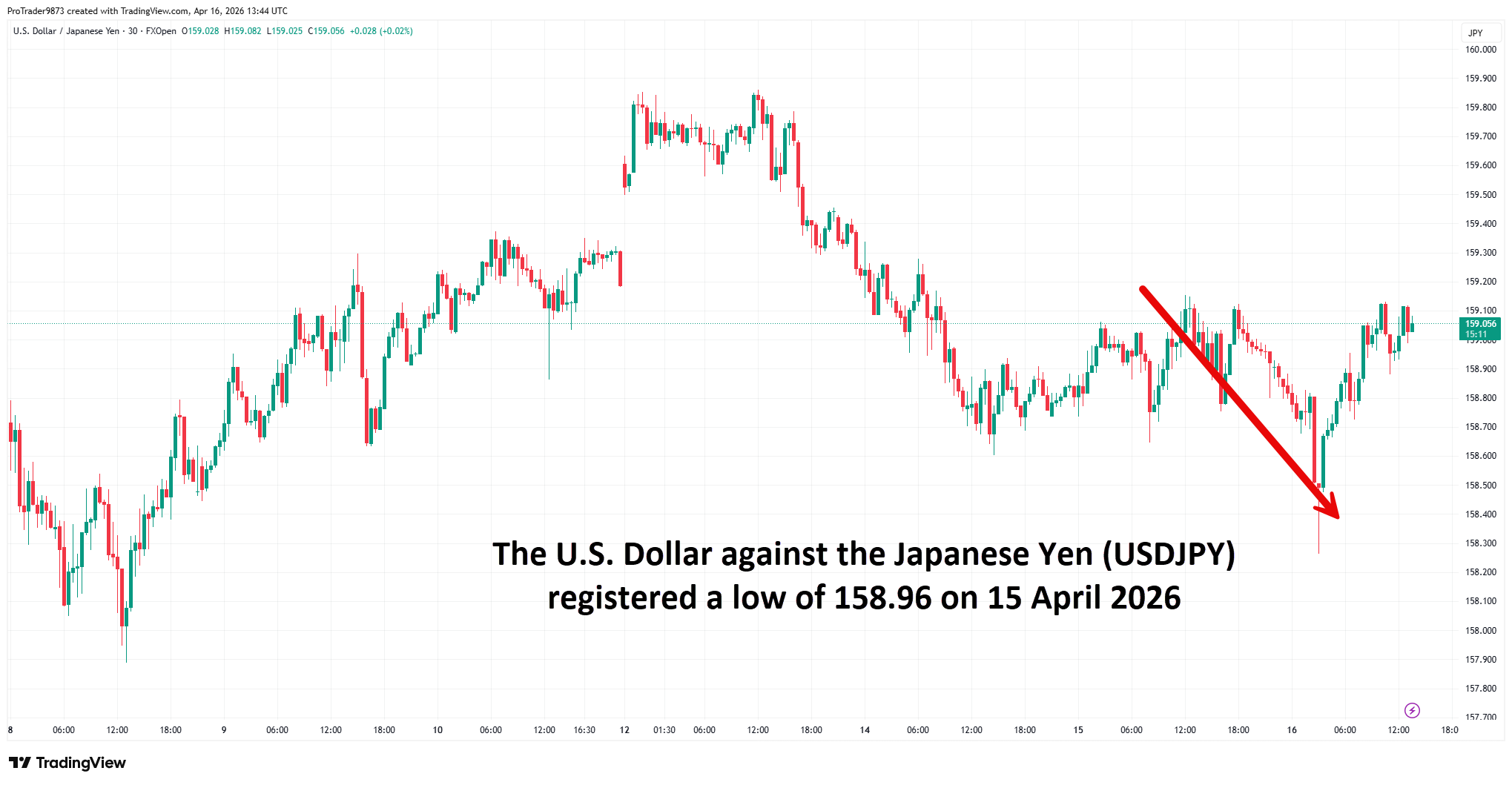
USDJPY - The U.S. Dollar against the Japanese Yen (USDJPY) registered a low of 158.96 on 15 April 2026
EsbGA7aP_o.png


USDJPY Technical Analysis – 15 April 2026

Multi Timeframe Overview

The U.S. Dollar against the Japanese Yen (USDJPY) registered a low of 158.96 on 15 April 2026, marking a corrective phase within a broader bullish trend. On the daily chart, the pair has retreated from highs near 161.00, with the latest dip testing the lower boundary of the short term consolidation zone. On the weekly timeframe, USDJPY remains in a strong uptrend, supported by higher lows since late 2025, though the recent pullback highlights profit taking and temporary Yen strength.

Trend Structure
Despite the decline to 158.96, the broader structure remains bullish. The drop represents a corrective retracement within the ascending channel, with medium term support holding near 159.00. As long as USDJPY sustains above this level, the bullish bias remains intact. A recovery above 160.50 would confirm renewed upside momentum, while a failure to hold above 158.50 could expose deeper retracement toward 157.20.

Momentum Indicators
• Relative Strength Index (RSI – Daily): Currently at 44, reflecting weakened momentum but not yet oversold. This suggests room for further downside before exhaustion.
• MACD (Daily): The MACD line has crossed below the signal line, with negative histogram bars expanding, confirming short term bearish momentum.
• Stochastic Oscillator: Approaching oversold territory, indicating potential for a corrective rebound if sellers lose steam.

Support and Resistance Levels
• Immediate Support: 158.96 (recent low)
• Secondary Support: 158.50 (channel base and psychological level)
• Immediate Resistance: 160.00 (short term pivot)
• Key Resistance: 160.50 (former swing high)
• Major Resistance: 161.00 (multi month peak and channel top)

Scenario Implications
• Bearish Case: A sustained break below 158.96 would expose 158.50, with extended downside risk toward 157.20 if Yen strength persists.
• Bullish Case: A rebound above 160.00 could trigger upside toward 160.50, with extended targets at 161.00 if momentum returns.
• Neutral Case: Consolidation between 158.96–160.00 is possible if traders await clarity from U.S. inflation data or Bank of Japan policy signals.

Macro Considerations
USDJPY’s trajectory remains heavily influenced by monetary policy divergence. The Federal Reserve’s hawkish stance supports Dollar strength, while the Bank of Japan’s continued ultra loose policy keeps the Yen under pressure. However, temporary safe haven demand for the Yen amid global uncertainties has contributed to the recent pullback. Unless risk sentiment deteriorates further, USDJPY is likely to resume its upward trajectory once corrective pressures ease.

Conclusion
USDJPY’s dip to 158.96 highlights a corrective phase within a broader bullish trend. The immediate focus is on whether the pair can hold above this low; failure would open the path toward 158.50–157.20, while resilience could set the stage for a rebound toward 160.00–160.50. Despite short term weakness, the medium term technical and macro backdrop continues to favour upside, with the correction offering potential entry opportunities for trend aligned traders.

#fxopen #forex #forexanalysis

Disclaimer: This analysis represents my own opinion only. It is not to be construed as an opinion, offer, solicitation, recommendation, or financial advice of the Companies operating under the FXOpen brand.

For in-depth analysis, please check ...
 
AUDUSD Technical Analysis – 16th APR, 2026
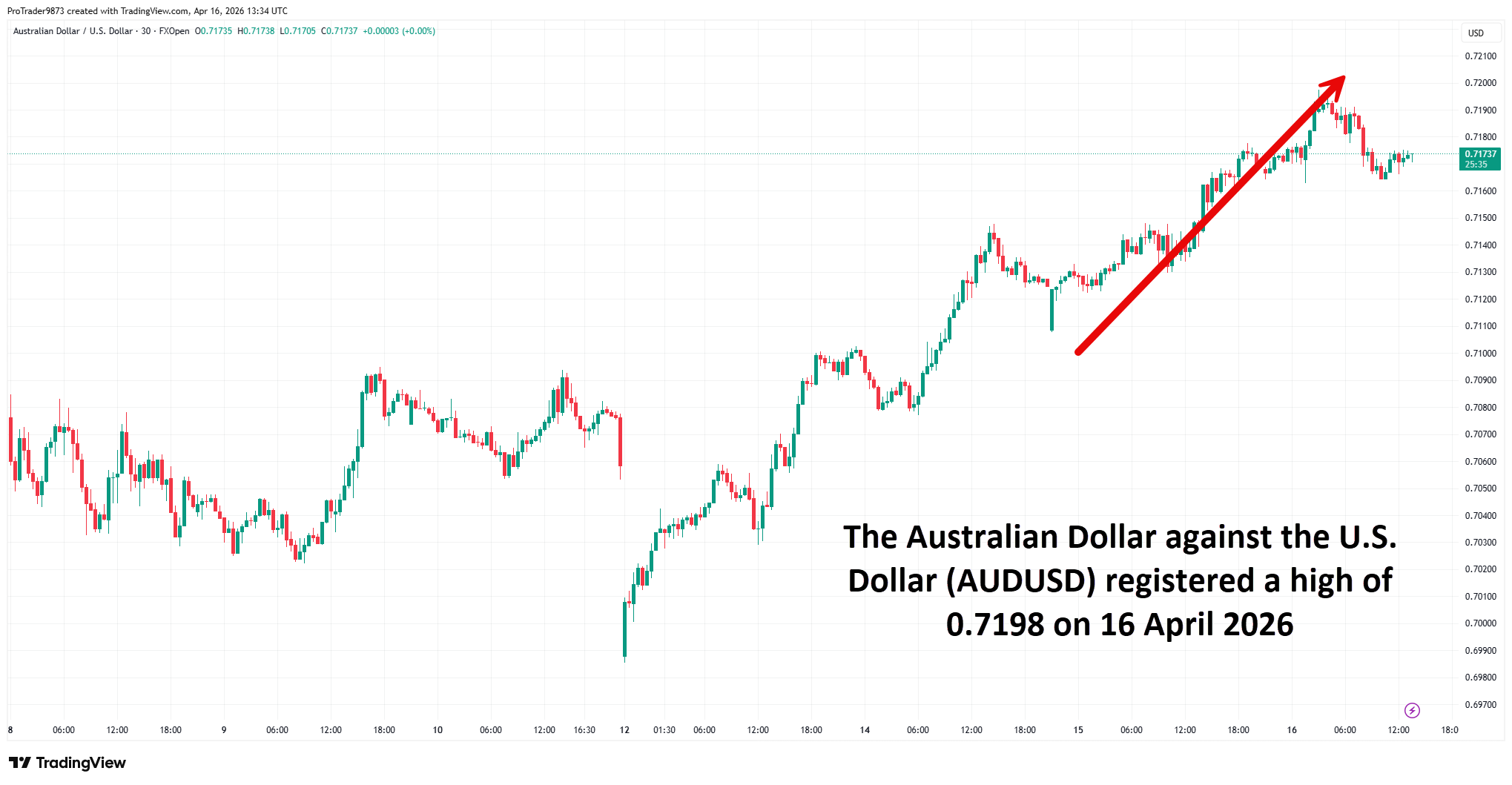
AUDUSD – The Australian Dollar against the U.S. Dollar (AUDUSD) registered a high of 0.7198 on 16 April 2026

mLF3uEN2_o.png


AUDUSD Technical Analysis – 16 April 2026

Multi Timeframe Overview

The Australian Dollar against the U.S. Dollar (AUDUSD) registered a high of 0.7198 on 16 April 2026, extending its upward momentum from the prior session’s peak at 0.7177. On the daily chart, the pair has continued its recovery from March lows near 0.6980, with price action now pressing against the upper boundary of the medium term consolidation zone. On the weekly timeframe, AUDUSD remains in a corrective phase but is showing signs of strength, with buyers attempting to reclaim control above the 0.7150–0.7200 resistance band.

Trend Structure
The prevailing structure is bullish in the short term. The 0.7198 high represents a fresh breakout attempt above the prior ceiling, confirming buyers’ willingness to extend gains. The medium term ascending channel remains intact, with the upper boundary projected near 0.7250–0.7300. As long as AUDUSD holds above 0.7150, the bullish bias remains dominant. A failure to sustain above this level, however, could trigger profit taking and a retracement toward 0.7100.

Momentum Indicators
• Relative Strength Index (RSI – Daily): Currently at 66, showing strong bullish momentum but approaching overbought territory. This suggests upside potential remains, though caution is warranted.
• MACD (Daily): The MACD line remains above the signal line, with positive histogram bars expanding, confirming bullish continuation.
• Stochastic Oscillator: Nearing overbought territory, indicating that while the trend is strong, a corrective pause could emerge before further upside.

Support and Resistance Levels
• Immediate Resistance: 0.7198 (recent high)
• Secondary Resistance: 0.7250 (psychological barrier and Fibonacci 61.8% retracement of Jan–Mar decline)
• Immediate Support: 0.7150 (short term pivot)
• Key Support: 0.7100 (trendline support and 20 day moving average)
• Major Support: 0.7050 (March swing low and 50 day moving average)

Scenario Implications
• Bullish Case: A decisive close above 0.7198 would open the path toward 0.7250, with extended upside potential toward 0.7300 if momentum persists.
• Bearish Case: Failure to sustain above 0.7150 may invite selling pressure, dragging the pair back toward 0.7100. A break below 0.7050 would shift the medium term outlook bearish, exposing 0.6980.
• Neutral Case: Consolidation between 0.7150–0.7198 is likely if traders await clarity on U.S. inflation data and Reserve Bank of Australia policy signals.

Macro Considerations
AUDUSD remains sensitive to global risk appetite and commodity demand. Recent stabilization in equity markets and firming commodity prices have supported the Aussie, but U.S. Dollar strength tied to Federal Reserve rate expectations continues to cap upside. The balance between New Zealand’s trade outlook and U.S. yields will dictate whether AUDUSD can break decisively above the 0.7200–0.7250 ceiling.

Conclusion
AUDUSD’s test of 0.7198 highlights a pivotal juncture. The pair is biased upward in the short term, but momentum indicators suggest caution as resistance looms. Traders should monitor 0.7150 support for signs of resilience; holding above this level keeps the bullish narrative intact, while a breakdown would shift focus back toward 0.7100–0.7050. The coming sessions will determine whether AUDUSD transitions into a sustained bullish breakout or reverts to range bound consolidation.

#fxopen #forex #forexanalysis

Disclaimer: This analysis represents my own opinion only. It is not to be construed as an opinion, offer, solicitation, recommendation, or financial advice of the Companies operating under the FXOpen brand.

For in-depth analysis, please check ...
 
EURCHF Technical Analysis – 16th APR, 2026
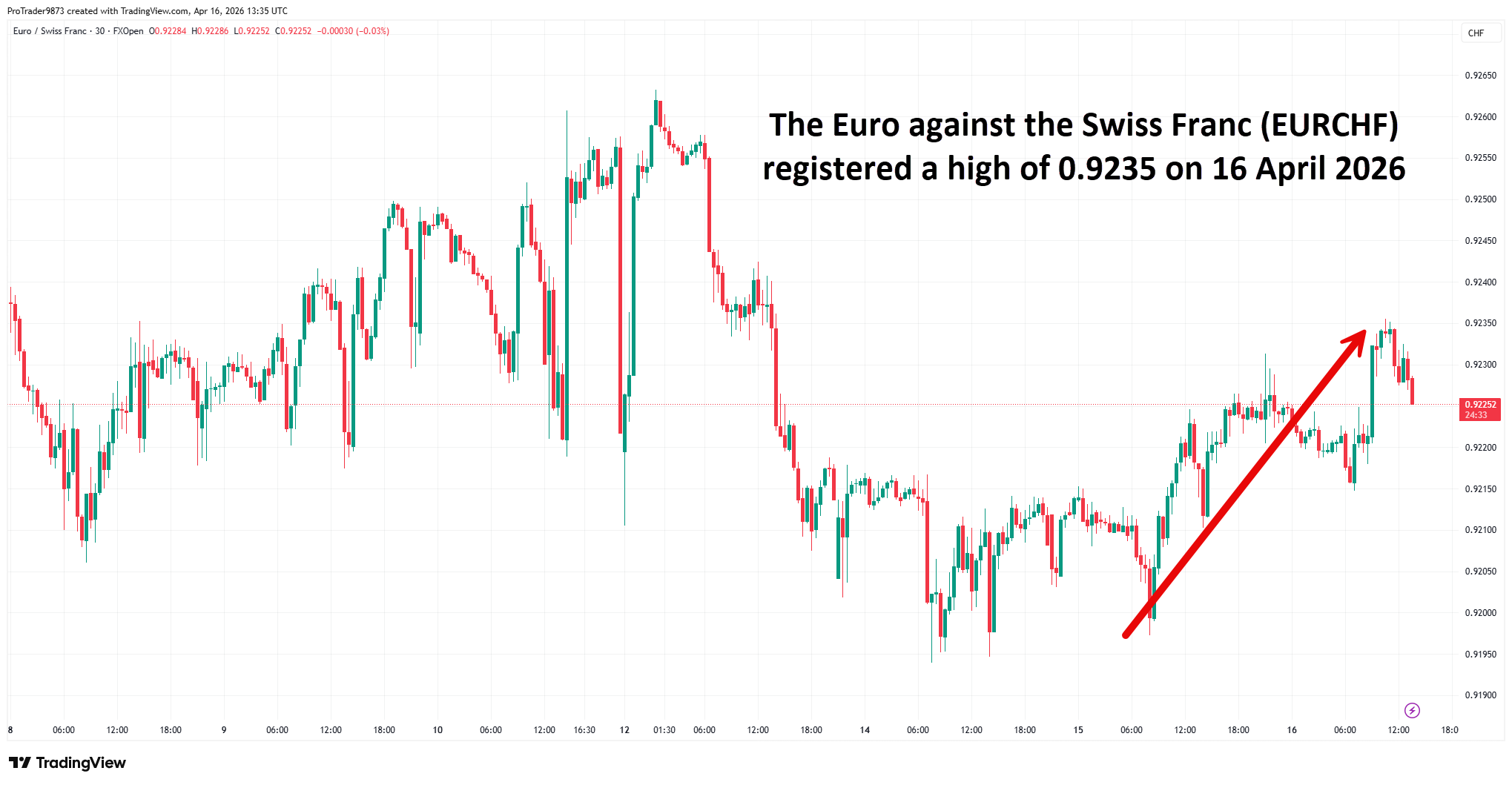
EURCHF – The Euro against the Swiss Franc (EURCHF) registered a high of 0.9235 on 16 April 2026

zNFVusUE_o.png


EURCHF Technical Analysis – 16 April 2026

Multi Timeframe Overview

The Euro against the Swiss Franc (EURCHF) registered a high of 0.9235 on 16 April 2026, marking a rebound from the prior session’s weakness where the pair tested lows near 0.9197. On the daily chart, the pair has staged a corrective rally, pushing back above the 0.9220 pivot zone and attempting to reclaim short term momentum. On the weekly timeframe, EURCHF remains in a broader downtrend, but the latest bounce highlights buyers’ efforts to stabilize the cross after persistent selling pressure.

Trend Structure
The prevailing structure is cautiously bullish in the short term but still bearish in the medium term. The 0.9235 high represents a test of resistance within the descending channel. A sustained break above 0.9250 would confirm bullish continuation toward 0.9300, while failure to hold above 0.9220 could trigger renewed selling pressure. The broader trendline resistance near 0.9300 remains the key level to watch for a potential shift in sentiment.

Momentum Indicators
• Relative Strength Index (RSI – Daily): Currently at 48, showing neutral momentum after recovering from oversold conditions. This suggests room for further upside if buyers maintain control.
• MACD (Daily): The MACD line is attempting to cross above the signal line, with histogram bars flattening, indicating early signs of bullish momentum.
• Stochastic Oscillator: Rising from oversold territory, suggesting that corrective upside may continue in the near term.

Support and Resistance Levels
• Immediate Resistance: 0.9235 (recent high)
• Secondary Resistance: 0.9250 (psychological barrier and former support turned resistance)
• Immediate Support: 0.9220 (short term pivot)
• Key Support: 0.9197 (prior session low)
• Major Support: 0.9150 (channel base and psychological level)

Scenario Implications
• Bullish Case: A decisive close above 0.9235–0.9250 would open the path toward 0.9300, with extended upside potential toward 0.9350 if momentum persists.
• Bearish Case: Failure to sustain above 0.9220 may invite selling pressure, dragging the pair back toward 0.9197. A break below 0.9150 would shift the medium term outlook bearish, exposing 0.9100.
• Neutral Case: Consolidation between 0.9197–0.9235 is likely if traders await clarity on Eurozone inflation data and Swiss National Bank policy signals.

Macro Considerations
EURCHF remains highly sensitive to risk sentiment and central bank divergence. The Swiss Franc continues to attract safe haven demand amid geopolitical uncertainties and subdued Eurozone growth. Meanwhile, the European Central Bank’s cautious stance on rate adjustments contrasts with the SNB’s commitment to currency stability, reinforcing downside pressure on the pair. The latest rebound reflects short term profit taking on Franc strength rather than a decisive shift in trend.

Conclusion
EURCHF’s rally to 0.9235 highlights a corrective phase within a broader bearish trend. The immediate focus is on whether the pair can sustain above this high; success would pave the way toward 0.9250–0.9300, while failure could invite a pullback toward 0.9197–0.9150. Despite short term recovery, the medium term technical and macro backdrop continues to favour downside, with rallies likely to be capped unless Eurozone fundamentals improve significantly.

#fxopen #forex #forexanalysis

Disclaimer: This analysis represents my own opinion only. It is not to be construed as an opinion, offer, solicitation, recommendation, or financial advice of the Companies operating under the FXOpen brand.

For in-depth analysis, please check ...
 
EURJPY Technical Analysis – 16th APR, 2026
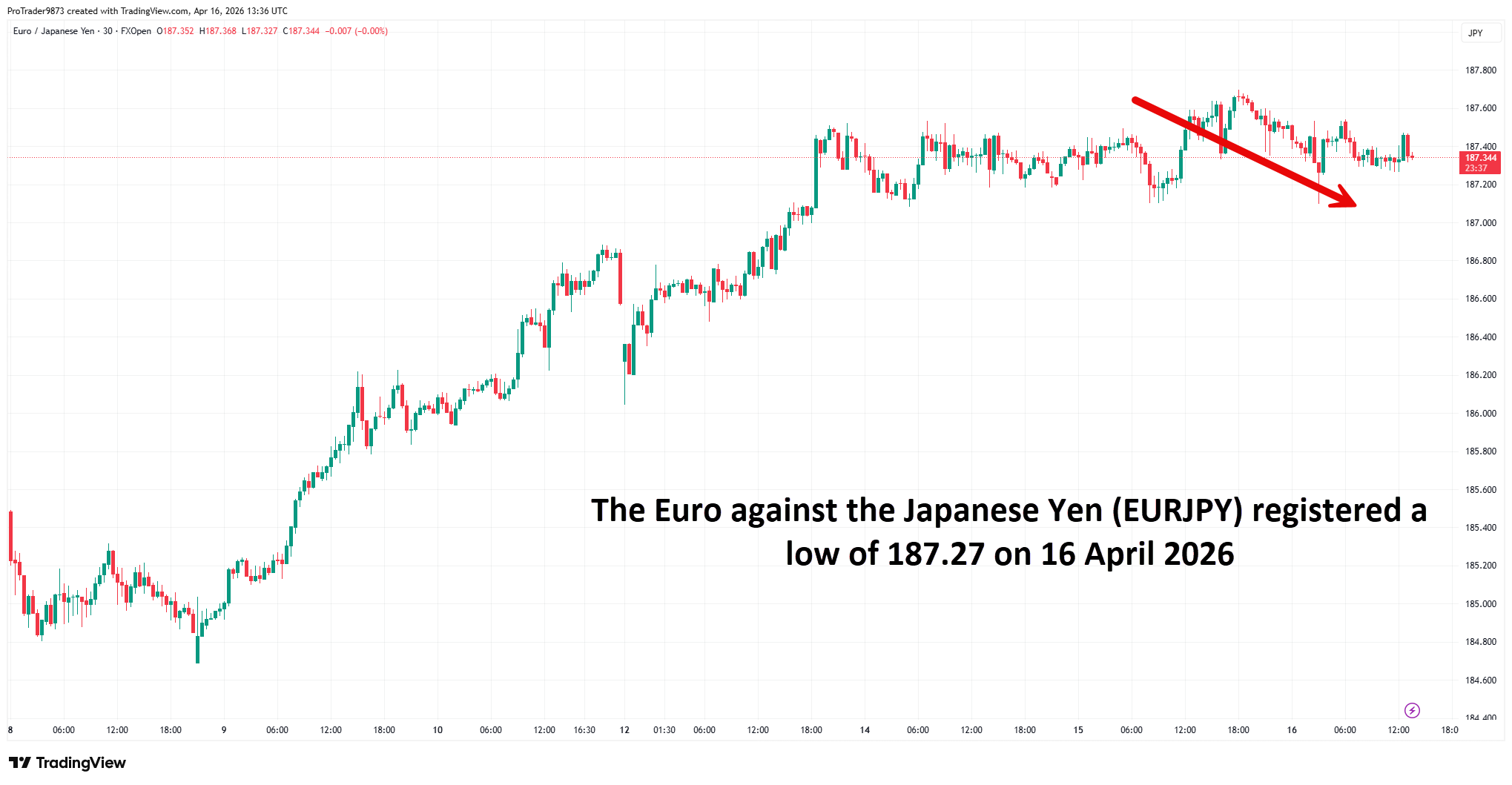
EURJPY – The Euro against the Japanese Yen (EURJPY) registered a low of 187.27 on 16 April 2026

yWrX6NhC_o.png


EURJPY Technical Analysis – 16 April 2026

Multi Timeframe Overview

The Euro against the Japanese Yen (EURJPY) registered a low of 187.27 on 16 April 2026, marking a corrective pullback within a broader bullish trend. On the daily chart, the pair has retreated from highs near 187.69 seen the prior session, with the latest dip testing the lower boundary of the short term consolidation zone. On the weekly timeframe, EURJPY remains firmly in an uptrend, supported by higher lows since late 2025, though the recent decline highlights profit taking and temporary Yen strength.

Trend Structure
Despite the drop to 187.27, the broader structure remains bullish. The decline represents a corrective retracement within the ascending channel, with medium term support holding near 187.00. As long as EURJPY sustains above this level, the bullish bias remains intact. A recovery above 188.00 would confirm renewed upside momentum, while a failure to hold above 187.00 could expose deeper retracement toward 185.80.

Momentum Indicators
• Relative Strength Index (RSI – Daily): Currently at 46, reflecting weakened momentum but not yet oversold. This suggests room for further downside before exhaustion.
• MACD (Daily): The MACD line has crossed below the signal line, with negative histogram bars expanding, confirming short term bearish momentum.
• Stochastic Oscillator: Approaching oversold territory, indicating potential for a corrective rebound if sellers lose steam.

Support and Resistance Levels
• Immediate Support: 187.27 (recent low)
• Secondary Support: 187.00 (channel base and psychological level)
• Immediate Resistance: 188.00 (short term pivot)
• Key Resistance: 188.50 (former swing high)
• Major Resistance: 189.00 (multi month peak and channel top)

Scenario Implications
• Bearish Case: A sustained break below 187.27–187.00 would expose 185.80, with extended downside risk toward 184.50 if Yen strength persists.
• Bullish Case: A rebound above 188.00 could trigger upside toward 188.50, with extended targets at 189.00 if momentum returns.
• Neutral Case: Consolidation between 187.27–188.00 is possible if traders await clarity from Eurozone economic data or Bank of Japan policy signals.

Macro Considerations
EURJPY’s trajectory remains heavily influenced by monetary policy divergence. The European Central Bank’s cautious but steady stance supports the Euro, while the Bank of Japan’s continued ultra loose policy keeps the Yen under pressure. However, temporary safe haven demand for the Yen amid global uncertainties has contributed to the recent pullback. Unless risk sentiment deteriorates further, EURJPY is likely to resume its upward trajectory once corrective pressures ease.

Conclusion
EURJPY’s dip to 187.27 highlights a corrective phase within a broader bullish trend. The immediate focus is on whether the pair can hold above this low; failure would open the path toward 185.80–184.50, while resilience could set the stage for a rebound toward 188.00–188.50. Despite short term weakness, the medium term technical and macro backdrop continues to favour upside, with the correction offering potential entry opportunities for trend aligned traders.

#fxopen #forex #forexanalysis

Disclaimer: This analysis represents my own opinion only. It is not to be construed as an opinion, offer, solicitation, recommendation, or financial advice of the Companies operating under the FXOpen brand.

For in-depth analysis, please check ...
 
EURUSD Technical Analysis – 16th APR, 2026
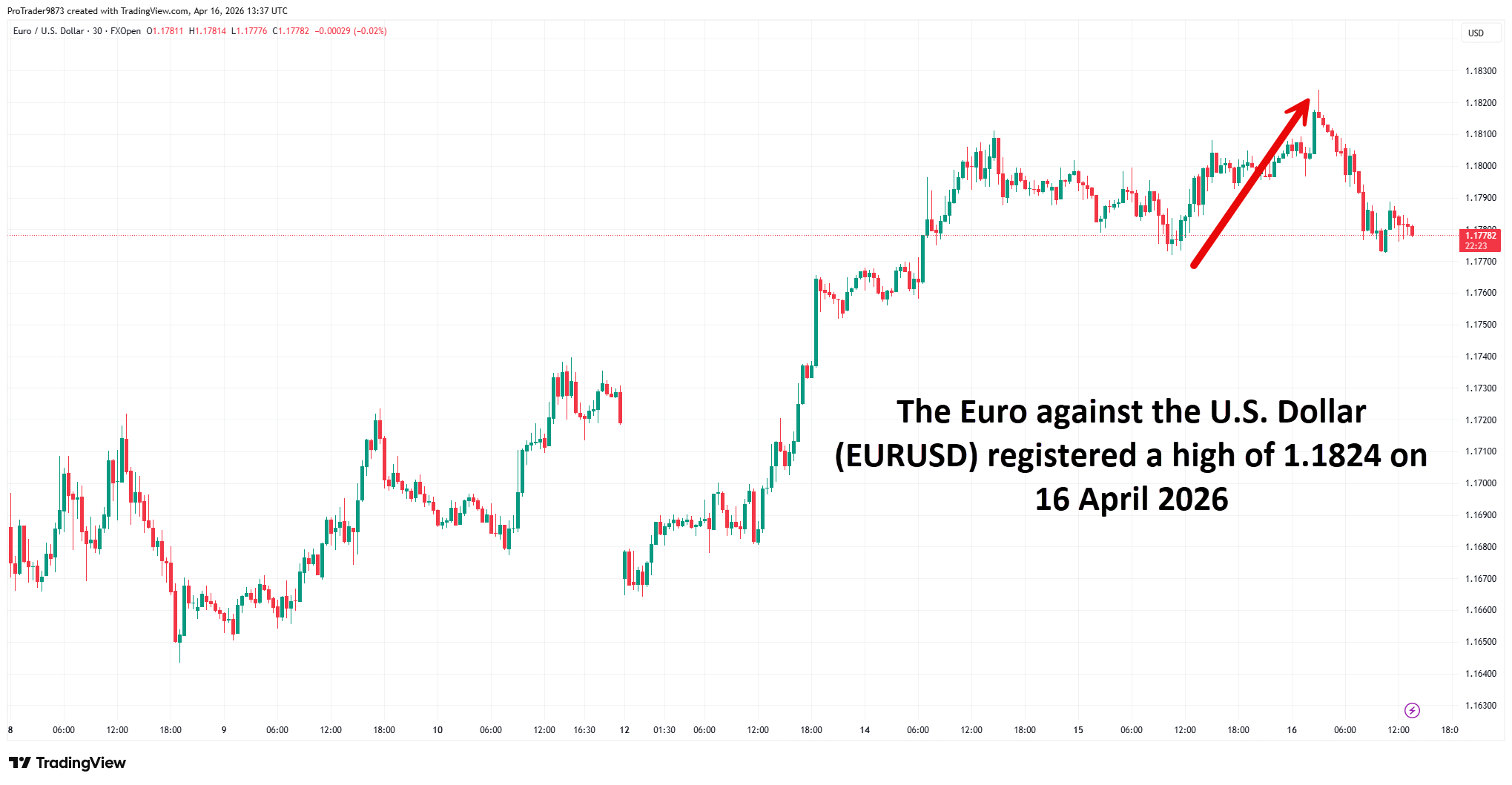
EURUSD – The Euro against the U.S. Dollar (EURUSD) registered a high of 1.1824 on 16 April 2026

7bikljT5_o.png


EURUSD Technical Analysis – 16 April 2026

Multi Timeframe Overview

The Euro against the U.S. Dollar (EURUSD) registered a high of 1.1824 on 16 April 2026, marking a rebound from the prior session’s weakness where the pair tested lows near 1.1772. On the daily chart, the pair has staged a corrective rally, pushing back above the 1.1800 pivot zone and attempting to reclaim short term momentum. On the weekly timeframe, EURUSD remains in a corrective downtrend, but the latest bounce highlights buyers’ efforts to stabilize the cross after persistent Dollar strength.

Trend Structure
The prevailing structure is cautiously bullish in the short term but still bearish in the medium term. The 1.1824 high represents a test of resistance within the descending channel. A sustained break above 1.1850 would confirm bullish continuation toward 1.1900, while failure to hold above 1.1800 could trigger renewed selling pressure. The broader trendline resistance near 1.1900 remains the key level to watch for a potential shift in sentiment.

Momentum Indicators
• Relative Strength Index (RSI – Daily): Currently at 52, showing neutral momentum after recovering from oversold conditions. This suggests room for further upside if buyers maintain control.
• MACD (Daily): The MACD line is attempting to cross above the signal line, with histogram bars flattening, indicating early signs of bullish momentum.
• Stochastic Oscillator: Rising from oversold territory, suggesting that corrective upside may continue in the near term.

Support and Resistance Levels
• Immediate Resistance: 1.1824 (recent high)
• Secondary Resistance: 1.1850 (psychological barrier and former support turned resistance)
• Immediate Support: 1.1800 (short term pivot)
• Key Support: 1.1772 (prior session low)
• Major Support: 1.1720 (channel base and psychological level)

Scenario Implications
• Bullish Case: A decisive close above 1.1824–1.1850 would open the path toward 1.1900, with extended upside potential toward 1.1950 if momentum persists.
• Bearish Case: Failure to sustain above 1.1800 may invite selling pressure, dragging the pair back toward 1.1772. A break below 1.1720 would shift the medium term outlook bearish, exposing 1.1650.
• Neutral Case: Consolidation between 1.1772–1.1824 is likely if traders await clarity on Eurozone inflation data and U.S. Federal Reserve policy signals.

Macro Considerations
EURUSD remains highly sensitive to monetary policy divergence. The Federal Reserve’s hawkish stance, supported by resilient U.S. economic data, continues to underpin Dollar strength. Meanwhile, the European Central Bank’s cautious approach and weaker Eurozone growth outlook weigh on the Euro. The latest rebound reflects short term profit taking on Dollar strength rather than a decisive shift in trend.

Conclusion
EURUSD’s rally to 1.1824 highlights a corrective phase within a broader bearish trend. The immediate focus is on whether the pair can sustain above this high; success would pave the way toward 1.1850–1.1900, while failure could invite a pullback toward 1.1772–1.1720. Despite short term recovery, the medium term technical and macro backdrop continues to favour downside, with rallies likely to be capped unless Eurozone fundamentals improve significantly.

#fxopen #forex #forexanalysis

Disclaimer: This analysis represents my own opinion only. It is not to be construed as an opinion, offer, solicitation, recommendation, or financial advice of the Companies operating under the FXOpen brand.

For in-depth analysis, please check ...
 
GBPJPY Technical Analysis – 16th APR, 2026
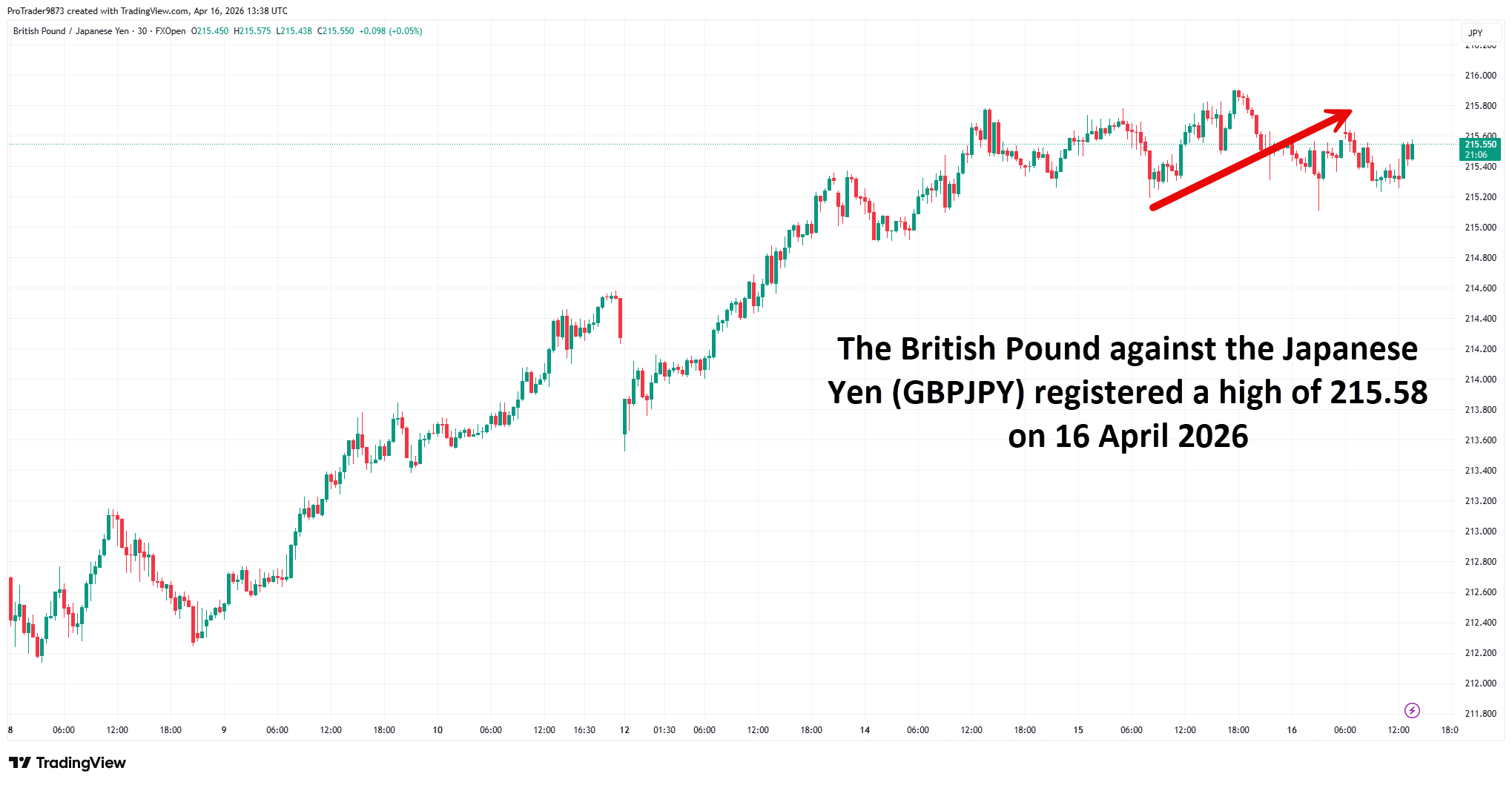
GBPJPY – The British Pound against the Japanese Yen (GBPJPY) registered a high of 215.58 on 16 April 2026

vYNY9LF6_o.png


GBPJPY Technical Analysis – 16 April 2026

Multi Timeframe Overview

The British Pound against the Japanese Yen (GBPJPY) registered a high of 215.58 on 16 April 2026, extending its bullish momentum after rebounding from the prior session’s corrective low at 215.19. On the daily chart, the pair has resumed its upward trajectory, pushing back toward the upper boundary of the short term consolidation zone. On the weekly timeframe, GBPJPY remains firmly in an uptrend, supported by higher lows since late 2025, with the latest rally reinforcing Sterling’s strength against the Yen.

Trend Structure
The prevailing structure is bullish. The 215.58 high represents a continuation of the broader rally, with price action pressing against the upper boundary of the ascending channel. A sustained break above 216.00 would confirm bullish continuation toward 217.50, while failure to hold above 215.00 could trigger renewed selling pressure. The medium term trendline support near 214.50 remains the key level to watch for downside protection.

Momentum Indicators
• Relative Strength Index (RSI – Daily): Currently at 63, showing strong bullish momentum but not yet overbought. This suggests upside potential remains, though caution is warranted.
• MACD (Daily): The MACD line remains above the signal line, with positive histogram bars expanding, confirming bullish continuation.
• Stochastic Oscillator: Rising toward overbought territory, indicating that while the trend is strong, a corrective pause could emerge before further upside.

Support and Resistance Levels
• Immediate Resistance: 215.58 (recent high)
• Secondary Resistance: 216.00 (psychological barrier and channel top)
• Immediate Support: 215.00 (short term pivot)
• Key Support: 214.50 (trendline support and 20 day moving average)
• Major Support: 213.50 (March swing low and 50 day moving average)

Scenario Implications
• Bullish Case: A decisive close above 215.58–216.00 would open the path toward 217.50, with extended upside potential toward 218.80 if momentum persists.
• Bearish Case: Failure to sustain above 215.00 may invite selling pressure, dragging the pair back toward 214.50. A break below 213.50 would shift the medium term outlook bearish, exposing 212.00.
• Neutral Case: Consolidation between 215.00–215.58 is likely if traders await clarity on U.K. inflation data and Bank of Japan policy signals.

Macro Considerations
GBPJPY’s strength is underpinned by monetary policy divergence. The Bank of England’s relatively hawkish stance supports Sterling, while the Bank of Japan’s continued ultra loose policy keeps the Yen under pressure. However, temporary safe haven demand for the Yen amid global uncertainties has contributed to short term volatility. Unless risk sentiment deteriorates further, GBPJPY is likely to maintain its upward trajectory once corrective pressures ease.

Conclusion
GBPJPY’s rally to 215.58 underscores the dominance of bullish momentum and policy divergence favouring Sterling. The immediate focus is on whether the pair can sustain above this high; success would pave the way toward 217.50–218.80, while failure could invite a pullback toward 215.00–214.50. Despite near term caution, the medium term technical and macro backdrop continues to favour upside, with corrections offering potential entry opportunities for trend aligned traders.

#fxopen #forex #forexanalysis

Disclaimer: This analysis represents my own opinion only. It is not to be construed as an opinion, offer, solicitation, recommendation, or financial advice of the Companies operating under the FXOpen brand.

For in-depth analysis, please check ...
 
GBPUSD Technical Analysis – 16th APR, 2026
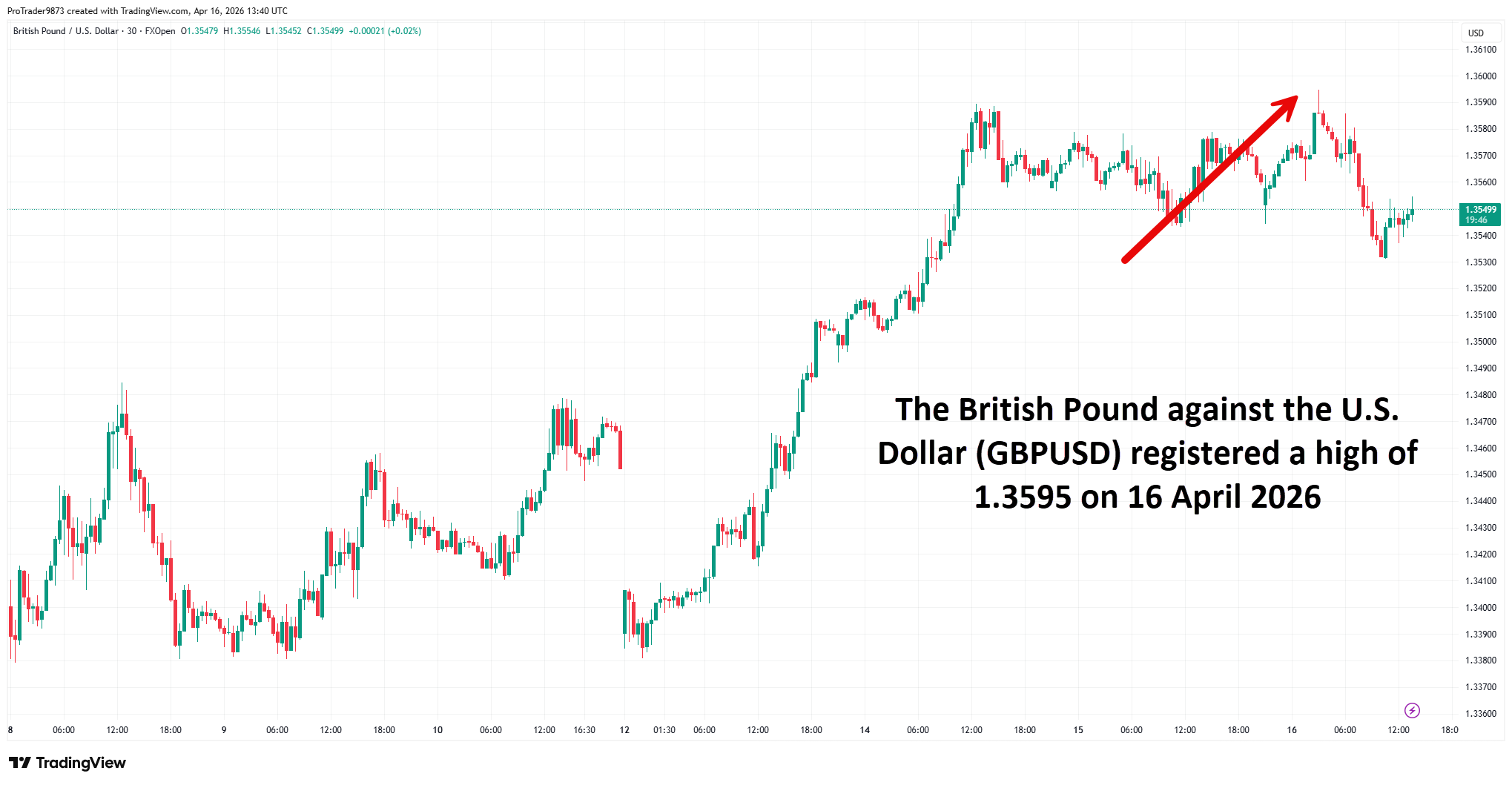
GBPUSD – The British Pound against the U.S. Dollar (GBPUSD) registered a high of 1.3595 on 16 April 2026

SG7Rwr4k_o.png


GBPUSD Technical Analysis – 16 April 2026

Multi Timeframe Overview

The British Pound against the U.S. Dollar (GBPUSD) registered a high of 1.3595 on 16 April 2026, marking a rebound from the prior session’s weakness where the pair tested lows near 1.3542. On the daily chart, the pair has staged a corrective rally, pushing back above the 1.3575 pivot zone and attempting to reclaim short term momentum. On the weekly timeframe, GBPUSD remains in a corrective downtrend, but the latest bounce highlights buyers’ efforts to stabilize Sterling after persistent Dollar strength.

Trend Structure
The prevailing structure is cautiously bullish in the short term but still bearish in the medium term. The 1.3595 high represents a test of resistance within the descending channel. A sustained break above 1.3600 would confirm bullish continuation toward 1.3650, while failure to hold above 1.3575 could trigger renewed selling pressure. The broader trendline resistance near 1.3650 remains the key level to watch for a potential shift in sentiment.

Momentum Indicators
• Relative Strength Index (RSI – Daily): Currently at 51, showing neutral momentum after recovering from oversold conditions. This suggests room for further upside if buyers maintain control.
• MACD (Daily): The MACD line is attempting to cross above the signal line, with histogram bars flattening, indicating early signs of bullish momentum.
• Stochastic Oscillator: Rising from oversold territory, suggesting that corrective upside may continue in the near term.

Support and Resistance Levels
• Immediate Resistance: 1.3595 (recent high)
• Secondary Resistance: 1.3600 (psychological barrier and former support turned resistance)
• Immediate Support: 1.3575 (short term pivot)
• Key Support: 1.3542 (prior session low)
• Major Support: 1.3500 (channel base and psychological level)

Scenario Implications
• Bullish Case: A decisive close above 1.3595–1.3600 would open the path toward 1.3650, with extended upside potential toward 1.3700 if momentum persists.
• Bearish Case: Failure to sustain above 1.3575 may invite selling pressure, dragging the pair back toward 1.3542. A break below 1.3500 would shift the medium term outlook bearish, exposing 1.3450.
• Neutral Case: Consolidation between 1.3542–1.3595 is likely if traders await clarity on U.K. inflation data and U.S. Federal Reserve policy signals.

Macro Considerations
GBPUSD remains highly sensitive to monetary policy divergence. The Federal Reserve’s hawkish stance, supported by resilient U.S. economic data, continues to underpin Dollar strength. Meanwhile, the Bank of England’s cautious approach and weaker U.K. growth outlook weigh on Sterling. The latest rebound reflects short term profit taking on Dollar strength rather than a decisive shift in trend.

Conclusion
GBPUSD’s rally to 1.3595 highlights a corrective phase within a broader bearish trend. The immediate focus is on whether the pair can sustain above this high; success would pave the way toward 1.3650–1.3700, while failure could invite a pullback toward 1.3575–1.3542. Despite short term recovery, the medium term technical and macro backdrop continues to favour downside, with rallies likely to be capped unless U.K. fundamentals improve significantly.

#fxopen #forex #forexanalysis

Disclaimer: This analysis represents my own opinion only. It is not to be construed as an opinion, offer, solicitation, recommendation, or financial advice of the Companies operating under the FXOpen brand.

For in-depth analysis, please check ...
 
NZDUSD Technical Analysis – 16th APR, 2026
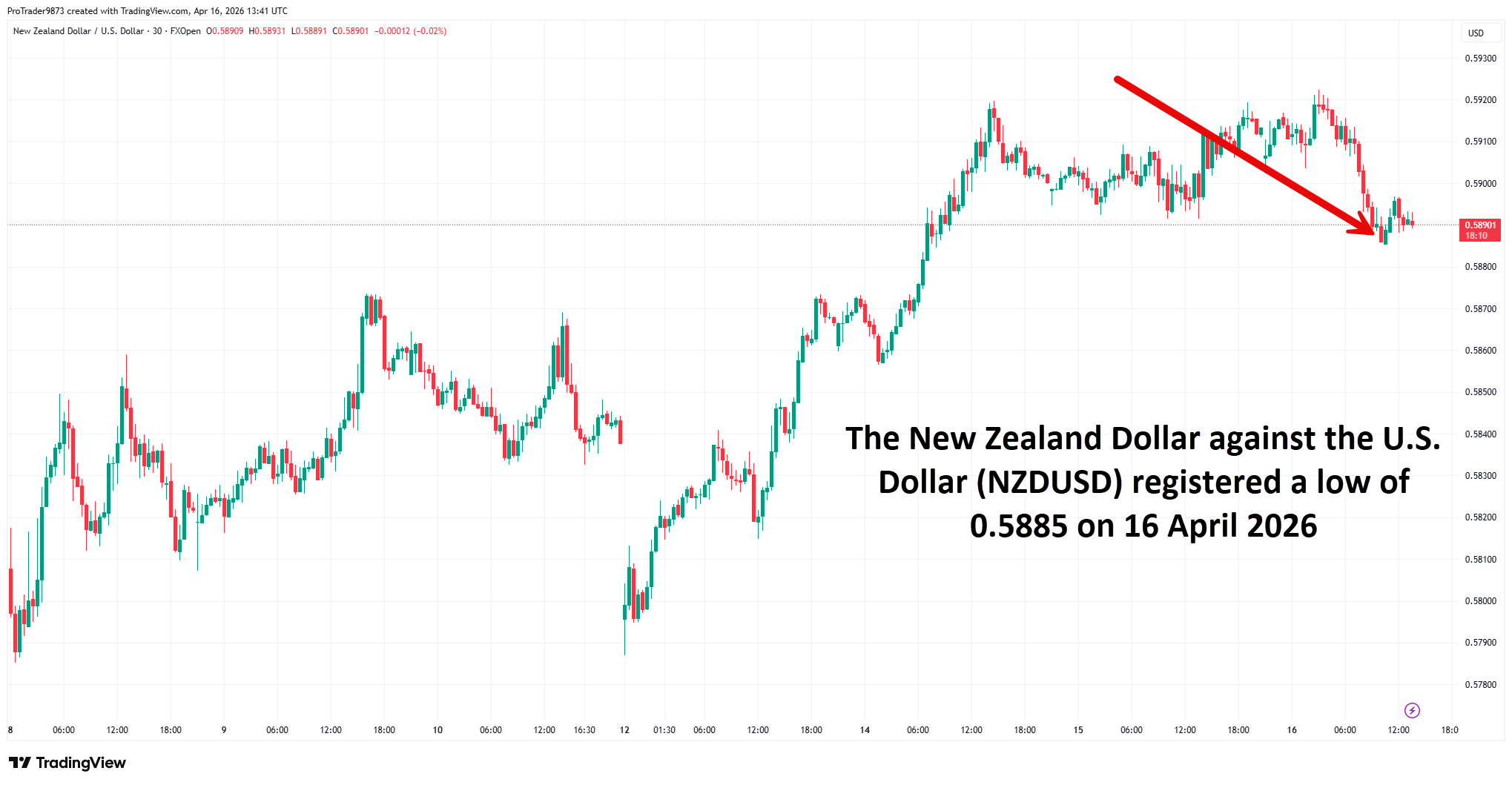
NZDUSD – The New Zealand Dollar against the U.S. Dollar (NZDUSD) registered a low of 0.5885 on 16 April 2026

Q0Fis2bq_o.png


NZDUSD Technical Analysis – 16 April 2026

Multi Timeframe Overview

The New Zealand Dollar against the U.S. Dollar (NZDUSD) registered a low of 0.5885 on 16 April 2026, marking a continuation of weakness after failing to sustain the prior session’s rebound toward 0.5919. On the daily chart, the pair has slipped back below the 0.5900 pivot zone, testing the lower boundary of the short term consolidation. On the weekly timeframe, NZDUSD remains in a broader downtrend, with successive lower highs since February underscoring persistent Dollar dominance.

Trend Structure
The prevailing structure is bearish. The 0.5885 low represents a fresh test of support within the descending channel. Unless NZDUSD can reclaim 0.5900–0.5920, the bias remains tilted toward further downside. The medium term trendline resistance near 0.5950 continues to cap rallies, while the inability to sustain above 0.5900 highlights Kiwi fragility against the Dollar.

Momentum Indicators
• Relative Strength Index (RSI – Daily): Currently at 37, approaching oversold territory. This suggests bearish momentum is strong but also warns of potential short term exhaustion.
• MACD (Daily): The MACD line remains below the signal line, with widening negative histogram bars, confirming bearish continuation.
• Stochastic Oscillator: Deep in oversold territory, indicating that while the trend is bearish, a corrective bounce could emerge if sellers pause.

Support and Resistance Levels
• Immediate Support: 0.5885 (recent low)
• Secondary Support: 0.5850 (channel base and psychological level)
• Immediate Resistance: 0.5900 (short term pivot)
• Key Resistance: 0.5920 (former support turned resistance)
• Major Resistance: 0.5950 (descending trendline and 50 day moving average)

Scenario Implications
• Bearish Case: A sustained break below 0.5885 would expose 0.5850, with extended downside risk toward 0.5800 if Dollar strength persists.
• Bullish Case: A rebound above 0.5900 could trigger corrective upside toward 0.5920, but only a decisive close above 0.5950 would shift the medium term outlook toward neutrality.
• Neutral Case: Consolidation between 0.5885–0.5920 is possible if traders await clarity on U.S. inflation data and Reserve Bank of New Zealand policy signals.

Macro Considerations
NZDUSD remains highly sensitive to global risk sentiment and commodity demand. Recent softness in dairy and agricultural exports has weighed on the Kiwi, while U.S. Dollar strength tied to Federal Reserve rate expectations continues to dominate. Unless New Zealand’s trade outlook improves or U.S. yields stabilize, NZDUSD is likely to remain under pressure.

Conclusion
NZDUSD’s drop to 0.5885 reflects entrenched bearish momentum and Dollar dominance. The immediate focus is on whether the pair can hold above this low; failure would open the path toward 0.5850–0.5800. Only a recovery above 0.5920–0.5950 would ease bearish pressure and signal a shift toward consolidation. For now, the technical landscape favours continued downside, with oversold conditions offering only limited scope for corrective rebounds.

#fxopen #forex #forexanalysis

Disclaimer: This analysis represents my own opinion only. It is not to be construed as an opinion, offer, solicitation, recommendation, or financial advice of the Companies operating under the FXOpen brand.

For in-depth analysis, please check ...
 
USDCAD Technical Analysis – 16th APR, 2026
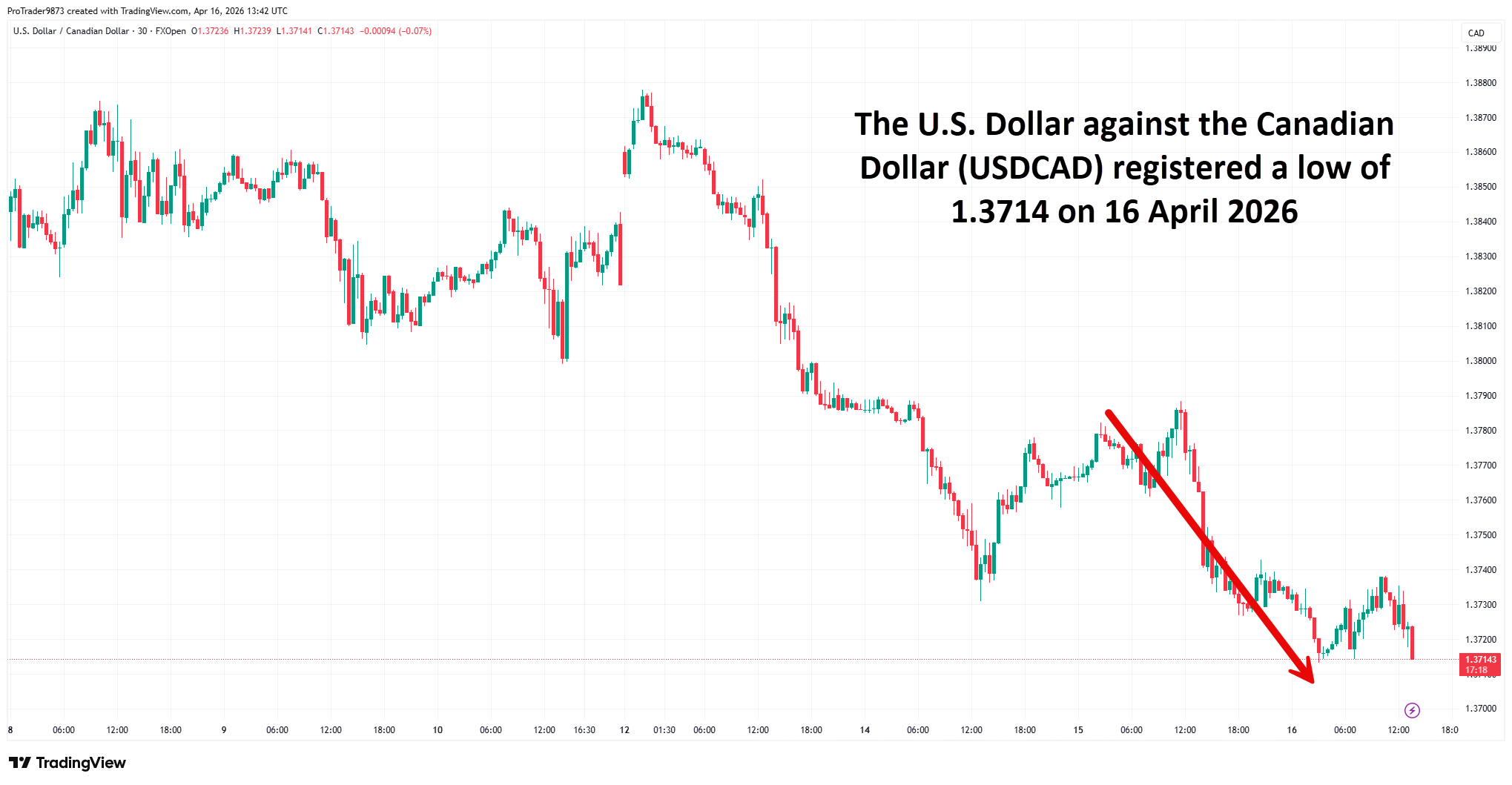
USDCAD – The U.S. Dollar against the Canadian Dollar (USDCAD) registered a low of 1.3714 on 16 April 2026

CFMcPRyx_o.png


USDCAD Technical Analysis – 16 April 2026

Multi Timeframe Overview

The U.S. Dollar against the Canadian Dollar (USDCAD) registered a low of 1.3714 on 16 April 2026, marking a corrective pullback after the prior session’s rally to 1.3788. On the daily chart, the pair has slipped back below the 1.3730 pivot zone, testing the lower boundary of the short term consolidation. On the weekly timeframe, USDCAD remains firmly in an uptrend, but the latest decline highlights profit taking and temporary CAD strength, likely linked to commodity price stabilization.

Trend Structure
The prevailing structure is bullish in the medium term but corrective in the short term. The 1.3714 low represents a test of support within the ascending channel. Unless USDCAD can reclaim 1.3730–1.3750, the bias remains tilted toward consolidation. The medium term trendline support near 1.3700 remains critical; holding above this level keeps the bullish narrative intact, while a breakdown would expose deeper retracement toward 1.3650.

Momentum Indicators
• Relative Strength Index (RSI – Daily): Currently at 47, reflecting neutral momentum after retreating from overbought conditions. This suggests room for further downside if sellers maintain control.
• MACD (Daily): The MACD line has flattened, with histogram bars contracting, indicating waning bullish momentum and potential for consolidation.
• Stochastic Oscillator: Approaching oversold territory, suggesting that corrective downside may be nearing exhaustion.

Support and Resistance Levels
• Immediate Support: 1.3714 (recent low)
• Secondary Support: 1.3700 (channel base and psychological level)
• Immediate Resistance: 1.3730 (short term pivot)
• Key Resistance: 1.3750 (former swing high)
• Major Resistance: 1.3788 (multi month peak and channel top)

Scenario Implications
• Bearish Case: A sustained break below 1.3714–1.3700 would expose 1.3650, with extended downside risk toward 1.3600 if CAD strength persists.
• Bullish Case: A rebound above 1.3730 could trigger upside toward 1.3750, with extended targets at 1.3788 if momentum returns.
• Neutral Case: Consolidation between 1.3700–1.3750 is likely if traders await clarity from U.S. inflation data and Bank of Canada commentary.

Macro Considerations
USDCAD’s trajectory remains heavily influenced by monetary policy divergence and oil price dynamics. The Federal Reserve’s hawkish stance supports Dollar strength, while the Canadian Dollar benefits from stabilization in crude oil markets. Unless oil prices weaken further or the Bank of Canada signals dovishness, CAD resilience could cap USDCAD’s upside in the near term.

Conclusion
USDCAD’s dip to 1.3714 highlights a corrective phase within a broader bullish trend. The immediate focus is on whether the pair can hold above this low; failure would open the path toward 1.3700–1.3650, while resilience could set the stage for a rebound toward 1.3730–1.3750. Despite short term weakness, the medium term technical and macro backdrop continues to favour upside, with corrections offering potential entry opportunities for trend aligned traders.

#fxopen #forex #forexanalysis

Disclaimer: This analysis represents my own opinion only. It is not to be construed as an opinion, offer, solicitation, recommendation, or financial advice of the Companies operating under the FXOpen brand.

For in-depth analysis, please check ...
 
USDCHF Technical Analysis – 16th APR, 2026
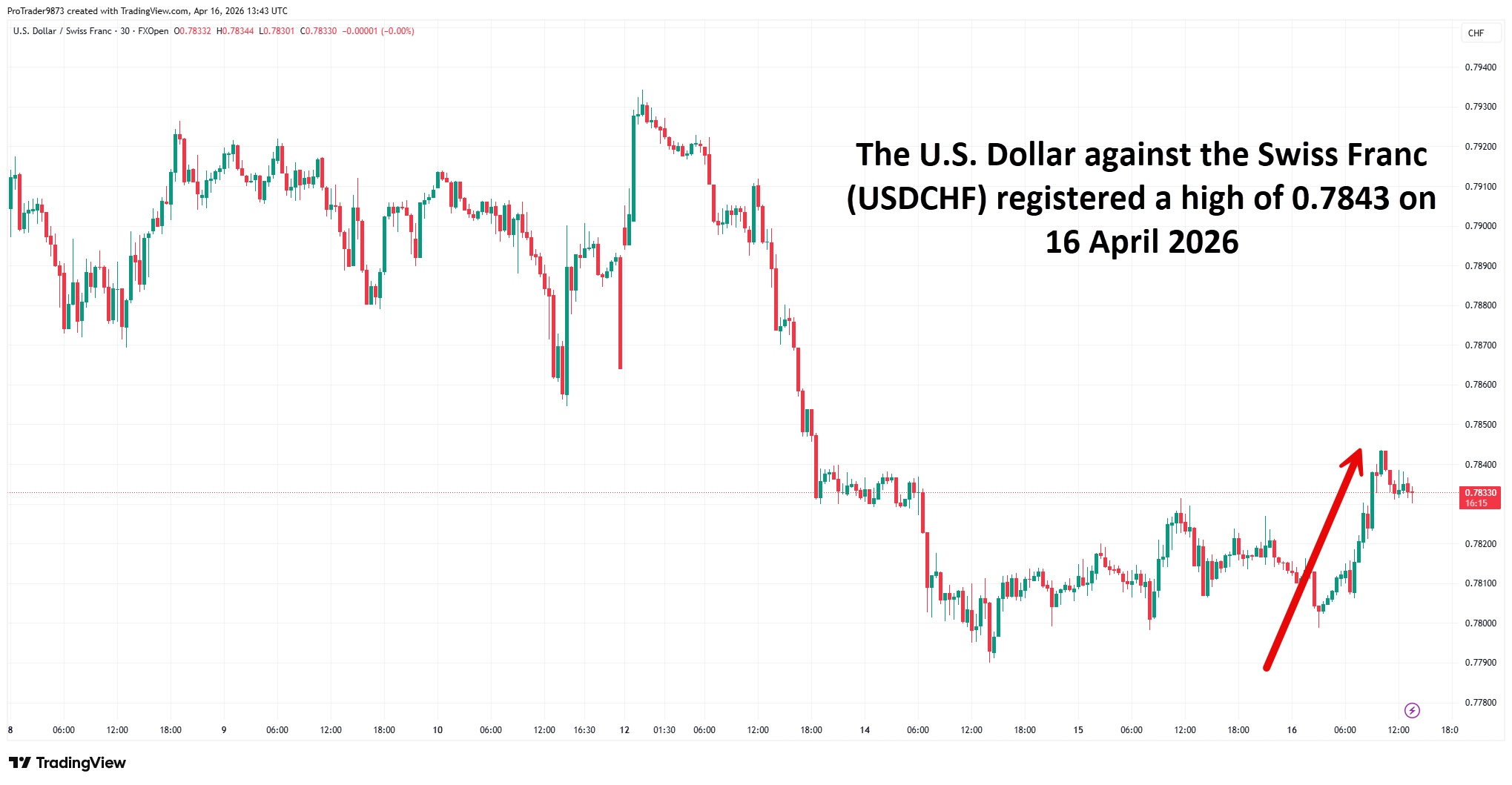
USDCHF – The U.S. Dollar against the Swiss Franc (USDCHF) registered a high of 0.7843 on 16 April 2026

SAr6J2Xs_o.png


USDCHF Technical Analysis – 16 April 2026

Multi Timeframe Overview

The U.S. Dollar against the Swiss Franc (USDCHF) registered a high of 0.7843 on 16 April 2026, marking a corrective rebound after the prior session’s weakness where the pair tested lows near 0.7798. On the daily chart, the pair has staged a modest recovery, pushing back above the 0.7820 pivot zone and attempting to reclaim short term momentum. On the weekly timeframe, USDCHF remains entrenched in a broader downtrend, though the latest bounce highlights buyers’ efforts to stabilize the cross after persistent Franc strength.

Trend Structure
The prevailing structure is cautiously bullish in the short term but still bearish in the medium term. The 0.7843 high represents a test of resistance within the descending channel. A sustained break above 0.7850 would confirm bullish continuation toward 0.7900, while failure to hold above 0.7820 could trigger renewed selling pressure. The broader trendline resistance near 0.7900 remains the key level to watch for a potential shift in sentiment.

Momentum Indicators
• Relative Strength Index (RSI – Daily): Currently at 46, showing neutral momentum after recovering from oversold conditions. This suggests room for further upside if buyers maintain control.
• MACD (Daily): The MACD line is attempting to cross above the signal line, with histogram bars flattening, indicating early signs of bullish momentum.
• Stochastic Oscillator: Rising from oversold territory, suggesting that corrective upside may continue in the near term.

Support and Resistance Levels
• Immediate Resistance: 0.7843 (recent high)
• Secondary Resistance: 0.7850 (psychological barrier and former support turned resistance)
• Immediate Support: 0.7820 (short term pivot)
• Key Support: 0.7798 (prior session low)
• Major Support: 0.7750 (channel base and psychological level)

Scenario Implications
• Bullish Case: A decisive close above 0.7843–0.7850 would open the path toward 0.7900, with extended upside potential toward 0.7950 if momentum persists.
• Bearish Case: Failure to sustain above 0.7820 may invite selling pressure, dragging the pair back toward 0.7798. A break below 0.7750 would shift the medium term outlook bearish, exposing 0.7700.
• Neutral Case: Consolidation between 0.7798–0.7843 is likely if traders await clarity on U.S. inflation data and Swiss National Bank policy signals.

Macro Considerations
USDCHF remains highly sensitive to risk sentiment and central bank divergence. The Swiss Franc continues to attract safe haven demand amid geopolitical uncertainties and subdued Eurozone growth. Meanwhile, the Federal Reserve’s hawkish stance supports the Dollar, but not enough to offset strong demand for the Franc. The latest rebound reflects short term profit taking on Franc strength rather than a decisive trend reversal.

Conclusion
USDCHF’s rally to 0.7843 highlights a corrective phase within a broader bearish trend. The immediate focus is on whether the pair can sustain above this high; success would pave the way toward 0.7850–0.7900, while failure could invite a pullback toward 0.7798–0.7750. Despite short term recovery, the medium term technical and macro backdrop continues to favour downside, with rallies likely to be capped unless U.S. fundamentals strengthen significantly.

#fxopen #forex #forexanalysis

Disclaimer: This analysis represents my own opinion only. It is not to be construed as an opinion, offer, solicitation, recommendation, or financial advice of the Companies operating under the FXOpen brand.

For in-depth analysis, please check ...
 
USDJPY Technical Analysis – 16th APR, 2026
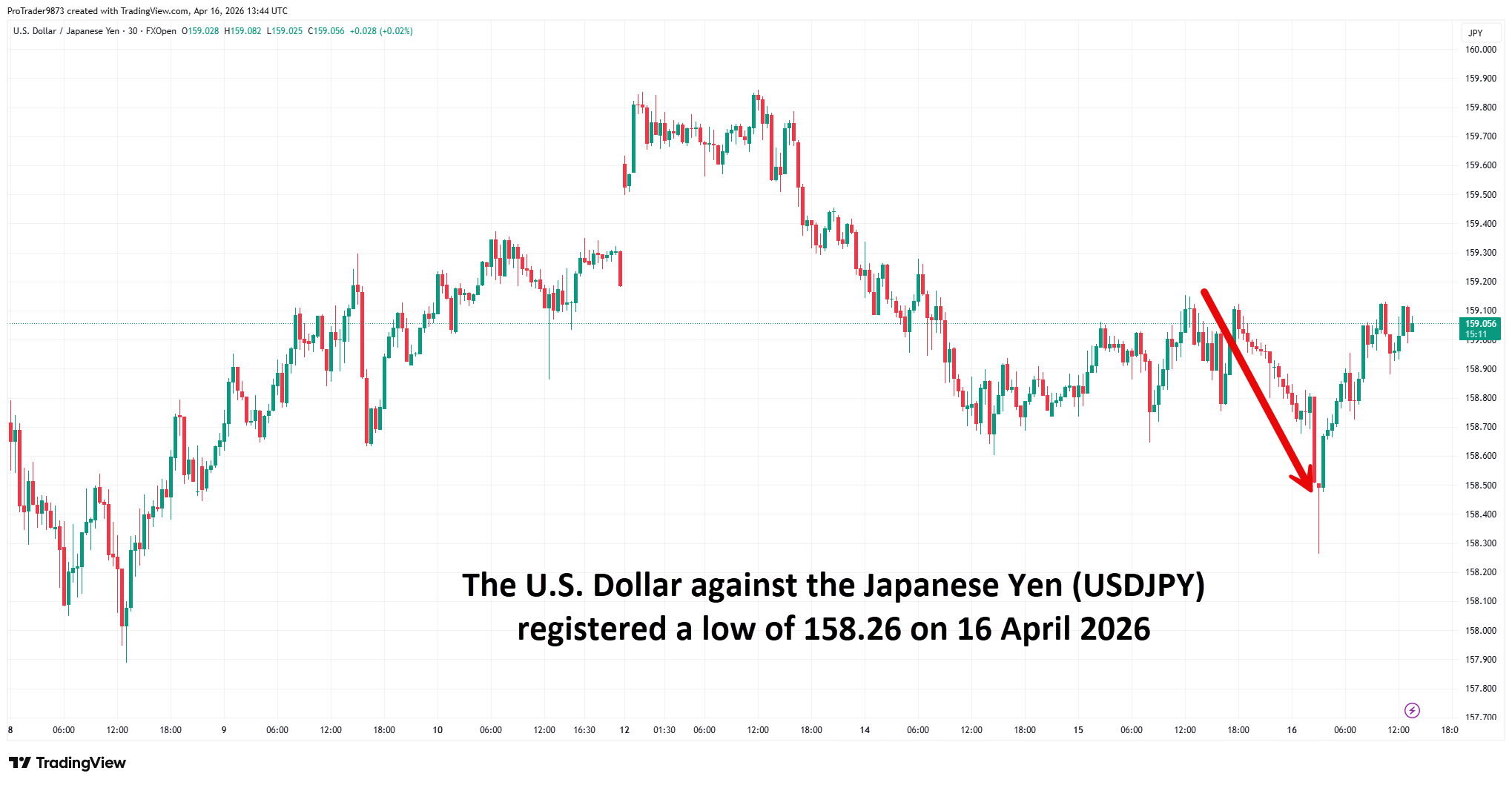
USDJPY - The U.S. Dollar against the Japanese Yen (USDJPY) registered a low of 158.26 on 16 April 2026

KaiOzI6j_o.png


USDJPY Technical Analysis – 16 April 2026

Multi Timeframe Overview

The U.S. Dollar against the Japanese Yen (USDJPY) registered a low of 158.26 on 16 April 2026, marking a corrective pullback within a broader bullish trend. On the daily chart, the pair has retreated from highs near 160.50, with the latest dip testing the lower boundary of the short term consolidation zone. On the weekly timeframe, USDJPY remains firmly in an uptrend, supported by higher lows since late 2025, though the recent decline highlights profit taking and temporary Yen strength.

Trend Structure
Despite the drop to 158.26, the broader structure remains bullish. The decline represents a corrective retracement within the ascending channel, with medium term support holding near 158.00. As long as USDJPY sustains above this level, the bullish bias remains intact. A recovery above 159.50 would confirm renewed upside momentum, while a failure to hold above 158.00 could expose deeper retracement toward 156.80.

Momentum Indicators
• Relative Strength Index (RSI – Daily): Currently at 43, reflecting weakened momentum but not yet oversold. This suggests room for further downside before exhaustion.
• MACD (Daily): The MACD line has crossed below the signal line, with negative histogram bars expanding, confirming short term bearish momentum.
• Stochastic Oscillator: Approaching oversold territory, indicating potential for a corrective rebound if sellers lose steam.

Support and Resistance Levels
• Immediate Support: 158.26 (recent low)
• Secondary Support: 158.00 (channel base and psychological level)
• Immediate Resistance: 159.00 (short term pivot)
• Key Resistance: 159.50 (former swing high)
• Major Resistance: 160.50 (multi month peak and channel top)

Scenario Implications
• Bearish Case: A sustained break below 158.26–158.00 would expose 156.80, with extended downside risk toward 155.50 if Yen strength persists.
• Bullish Case: A rebound above 159.00 could trigger upside toward 159.50, with extended targets at 160.50 if momentum returns.
• Neutral Case: Consolidation between 158.26–159.00 is possible if traders await clarity from U.S. inflation data or Bank of Japan policy signals.

Macro Considerations
USDJPY’s trajectory remains heavily influenced by monetary policy divergence. The Federal Reserve’s hawkish stance supports Dollar strength, while the Bank of Japan’s continued ultra loose policy keeps the Yen under pressure. However, temporary safe haven demand for the Yen amid global uncertainties has contributed to the recent pullback. Unless risk sentiment deteriorates further, USDJPY is likely to resume its upward trajectory once corrective pressures ease.

Conclusion
USDJPY’s dip to 158.26 highlights a corrective phase within a broader bullish trend. The immediate focus is on whether the pair can hold above this low; failure would open the path toward 156.80–155.50, while resilience could set the stage for a rebound toward 159.00–159.50. Despite short term weakness, the medium term technical and macro backdrop continues to favour upside, with the correction offering potential entry opportunities for trend aligned traders.

#fxopen #forex #forexanalysis

Disclaimer: This analysis represents my own opinion only. It is not to be construed as an opinion, offer, solicitation, recommendation, or financial advice of the Companies operating under the FXOpen brand.

For in-depth analysis, please check ...
 
Back
Top