
Daily Market Analytics - Forex

NZDUSD Technical Analysis – 17th DEC, 2025 – LONDON SESSION
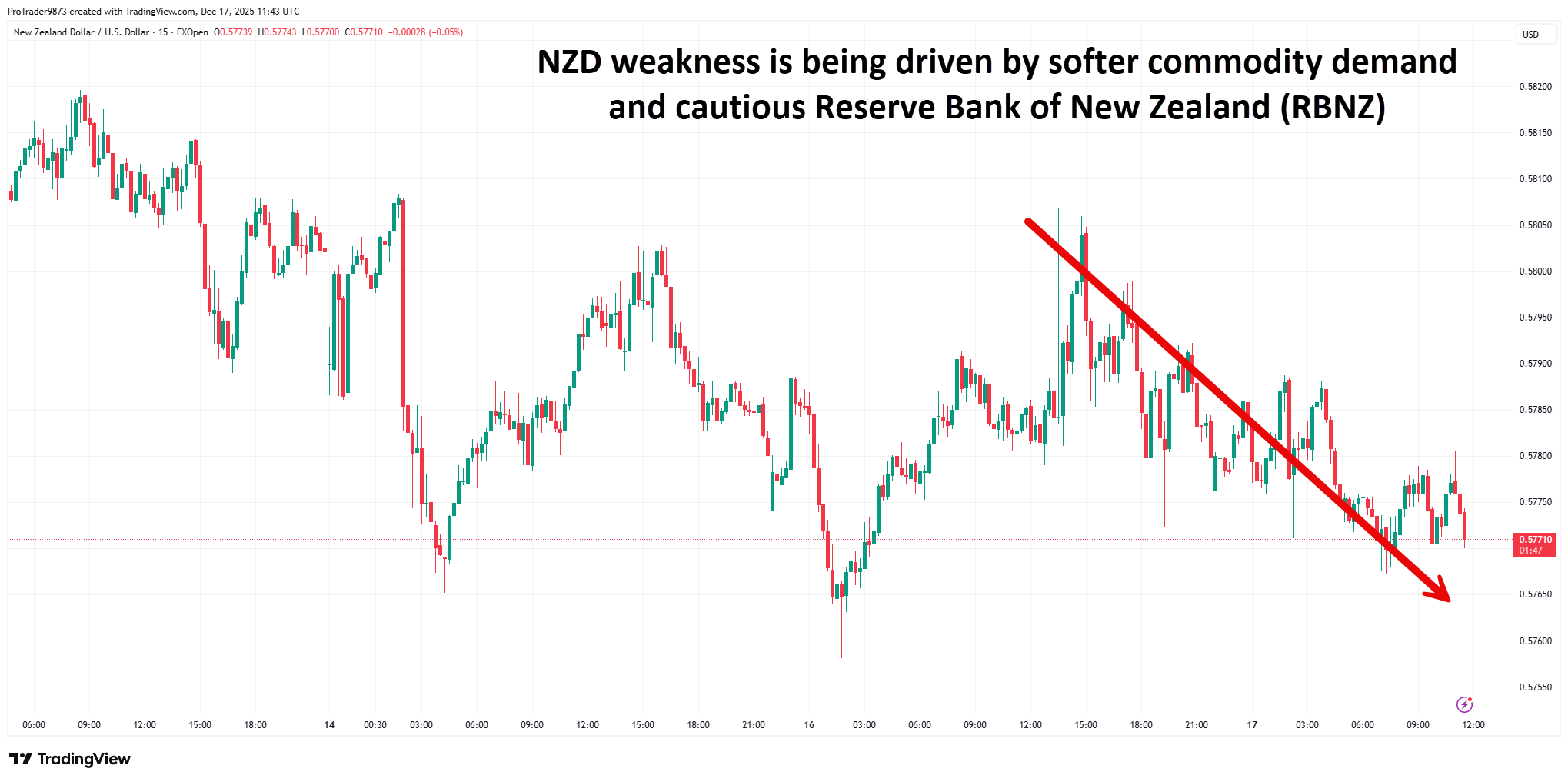
NZDUSD – NZD weakness is being driven by softer commodity demand and cautious Reserve Bank of New Zealand (RBNZ)
lSlptdVZ_o.png


NZDUSD – Technical Analysis (17 Dec 2025)

Price Action Overview:

On December 17th, NZDUSD fell to a low of 0.5767, marking a significant bearish move after failing to sustain momentum above the 0.5800 resistance zone earlier in the week. The daily candlestick showed a strong bearish body with limited upper shadows, reflecting decisive selling pressure and rejection of higher levels. This decline highlights the vulnerability of NZDUSD near critical support zones.

Momentum Indicators
• Relative Strength Index (RSI): Dropped to around 36, signalling bearish momentum and approaching oversold territory.
• MACD: Lines crossed downward, with the histogram expanding negatively, confirming accelerating bearish bias.
• Stochastic Oscillator: Fell below 25, reinforcing oversold conditions and hinting at potential short-term rebound attempts.

Moving Averages
• 20-day EMA: Turned downward, reflecting short-term bearish momentum.
• 50-day SMA: Positioned near 0.5820, now acting as overhead resistance.
• The alignment of shorter-term averages below longer-term ones confirms corrective pressure within the broader structure.

Volatility & Volume
• Bollinger Bands: Widened during the decline, indicating heightened volatility.
• Volume: Spiked as the pair touched 0.5767, validating strong selling interest and suggesting active participation from bears.

Support & Resistance Levels
• Immediate Support: 0.5760. A breakdown below this level could expose 0.5720 and deeper toward 0.5680.
• Immediate Resistance: 0.5820. A rebound above this level would ease bearish pressure and open the path toward 0.5860.

Multi-Timeframe Analysis
• Daily Chart: Shows a strong bearish candle, confirming downside momentum.
• Weekly Chart: Indicates reversal from recent highs, with price compressing into a corrective phase.
• Monthly Chart: Still reflects a broader downtrend, with NZDUSD struggling to establish sustained bullish momentum.

Fundamental Overlay
NZD weakness is being driven by softer commodity demand and cautious Reserve Bank of New Zealand (RBNZ) policy stance. Meanwhile, USD strength is supported by safe-haven flows and expectations of stable US yields. This fundamental backdrop aligns with the technical bearish bias.

Future Trend Outlook
• Bearish Scenario: A decisive break below 0.5760 would confirm continuation of the downtrend, targeting 0.5720 and 0.5680 in the short term.
• Bullish Scenario: If buyers defend 0.5760 and push above 0.5820, a rebound toward 0.5860 could unfold.
• Neutral Scenario: Consolidation between 0.5760–0.5820 until new macroeconomic catalysts provide direction.

Expert View
NZDUSD’s drop to 0.5767 underscores bearish dominance but also highlights the importance of support near 0.5760. The pair is oversold on multiple indicators, raising the possibility of a short-term rebound. However, unless price reclaims 0.5820, the broader bias remains bearish. Traders should closely monitor commodity market trends and RBNZ commentary, as these will likely dictate the next breakout direction.

#fxopen #forex #forexanalysis

Disclaimer: This analysis represents my own opinion only. It is not to be construed as an opinion, offer, solicitation, recommendation, or financial advice of the Companies operating under the FXOpen brand.

For in-depth analysis, please check ...
 
USDCAD Technical Analysis – 17th DEC, 2025 – LONDON SESSION
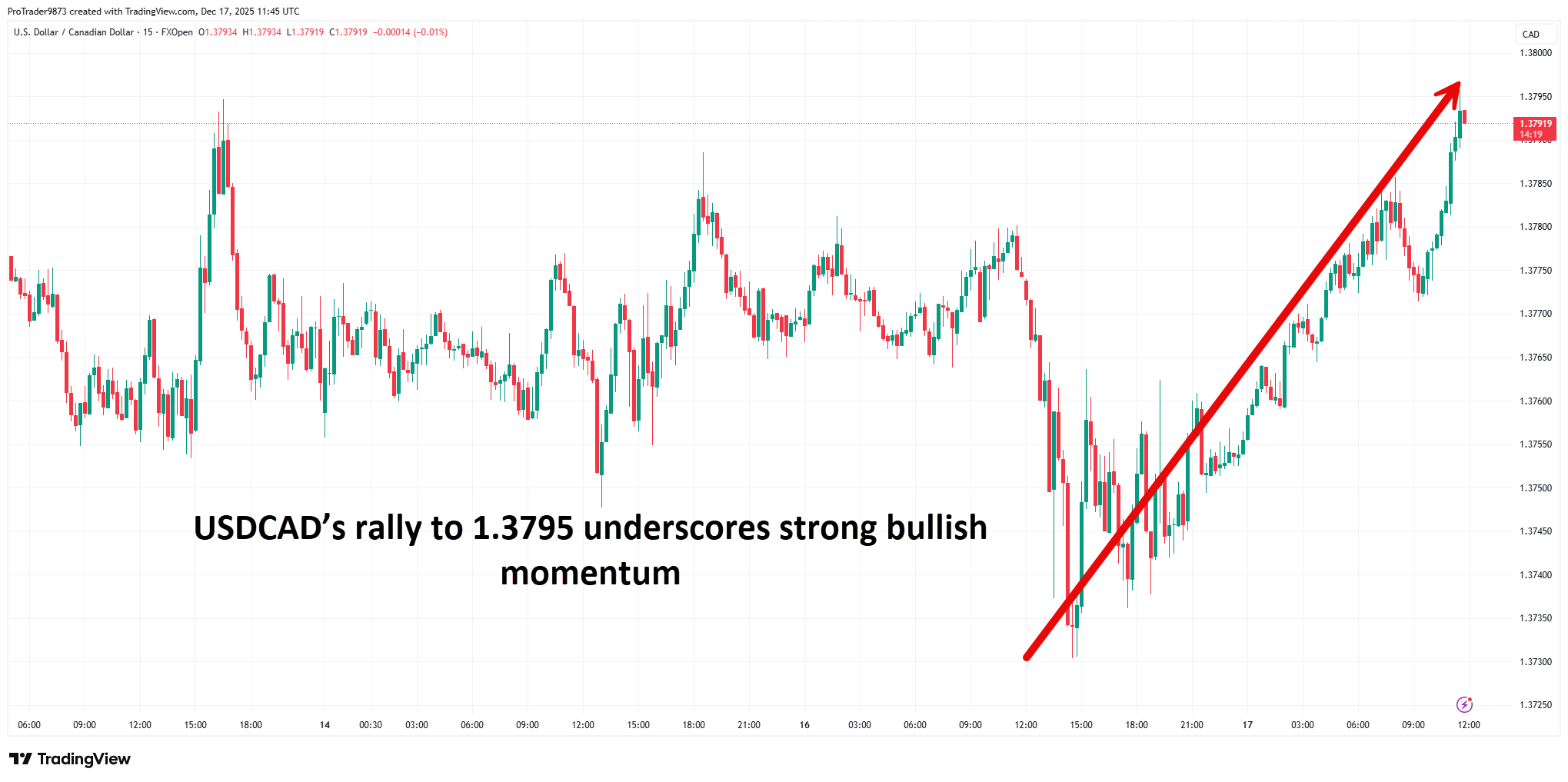
USDCAD – USDCAD’s rally to 1.3795 underscores strong bullish momentum

oUnFb6ZK_o.png


USDCAD – Technical Analysis (17 Dec 2025)

Price Action Overview:

On December 17th, USDCAD surged to a high of 1.3795, marking a strong bullish move and testing a critical resistance zone. The daily candlestick displayed a wide bullish body with limited lower shadows, reflecting aggressive buying pressure and rejection of downside attempts. This price action highlights the importance of the 1.3800 psychological barrier as a pivotal level for continuation or reversal.

Momentum Indicators
• Relative Strength Index (RSI): Climbed to around 68, signalling strong bullish momentum but nearing overbought territory.
• MACD: Histogram expanded positively, with the signal line diverging upward, confirming bullish bias.
• Stochastic Oscillator: Above 75, suggesting strong momentum but caution for potential short-term pullbacks.

Moving Averages
• 20-day EMA: Rising sharply, confirming short-term bullish strength.
• 50-day SMA: Positioned near 1.3700, acting as a strong support base.
• The alignment of shorter-term averages above longer-term ones reflects a healthy bullish structure.

Volatility & Volume
• Bollinger Bands: Expanding, indicating rising volatility and potential for continuation.
• Volume: Increased during the rally, validating genuine buying interest rather than speculative spikes.

Support & Resistance Levels
• Immediate Resistance: 1.3800. A breakout above this level would open the path toward 1.3850 and 1.3920.
• Immediate Support: 1.3700. A breakdown below this level could trigger a correction toward 1.3650 and 1.3600.

Multi-Timeframe Analysis
• Daily Chart: Shows a strong bullish candle, confirming upside momentum.
• Weekly Chart: Breakout attempt from consolidation, with price pressing against upper resistance zones.
• Monthly Chart: Reflects a broader uptrend, with USDCAD building higher lows and higher highs.

Fundamental Overlay
The Canadian dollar remains sensitive to oil price movements. Any weakness in crude could further support USD strength. Meanwhile, USD is buoyed by safe-haven demand and expectations of stable US yields, aligning with the technical bullish bias.

Future Trend Outlook
• Bullish Scenario: Sustained break above 1.3800 would confirm continuation, targeting 1.3850 initially and 1.3920 in the medium term.
• Bearish Scenario: Failure to hold above 1.3795 and a breakdown below 1.3700 could trigger profit-taking, leading to a pullback toward 1.3650.
• Neutral Scenario: Consolidation between 1.3700–1.3800 until new macroeconomic catalysts provide direction.

Expert View
USDCAD’s rally to 1.3795 underscores strong bullish momentum, but the resistance at 1.3800 is pivotal. A decisive breakout would extend the rally, while rejection could lead to consolidation or correction. Traders should closely monitor oil price trends and central bank commentary, as these will likely dictate the next breakout direction.

#fxopen #forex #forexanalysis

Disclaimer: This analysis represents my own opinion only. It is not to be construed as an opinion, offer, solicitation, recommendation, or financial advice of the Companies operating under the FXOpen brand.

For in-depth analysis, please check ...
 
USDCHF Technical Analysis – 17th DEC, 2025 – LONDON SESSION
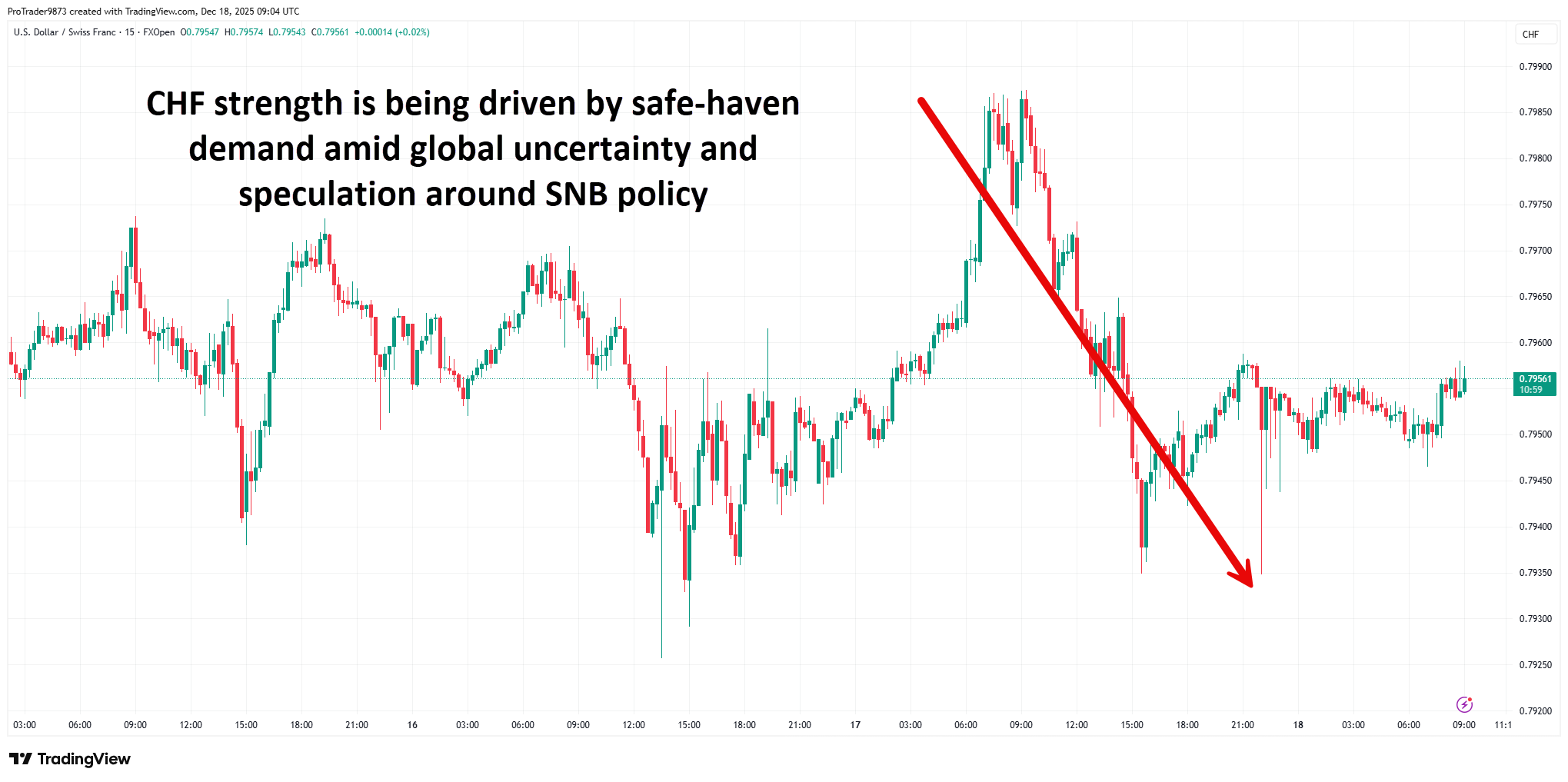
USDCHF – CHF strength is being driven by safe-haven demand amid global uncertainty and speculation around SNB policy

GpNbIaHH_o.png


USDCHF – Technical Analysis (17 Dec 2025)

Price Action Overview:

On December 17th, USDCHF dropped to a low of 0.7935, marking a sharp bearish move after failing to sustain momentum above the 0.8000 psychological barrier earlier in the week. The daily candlestick displayed a strong bearish body with a long lower shadow, reflecting decisive selling pressure but also some buyer defense near the lows. This price action highlights the importance of the 0.7930–0.7950 support zone as a critical pivot area.

Momentum Indicators
• Relative Strength Index (RSI): Fell to around 35, signaling bearish momentum and approaching oversold territory.
• MACD: Lines remain negative, with the histogram expanding downward, confirming accelerating bearish bias.
• Stochastic Oscillator: Dropped below 25, reinforcing oversold conditions and hinting at potential short-term rebound attempts.

Moving Averages
• 20-day EMA: Turned downward, reflecting short-term bearish momentum.
• 50-day SMA: Positioned near 0.8000, now acting as overhead resistance.
• The alignment of shorter-term averages below longer-term ones confirms corrective pressure within the broader structure.

Volatility & Volume
• Bollinger Bands: Widened during the decline, indicating heightened volatility.
• Volume: Spiked as the pair touched 0.7935, validating strong selling interest and suggesting active participation from bears.

Support & Resistance Levels
• Immediate Support: 0.7930. A breakdown below this level could expose 0.7900 and deeper toward 0.7850.
• Immediate Resistance: 0.8000. A rebound above this level would ease bearish pressure and open the path toward 0.8050.

Multi-Timeframe Analysis
• Daily Chart: Shows a strong bearish candle testing support, with indecision around whether buyers can defend the level.
• Weekly Chart: Indicates reversal from recent highs, with price compressing into a corrective phase.
• Monthly Chart: Still reflects a longer-term downtrend, with USDCHF struggling to establish sustained bullish momentum.

Fundamental Overlay
CHF strength is being driven by safe-haven demand amid global uncertainty and speculation around SNB policy. Meanwhile, USD sentiment is capped by softer yields and dovish Federal Reserve expectations. This fundamental backdrop aligns with the technical bearish bias.

Future Trend Outlook
• Bearish Scenario: A decisive break below 0.7930 would confirm continuation of the downtrend, targeting 0.7900 and 0.7850 in the short term.
• Bullish Scenario: If buyers defend 0.7930 and push above 0.8000, a rebound toward 0.8050 could unfold.
• Neutral Scenario: Consolidation between 0.7930–0.8000 until new macroeconomic catalysts provide direction.

Expert View
USDCHF’s drop to 0.7935 underscores bearish dominance but also highlights the importance of support near 0.7930. The pair is oversold on multiple indicators, raising the possibility of a short-term rebound. However, unless price reclaims 0.8000, the broader bias remains bearish. Traders should closely monitor safe-haven flows and SNB commentary, as these will likely dictate the next breakout direction.

#fxopen #forex #forexanalysis

Disclaimer: This analysis represents my own opinion only. It is not to be construed as an opinion, offer, solicitation, recommendation, or financial advice of the Companies operating under the FXOpen brand.

For in-depth analysis, please check ...
 
USDJPY Technical Analysis – 17th DEC, 2025 – LONDON SESSION
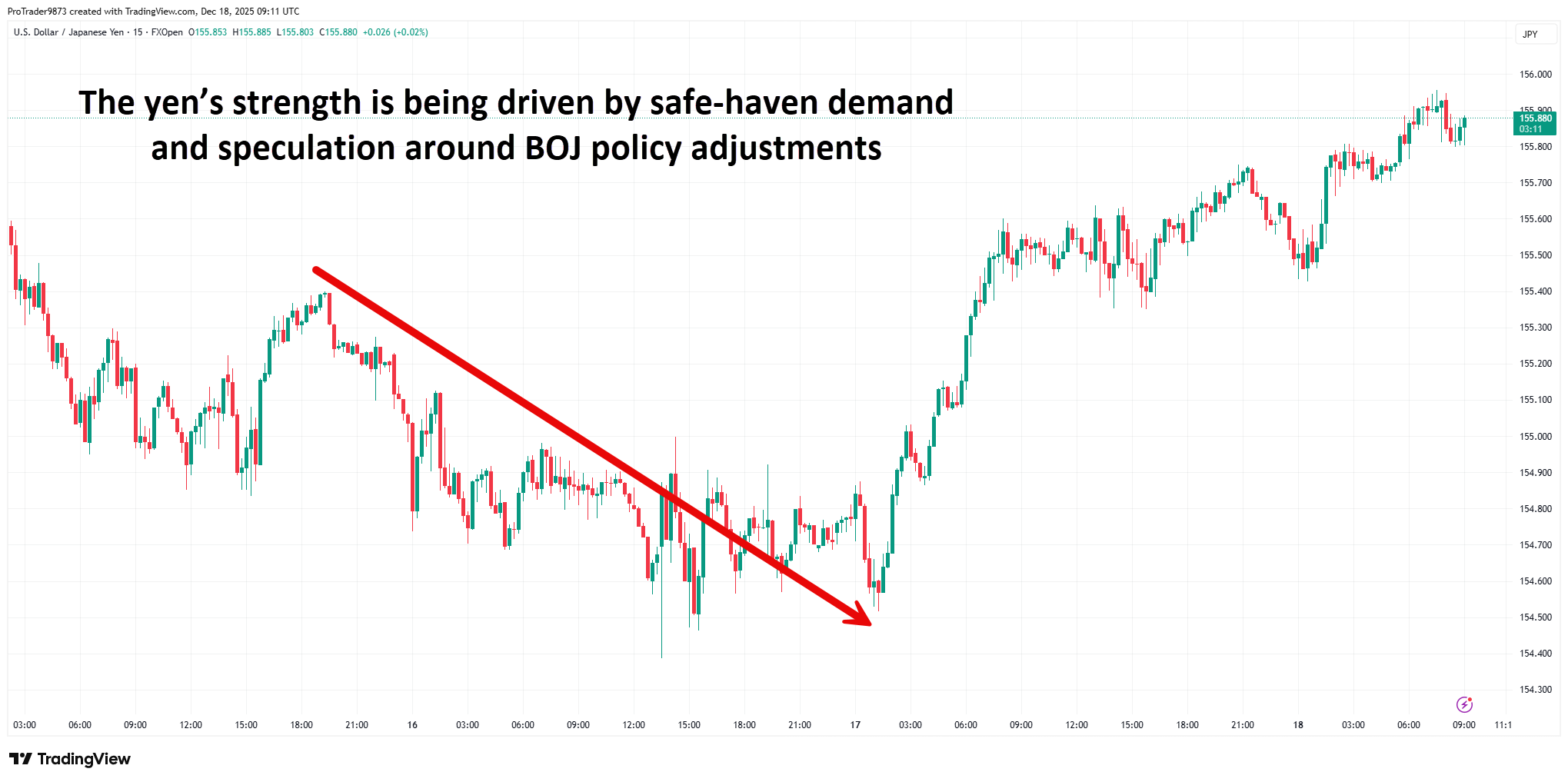
USDJPY - The yen’s strength is being driven by safe-haven demand and speculation around BOJ policy adjustments

FEXnWN7n_o.png


USDJPY – Technical Analysis (17 Dec 2025)

Price Action Overview:

On December 17th, USDJPY fell to a low of 154.38, marking a notable bearish correction after failing to sustain momentum above the 155.20 zone earlier in the week. The daily candlestick displayed a bearish body with a long lower shadow, reflecting strong selling pressure but also some buyer defense near the lows. This price action highlights the importance of the 154.30–154.50 support zone as a critical pivot level.

Momentum Indicators
• Relative Strength Index (RSI): Dropped to around 39, signalling bearish momentum and approaching oversold territory.
• MACD: Lines remain negative, with the histogram expanding downward, confirming accelerating bearish bias.
• Stochastic Oscillator: Fell below 30, reinforcing oversold conditions and hinting at potential short-term rebound attempts.

Moving Averages
• 20-day EMA: Turned downward, reflecting short-term bearish momentum.
• 50-day SMA: Positioned near 155.20, now acting as overhead resistance.
• The alignment of shorter-term averages below longer-term ones confirms corrective pressure within the broader structure.

Volatility & Volume
• Bollinger Bands: Widened during the decline, indicating heightened volatility.
• Volume: Spiked as the pair touched 154.38, validating strong selling interest and suggesting active participation from bears.

Support & Resistance Levels
• Immediate Support: 154.30. A breakdown below this level could expose 154.00 and deeper toward 153.50.
• Immediate Resistance: 155.20. A rebound above this level would ease bearish pressure and open the path toward 156.00.

Multi-Timeframe Analysis
• Daily Chart: Shows a strong bearish candle testing support, with indecision around whether buyers can defend the level.
• Weekly Chart: Indicates reversal from recent highs, with price compressing into a corrective phase.
• Monthly Chart: Still reflects a broader bullish trend, but the current decline is a significant correction within that structure.

Fundamental Overlay
The yen’s strength is being driven by safe-haven demand and speculation around BOJ policy adjustments. Meanwhile, USD sentiment is capped by softer yields and dovish Federal Reserve expectations. This fundamental backdrop aligns with the technical bearish bias.

Future Trend Outlook
• Bearish Scenario: A decisive break below 154.30 would confirm continuation of the downtrend, targeting 154.00 and 153.50 in the short term.
• Bullish Scenario: If buyers defend 154.30 and push above 155.20, a rebound toward 156.00 could unfold.
• Neutral Scenario: Consolidation between 154.30–155.20 until new macroeconomic catalysts provide direction.

Expert View
USDJPY’s drop to 154.38 underscores bearish dominance but also highlights the importance of support near 154.30. The pair is oversold on multiple indicators, raising the possibility of a short-term rebound. However, unless price reclaims 155.20, the broader bias remains bearish. Traders should closely monitor BOJ commentary and US economic data releases, as these will likely dictate the next breakout direction.

#fxopen #forex #forexanalysis

Disclaimer: This analysis represents my own opinion only. It is not to be construed as an opinion, offer, solicitation, recommendation, or financial advice of the Companies operating under the FXOpen brand.

For in-depth analysis, please check ...
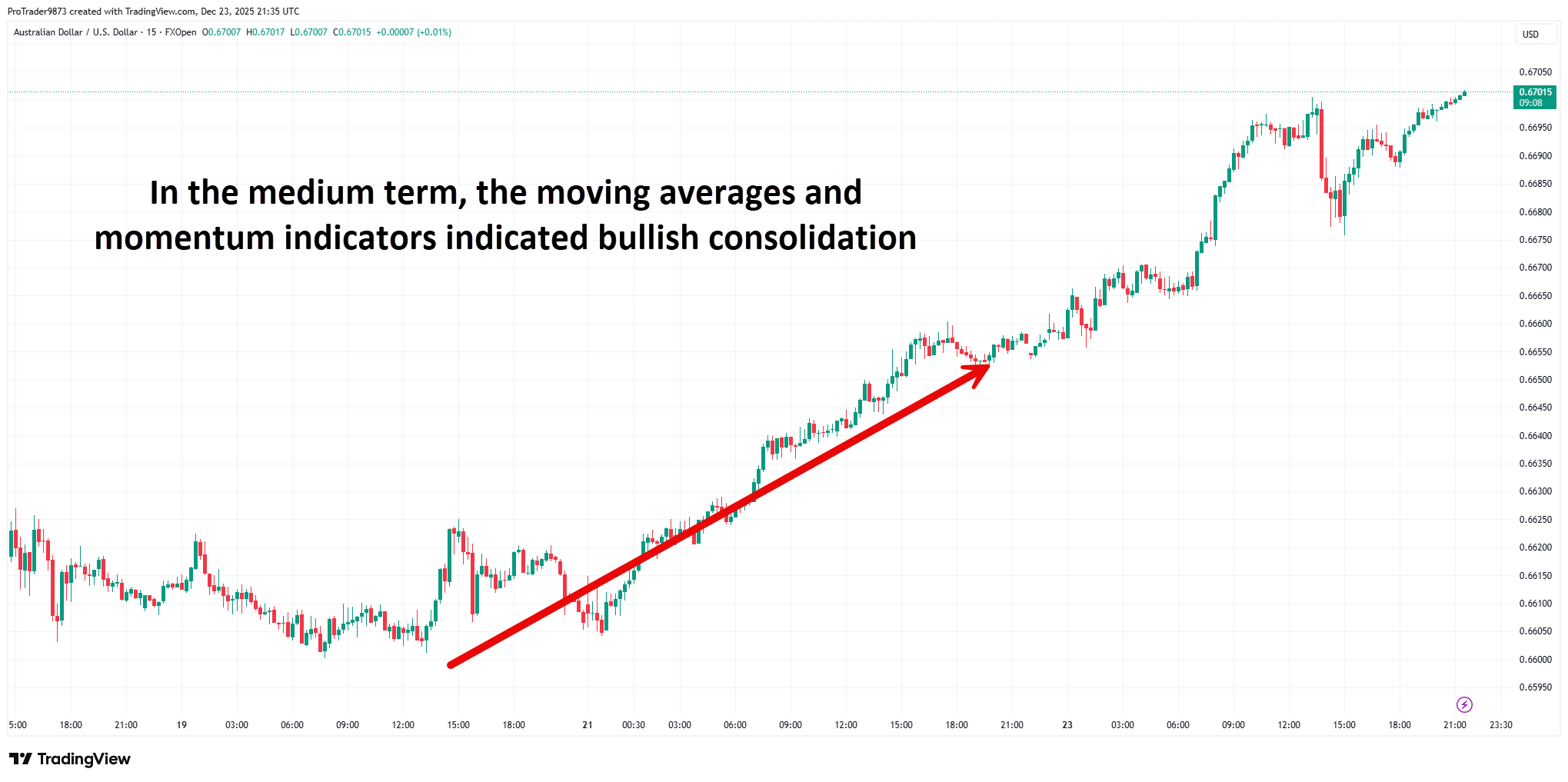
 
AUDUSD Technical Analysis – 22nd DEC, 2025
AUDUSD – In the medium term, the moving averages and momentum indicators indicated bullish consolidation

rPHoVH8R_o.png


AUD/USD Technical Analysis – 22nd December 2025

On 22nd December 2025, AUD/USD touched a high of 0.6662, which proved to be a significant resistance level. The price action on this day reflected hesitation among buyers, as the pair failed to sustain momentum beyond this point. The candlestick structure showed a relatively small body with an upper wick, indicating rejection at higher levels and suggesting that sellers were active near the 0.6660–0.6670 zone.

From a daily chart perspective, the moving averages provided a clear picture of the prevailing trend. The 20 day moving average was positioned around 0.6648, just below the day’s high, which reinforced the idea of resistance pressure. The 50 day moving average was located near 0.6525 and was sloping upward, confirming medium term bullish momentum. The 200 day moving average stood at approximately 0.6480, also pointing upward, which highlighted that the long term bias had shifted toward bullishness. Momentum indicators supported this view. The Relative Strength Index (RSI) hovered around 61, a level that reflects moderately strong bullish momentum but also warns of potential overextension, while the MACD histogram remained positive with the signal line above zero, confirming that buyers were still present in the market though momentum was beginning to flatten.

On the four hour chart, the pair showed consolidation after touching 0.6662. The stochastic oscillator was positioned near 72, which indicated overbought conditions and the possibility of a short term pullback. Momentum readings were flattening, suggesting that buyers were not able to push the pair higher with conviction. Immediate support was seen at 0.6625, with stronger support at 0.6600. Resistance was clearly defined at 0.6662–0.6670, with the next level of resistance at 0.6710. This intraday structure pointed to range bound trading conditions, with sellers defending the upper boundary.

The weekly chart provided a broader perspective. AUD/USD has been in a recovery phase since the October 2025 lows near 0.6280, characterized by higher lows and higher highs. Volatility, measured by the Average True Range (ATR), was moderate at around 0.0075, suggesting that price swings were contained but directional bias remained bullish. A Fibonacci retracement drawn from the July 2025 high of 0.6890 to the October low of 0.6280 revealed important levels. The 38.2 percent retracement stood at 0.6510, the 50 percent retracement at 0.6585, and the 61.8 percent retracement at 0.6660. The high of 0.6662 coincided almost exactly with the 61.8 percent retracement, which reinforced the dominance of sellers at this level and confirmed that the market was testing a classic resistance zone.

Taken together, these signals suggest that AUD/USD faced strong resistance at 0.6662–0.6670. In the short term, the rejection at this level pointed to potential downside risks, with 0.6625 and 0.6600 acting as immediate support zones. In the medium term, the moving averages and momentum indicators indicated bullish consolidation, with the pair likely to remain supported unless it broke decisively below 0.6600. In the longer term, the recovery trend remained intact as long as the pair traded above the 0.6510–0.6525 region, which coincides with the 50 day moving average and the 38.2 percent Fibonacci retracement.

From a trading perspective, a bullish scenario would only emerge if the pair broke above 0.6670, opening the path toward 0.6710 and potentially 0.6780. A bearish scenario would be confirmed if the pair failed to hold above 0.6600, which could lead to a decline toward 0.6550 and possibly 0.6510. A neutral scenario would involve range bound trading between 0.6600 and 0.6670, with traders focusing on short term opportunities within this narrow band.

#fxopen #forex #forexanalysis

Disclaimer: This analysis represents my own opinion only. It is not to be construed as an opinion, offer, solicitation, recommendation, or financial advice of the Companies operating under the FXOpen brand.

For in-depth analysis, please check ...
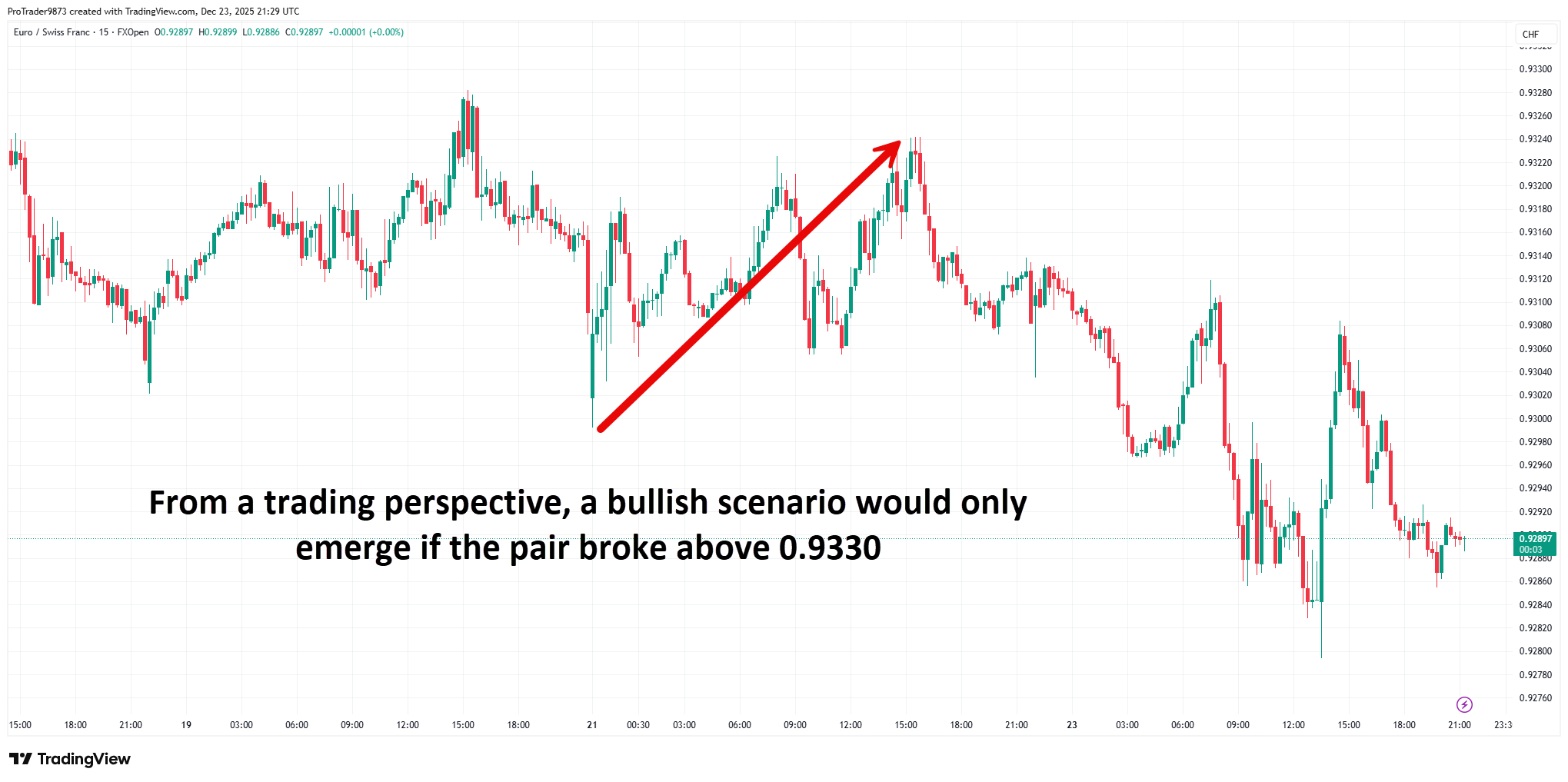
 
EURCHF Technical Analysis – 22nd DEC, 2025
EURCHF – From a trading perspective, a bullish scenario would only emerge if the pair broke above 0.9330

52pofIto_o.png


EUR/CHF Technical Analysis – 22nd December 2025

On 22nd December 2025, EUR/CHF touched a high of 0.9324, which proved to be a significant resistance level. The price action on this day reflected hesitation among buyers, as the pair failed to sustain momentum beyond this point. The candlestick structure showed a relatively small body with an upper wick, indicating rejection at higher levels and suggesting that sellers were active near the 0.9330 zone.

From a daily chart perspective, the moving averages provided a clear picture of the prevailing trend. The 20-day moving average was positioned around 0.9331, just above the day’s high, which reinforced the idea of resistance pressure. The 50-day moving average was located near 0.9443 and was sloping downward, confirming medium-term weakness. The 200-day moving average stood at approximately 0.9411, also pointing lower, which highlighted that the long-term bias remained bearish. Momentum indicators supported this view. The Relative Strength Index (RSI) hovered around 43, a level that reflects neutral-to-bearish momentum, while the MACD histogram remained negative with the signal line below zero, confirming that bearish undertones were still present in the market.

On the four-hour chart, the pair showed consolidation below the 0.9330 resistance. The stochastic oscillator was positioned around the mid-range, close to 55, which indicated indecision and a lack of strong directional bias. Momentum readings were flat, suggesting that buyers were not able to push the pair higher with conviction. Immediate support was seen at 0.9300, with stronger support at 0.9275. Resistance was clearly defined at 0.9325–0.9330, with the next level of resistance at 0.9360. This intraday structure pointed to range-bound trading conditions, with sellers defending the upper boundary.

The weekly chart provided a broader perspective. EUR/CHF has been in a long-term downtrend, characterized by lower highs since mid-2025. Volatility, measured by the Average True Range (ATR), was moderate at around 0.0068, suggesting that price swings were contained but directional bias remained weak. A Fibonacci retracement drawn from the November swing high of 0.9664 to the December low of 0.9178 revealed important levels. The 38.2 percent retracement stood at 0.9360, the 50 percent retracement at 0.9420, and the 61.8 percent retracement at 0.9480. The high of 0.9324 fell below the 38.2 percent retracement, which reinforced the dominance of sellers and confirmed that the market had not yet managed to reclaim even the first meaningful retracement level.

Taken together, these signals suggest that EUR/CHF faced strong resistance at 0.9324–0.9330. In the short term, the rejection at this level pointed to potential downside risks, with 0.9300 and 0.9275 acting as immediate support zones. In the medium term, the moving averages and momentum indicators indicated bearish consolidation, with the pair unlikely to break higher unless it managed to clear 0.9360 decisively. In the longer term, the downtrend remained intact as long as the pair traded below the 0.9420–0.9440 region, which coincides with the 50-day and 200-day moving averages.

From a trading perspective, a bullish scenario would only emerge if the pair broke above 0.9330, opening the path toward 0.9360 and potentially 0.9420. A bearish scenario would be confirmed if the pair failed to hold above 0.9300, which could lead to a decline toward 0.9275 and possibly 0.9250. A neutral scenario would involve range-bound trading between 0.9300 and 0.9330, with traders focusing on short-term opportunities within this narrow band.

#fxopen #forex #forexanalysis

Disclaimer: This analysis represents my own opinion only. It is not to be construed as an opinion, offer, solicitation, recommendation, or financial advice of the Companies operating under the FXOpen brand.

For in-depth analysis, please check ...
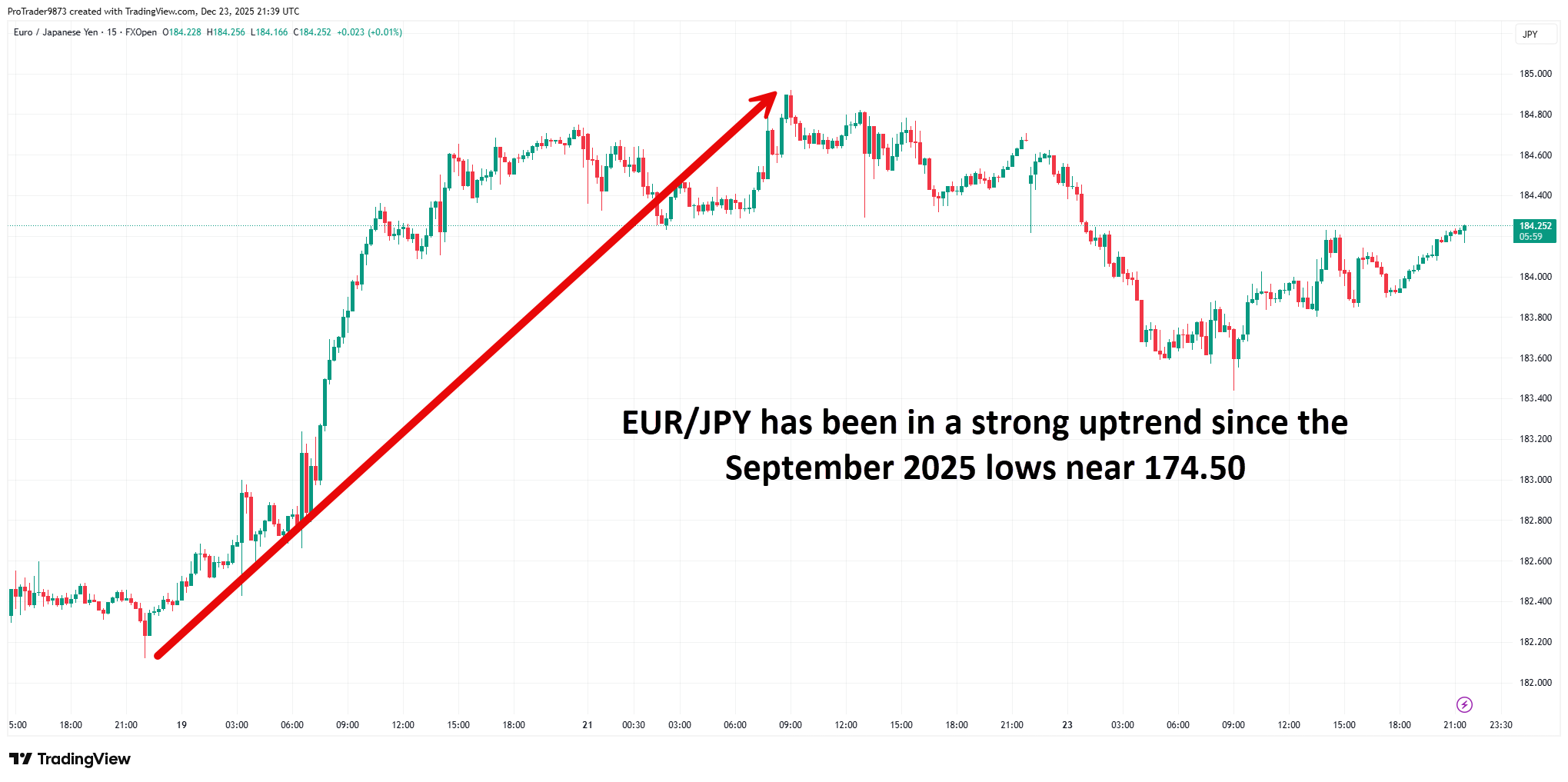
 
EURJPY Technical Analysis – 22nd DEC, 2025
EURJPY – EUR/JPY has been in a strong uptrend since the September 2025 lows near 174.50

nOSa1QOS_o.png


EUR/JPY Technical Analysis – 22nd December 2025

On 22nd December 2025, EUR/JPY touched a high of 184.92, which proved to be a significant resistance level. The price action on this day reflected hesitation among buyers, as the pair failed to sustain momentum beyond this point. The candlestick structure showed a relatively small body with an upper wick, indicating rejection at higher levels and suggesting that sellers were active near the 185.00 psychological zone.

From a daily chart perspective, the moving averages provided a clear picture of the prevailing trend. The 20‑day moving average was positioned around 183.85, just below the day’s high, which reinforced the idea of short‑term resistance pressure. The 50‑day moving average was located near 182.10 and was sloping upward, confirming medium‑term bullish momentum. The 200‑day moving average stood at approximately 178.40, also pointing upward, which highlighted that the long‑term bias remained bullish. Momentum indicators supported this view. The Relative Strength Index (RSI) hovered around 64, a level that reflects strong bullish momentum but also warns of potential overbought conditions. The MACD histogram remained positive with the signal line above zero, confirming that buyers were still present in the market, though momentum was beginning to flatten near resistance.

On the four‑hour chart, the pair showed consolidation after touching 184.92. The stochastic oscillator was positioned near 78, which indicated overbought conditions and the possibility of a short‑term pullback. Momentum readings were flattening, suggesting that buyers were not able to push the pair higher with conviction. Immediate support was seen at 184.00, with stronger support at 183.20. Resistance was clearly defined at 184.90–185.00, with the next level of resistance at 186.00. This intraday structure pointed to range‑bound trading conditions, with sellers defending the upper boundary.

The weekly chart provided a broader perspective. EUR/JPY has been in a strong uptrend since the September 2025 lows near 174.50, characterized by higher lows and higher highs. Volatility, measured by the Average True Range (ATR), was moderate at around 1.25, suggesting that price swings were contained but directional bias remained bullish. A Fibonacci retracement drawn from the July 2025 high of 189.40 to the September low of 174.50 revealed important levels. The 38.2 percent retracement stood at 180.20, the 50 percent retracement at 181.95, and the 61.8 percent retracement at 183.70. The high of 184.92 was just above the 61.8 percent retracement, which reinforced the idea that the market was testing a critical resistance zone where sellers were likely to be active.

Taken together, these signals suggest that EUR/JPY faced strong resistance at 184.90–185.00. In the short term, the rejection at this level pointed to potential downside risks, with 184.00 and 183.20 acting as immediate support zones. In the medium term, the moving averages and momentum indicators indicated bullish consolidation, with the pair likely to remain supported unless it broke decisively below 183.00. In the longer term, the uptrend remained intact as long as the pair traded above the 181.95–182.10 region, which coincides with the 50‑day moving average and the 50 percent Fibonacci retracement.

From a trading perspective, a bullish scenario would only emerge if the pair broke above 185.00, opening the path toward 186.00 and potentially 188.00. A bearish scenario would be confirmed if the pair failed to hold above 183.20, which could lead to a decline toward 181.95 and possibly 180.20. A neutral scenario would involve range‑bound trading between 183.20 and 185.00, with traders focusing on short‑term opportunities within this narrow band.

#fxopen #forex #forexanalysis

Disclaimer: This analysis represents my own opinion only. It is not to be construed as an opinion, offer, solicitation, recommendation, or financial advice of the Companies operating under the FXOpen brand.

For in-depth analysis, please check ...
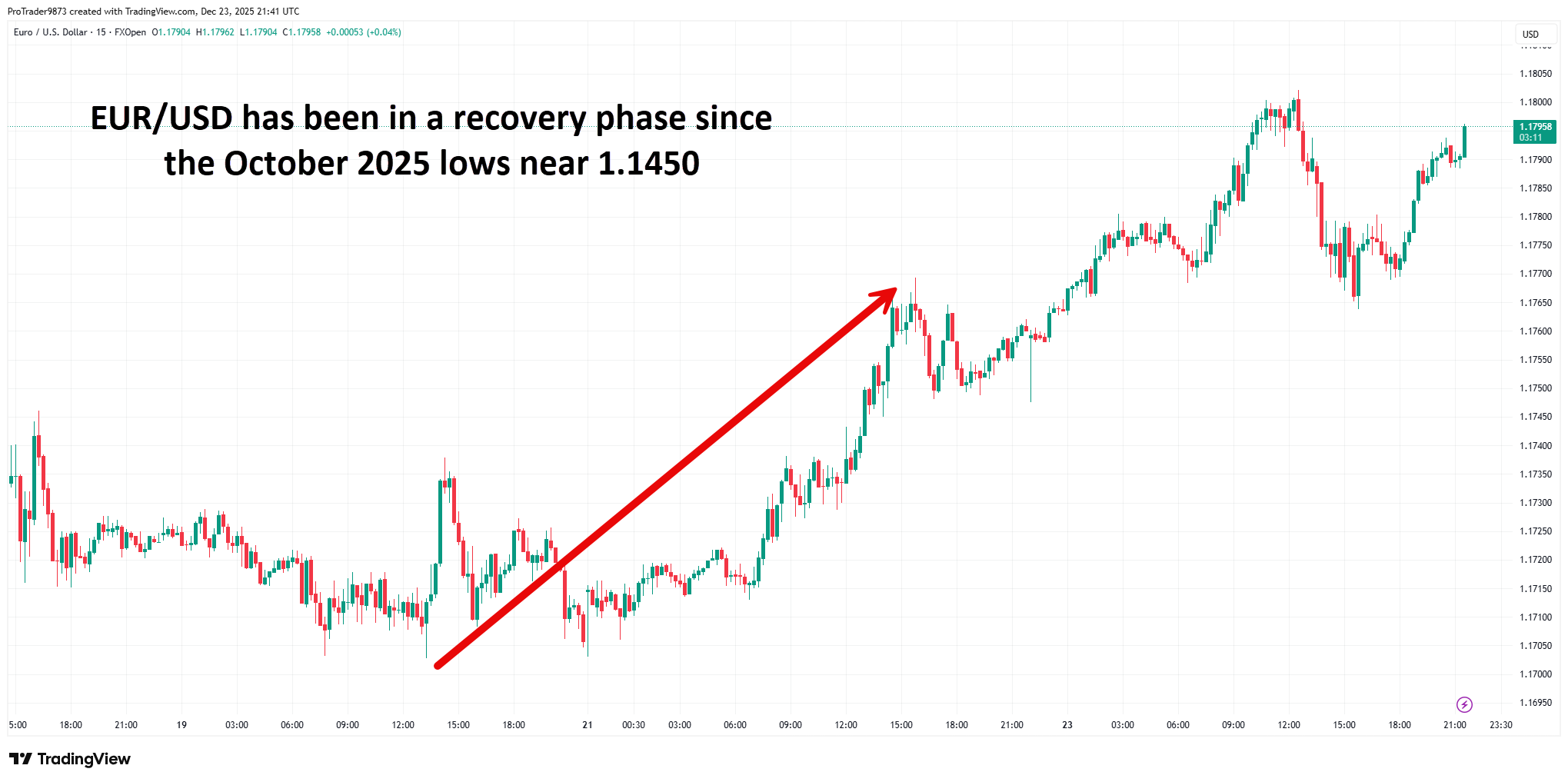
 
EURUSD Technical Analysis – 22nd DEC, 2025
EURUSD – EUR/USD has been in a recovery phase since the October 2025 lows near 1.1450

XFVS4yS0_o.png


EUR/USD Technical Analysis – 22nd December 2025

On 22nd December 2025, EUR/USD touched a high of 1.1769, which proved to be a significant resistance level. The price action on this day reflected hesitation among buyers, as the pair failed to sustain momentum beyond this point. The candlestick structure showed a relatively small body with an upper wick, indicating rejection at higher levels and suggesting that sellers were active near the 1.1770 psychological zone.

From a daily chart perspective, the moving averages provided a clear picture of the prevailing trend. The 20 day moving average was positioned around 1.1745, just below the day’s high, which reinforced the idea of short term resistance pressure. The 50 day moving average was located near 1.1680 and was sloping upward, confirming medium term bullish momentum. The 200 day moving average stood at approximately 1.1585, also pointing upward, which highlighted that the long term bias had shifted toward bullishness. Momentum indicators supported this view. The Relative Strength Index (RSI) hovered around 63, a level that reflects strong bullish momentum but also warns of potential overbought conditions. The MACD histogram remained positive with the signal line above zero, confirming that buyers were still present in the market, though momentum was beginning to flatten near resistance.

On the four hour chart, the pair showed consolidation after touching 1.1769. The stochastic oscillator was positioned near 76, which indicated overbought conditions and the possibility of a short term pullback. Momentum readings were flattening, suggesting that buyers were not able to push the pair higher with conviction. Immediate support was seen at 1.1730, with stronger support at 1.1700. Resistance was clearly defined at 1.1765–1.1770, with the next level of resistance at 1.1800. This intraday structure pointed to range bound trading conditions, with sellers defending the upper boundary.

The weekly chart provided a broader perspective. EUR/USD has been in a recovery phase since the October 2025 lows near 1.1450, characterized by higher lows and higher highs. Volatility, measured by the Average True Range (ATR), was moderate at around 0.0060, suggesting that price swings were contained but directional bias remained bullish. A Fibonacci retracement drawn from the July 2025 high of 1.1975 to the October low of 1.1450 revealed important levels. The 38.2 percent retracement stood at 1.1655, the 50 percent retracement at 1.1715, and the 61.8 percent retracement at 1.1775. The high of 1.1769 coincided almost exactly with the 61.8 percent retracement, which reinforced the idea that the market was testing a critical resistance zone where sellers were likely to be active.

Taken together, these signals suggest that EUR/USD faced strong resistance at 1.1765–1.1775. In the short term, the rejection at this level pointed to potential downside risks, with 1.1730 and 1.1700 acting as immediate support zones. In the medium term, the moving averages and momentum indicators indicated bullish consolidation, with the pair likely to remain supported unless it broke decisively below 1.1700. In the longer term, the recovery trend remained intact as long as the pair traded above the 1.1655–1.1680 region, which coincides with the 50 day moving average and the 38.2 percent Fibonacci retracement.

From a trading perspective, a bullish scenario would only emerge if the pair broke above 1.1775, opening the path toward 1.1800 and potentially 1.1850. A bearish scenario would be confirmed if the pair failed to hold above 1.1700, which could lead to a decline toward 1.1655 and possibly 1.1600. A neutral scenario would involve range bound trading between 1.1700 and 1.1770, with traders focusing on short term opportunities within this narrow band.

#fxopen #forex #forexanalysis

Disclaimer: This analysis represents my own opinion only. It is not to be construed as an opinion, offer, solicitation, recommendation, or financial advice of the Companies operating under the FXOpen brand.

For in-depth analysis, please check ...
 
GBPJPY Technical Analysis – 22nd DEC, 2025
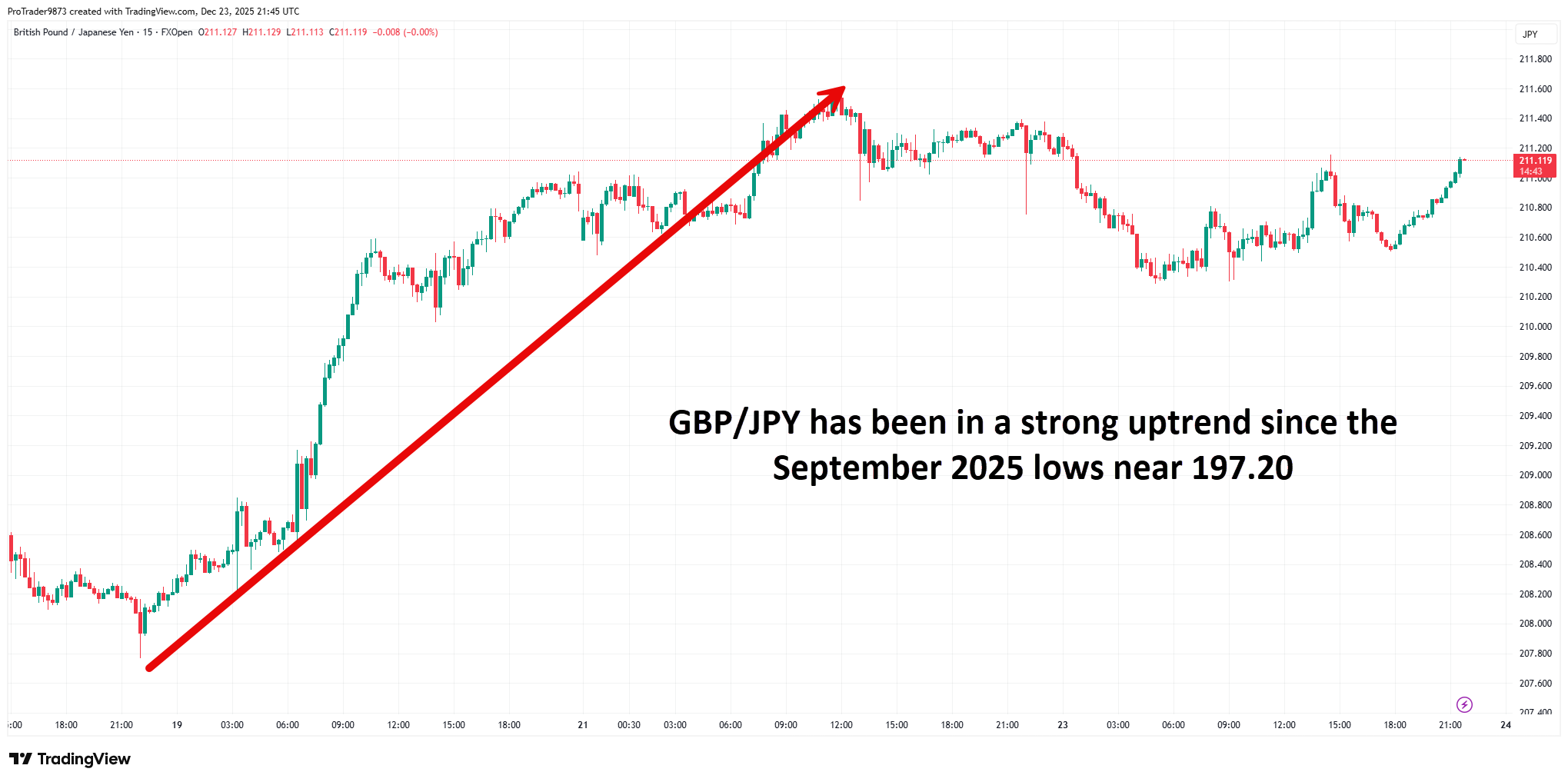
GBPJPY – GBP/JPY has been in a strong uptrend since the September 2025 lows near 197.20

h0LVFnw2_o.png


GBP/JPY Technical Analysis – 22nd December 2025

On 22nd December 2025, GBP/JPY touched a high of 211.58, which proved to be a significant resistance level. The price action on this day reflected hesitation among buyers, as the pair failed to sustain momentum beyond this point. The candlestick structure showed a relatively small body with an upper wick, indicating rejection at higher levels and suggesting that sellers were active near the 212.00 psychological zone.

From a daily chart perspective, the moving averages provided a clear picture of the prevailing trend. The 20 day moving average was positioned around 210.40, just below the day’s high, which reinforced the idea of short term resistance pressure. The 50 day moving average was located near 207.85 and was sloping upward, confirming medium term bullish momentum. The 200 day moving average stood at approximately 202.70, also pointing upward, which highlighted that the long term bias remained bullish. Momentum indicators supported this view. The Relative Strength Index (RSI) hovered around 66, a level that reflects strong bullish momentum but also warns of potential overbought conditions. The MACD histogram remained positive with the signal line above zero, confirming that buyers were still present in the market, though momentum was beginning to flatten near resistance.

On the four hour chart, the pair showed consolidation after touching 211.58. The stochastic oscillator was positioned near 80, which indicated overbought conditions and the possibility of a short term pullback. Momentum readings were flattening, suggesting that buyers were not able to push the pair higher with conviction. Immediate support was seen at 210.50, with stronger support at 209.80. Resistance was clearly defined at 211.50–212.00, with the next level of resistance at 213.00. This intraday structure pointed to range bound trading conditions, with sellers defending the upper boundary.

The weekly chart provided a broader perspective. GBP/JPY has been in a strong uptrend since the September 2025 lows near 197.20, characterized by higher lows and higher highs. Volatility, measured by the Average True Range (ATR), was moderate at around 2.10, suggesting that price swings were contained but directional bias remained bullish. A Fibonacci retracement drawn from the July 2025 high of 215.40 to the September low of 197.20 revealed important levels. The 38.2 percent retracement stood at 204.25, the 50 percent retracement at 206.30, and the 61.8 percent retracement at 208.35. The high of 211.58 was well above the 61.8 percent retracement, which reinforced the idea that the market was testing a critical resistance zone close to the prior swing highs.

Taken together, these signals suggest that GBP/JPY faced strong resistance at 211.50–212.00. In the short term, the rejection at this level pointed to potential downside risks, with 210.50 and 209.80 acting as immediate support zones. In the medium term, the moving averages and momentum indicators indicated bullish consolidation, with the pair likely to remain supported unless it broke decisively below 209.80. In the longer term, the uptrend remained intact as long as the pair traded above the 206.30–207.85 region, which coincides with the 50 day moving average and the 50 percent Fibonacci retracement.

From a trading perspective, a bullish scenario would only emerge if the pair broke above 212.00, opening the path toward 213.00 and potentially 215.00. A bearish scenario would be confirmed if the pair failed to hold above 209.80, which could lead to a decline toward 208.35 and possibly 206.30. A neutral scenario would involve range bound trading between 209.80 and 212.00, with traders focusing on short term opportunities within this narrow band.


#fxopen #forex #forexanalysis

Disclaimer: This analysis represents my own opinion only. It is not to be construed as an opinion, offer, solicitation, recommendation, or financial advice of the Companies operating under the FXOpen brand.

For in-depth analysis, please check ...
 
GBPUSD Technical Analysis – 22nd DEC, 2025
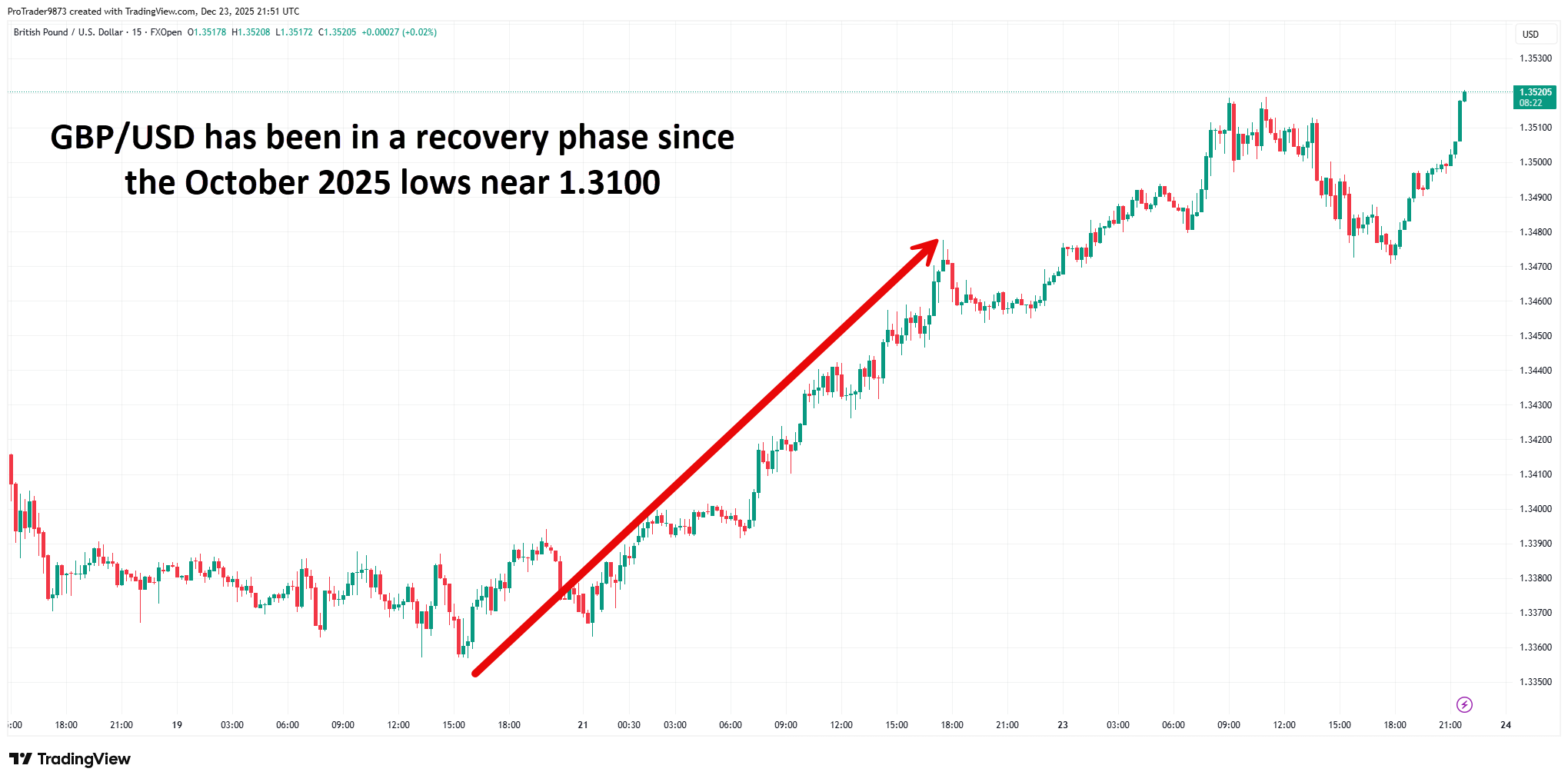
GBPUSD – GBP/USD has been in a recovery phase since the October 2025 lows near 1.3100

r3w071A8_o.png


GBP/USD Technical Analysis – 22nd December 2025

On 22nd December 2025, GBP/USD touched a high of 1.3477, which proved to be a significant resistance level. The price action on this day reflected hesitation among buyers, as the pair failed to sustain momentum beyond this point. The candlestick structure showed a relatively small body with an upper wick, indicating rejection at higher levels and suggesting that sellers were active near the 1.3480 psychological zone.

From a daily chart perspective, the moving averages provided a clear picture of the prevailing trend. The 20 day moving average was positioned around 1.3445, just below the day’s high, which reinforced the idea of short term resistance pressure. The 50 day moving average was located near 1.3360 and was sloping upward, confirming medium term bullish momentum. The 200 day moving average stood at approximately 1.3250, also pointing upward, which highlighted that the long term bias had shifted toward bullishness. Momentum indicators supported this view. The Relative Strength Index (RSI) hovered around 65, a level that reflects strong bullish momentum but also warns of potential overbought conditions. The MACD histogram remained positive with the signal line above zero, confirming that buyers were still present in the market, though momentum was beginning to flatten near resistance.

On the four hour chart, the pair showed consolidation after touching 1.3477. The stochastic oscillator was positioned near 79, which indicated overbought conditions and the possibility of a short term pullback. Momentum readings were flattening, suggesting that buyers were not able to push the pair higher with conviction. Immediate support was seen at 1.3440, with stronger support at 1.3400. Resistance was clearly defined at 1.3475–1.3480, with the next level of resistance at 1.3520. This intraday structure pointed to range bound trading conditions, with sellers defending the upper boundary.

The weekly chart provided a broader perspective. GBP/USD has been in a recovery phase since the October 2025 lows near 1.3100, characterized by higher lows and higher highs. Volatility, measured by the Average True Range (ATR), was moderate at around 0.0095, suggesting that price swings were contained but directional bias remained bullish. A Fibonacci retracement drawn from the July 2025 high of 1.3750 to the October low of 1.3100 revealed important levels. The 38.2 percent retracement stood at 1.3345, the 50 percent retracement at 1.3425, and the 61.8 percent retracement at 1.3505. The high of 1.3477 was positioned just below the 61.8 percent retracement, which reinforced the idea that the market was testing a critical resistance zone where sellers were likely to be active.

Taken together, these signals suggest that GBP/USD faced strong resistance at 1.3475–1.3480. In the short term, the rejection at this level pointed to potential downside risks, with 1.3440 and 1.3400 acting as immediate support zones. In the medium term, the moving averages and momentum indicators indicated bullish consolidation, with the pair likely to remain supported unless it broke decisively below 1.3400. In the longer term, the recovery trend remained intact as long as the pair traded above the 1.3345–1.3360 region, which coincides with the 50 day moving average and the 38.2 percent Fibonacci retracement.

From a trading perspective, a bullish scenario would only emerge if the pair broke above 1.3480, opening the path toward 1.3520 and potentially 1.3600. A bearish scenario would be confirmed if the pair failed to hold above 1.3400, which could lead to a decline toward 1.3345 and possibly 1.3300. A neutral scenario would involve range bound trading between 1.3400 and 1.3480, with traders focusing on short term opportunities within this narrow band.

#fxopen #forex #forexanalysis

Disclaimer: This analysis represents my own opinion only. It is not to be construed as an opinion, offer, solicitation, recommendation, or financial advice of the Companies operating under the FXOpen brand.

For in-depth analysis, please check ...
 
NZDUSD Technical Analysis – 22nd DEC, 2025
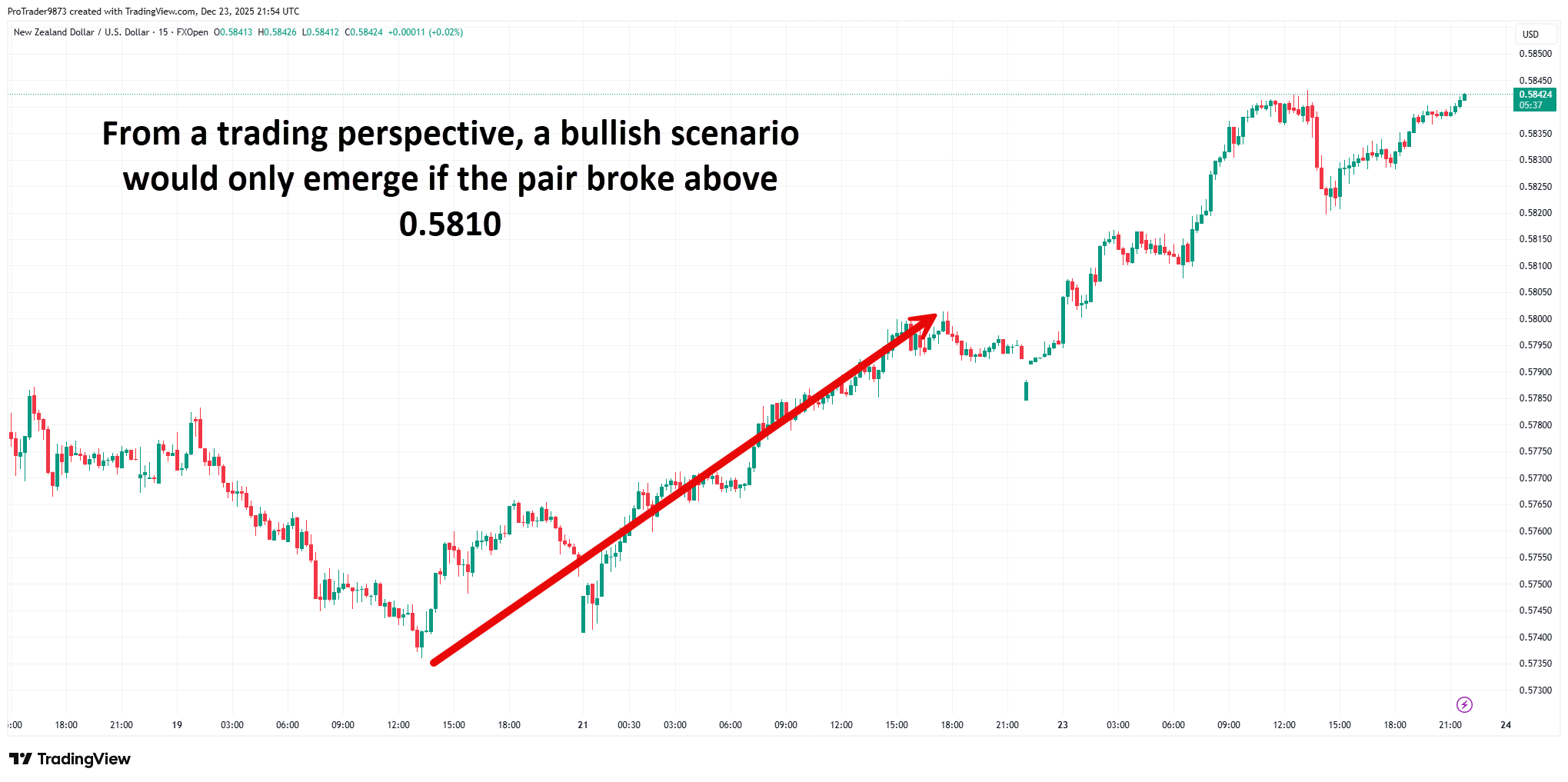
NZDUSD – From a trading perspective, a bullish scenario would only emerge if the pair broke above 0.5810

DMwfl5tJ_o.png


NZD/USD Technical Analysis – 22nd December 2025

On 22nd December 2025, NZD/USD touched a high of 0.5801, which proved to be a significant resistance level. The price action on this day reflected hesitation among buyers, as the pair failed to sustain momentum beyond this point. The candlestick structure showed a relatively small body with an upper wick, indicating rejection at higher levels and suggesting that sellers were active near the 0.5800 psychological zone.

From a daily chart perspective, the moving averages provided a clear picture of the prevailing trend. The 20 day moving average was positioned around 0.5775, just below the day’s high, which reinforced the idea of short term resistance pressure. The 50 day moving average was located near 0.5700 and was sloping upward, confirming medium term bullish momentum. The 200 day moving average stood at approximately 0.5620, also pointing upward, which highlighted that the long term bias had shifted toward bullishness. Momentum indicators supported this view. The Relative Strength Index (RSI) hovered around 62, a level that reflects strong bullish momentum but also warns of potential overbought conditions. The MACD histogram remained positive with the signal line above zero, confirming that buyers were still present in the market, though momentum was beginning to flatten near resistance.

On the four hour chart, the pair showed consolidation after touching 0.5801. The stochastic oscillator was positioned near 74, which indicated overbought conditions and the possibility of a short term pullback. Momentum readings were flattening, suggesting that buyers were not able to push the pair higher with conviction. Immediate support was seen at 0.5770, with stronger support at 0.5740. Resistance was clearly defined at 0.5800–0.5810, with the next level of resistance at 0.5850. This intraday structure pointed to range bound trading conditions, with sellers defending the upper boundary.

The weekly chart provided a broader perspective. NZD/USD has been in a recovery phase since the October 2025 lows near 0.5520, characterized by higher lows and higher highs. Volatility, measured by the Average True Range (ATR), was moderate at around 0.0055, suggesting that price swings were contained but directional bias remained bullish. A Fibonacci retracement drawn from the July 2025 high of 0.6050 to the October low of 0.5520 revealed important levels. The 38.2 percent retracement stood at 0.5725, the 50 percent retracement at 0.5785, and the 61.8 percent retracement at 0.5845. The high of 0.5801 coincided almost exactly with the 50 percent retracement, which reinforced the idea that the market was testing a critical resistance zone where sellers were likely to be active.

Taken together, these signals suggest that NZD/USD faced strong resistance at 0.5800–0.5810. In the short term, the rejection at this level pointed to potential downside risks, with 0.5770 and 0.5740 acting as immediate support zones. In the medium term, the moving averages and momentum indicators indicated bullish consolidation, with the pair likely to remain supported unless it broke decisively below 0.5740. In the longer term, the recovery trend remained intact as long as the pair traded above the 0.5725–0.5775 region, which coincides with the 20 day moving average and the 38.2 percent Fibonacci retracement.

From a trading perspective, a bullish scenario would only emerge if the pair broke above 0.5810, opening the path toward 0.5850 and potentially 0.5900. A bearish scenario would be confirmed if the pair failed to hold above 0.5740, which could lead to a decline toward 0.5725 and possibly 0.5680. A neutral scenario would involve range bound trading between 0.5740 and 0.5810, with traders focusing on short term opportunities within this narrow band.


#fxopen #forex #forexanalysis

Disclaimer: This analysis represents my own opinion only. It is not to be construed as an opinion, offer, solicitation, recommendation, or financial advice of the Companies operating under the FXOpen brand.

For in-depth analysis, please check ...
 
USDCAD Technical Analysis – 22nd DEC, 2025
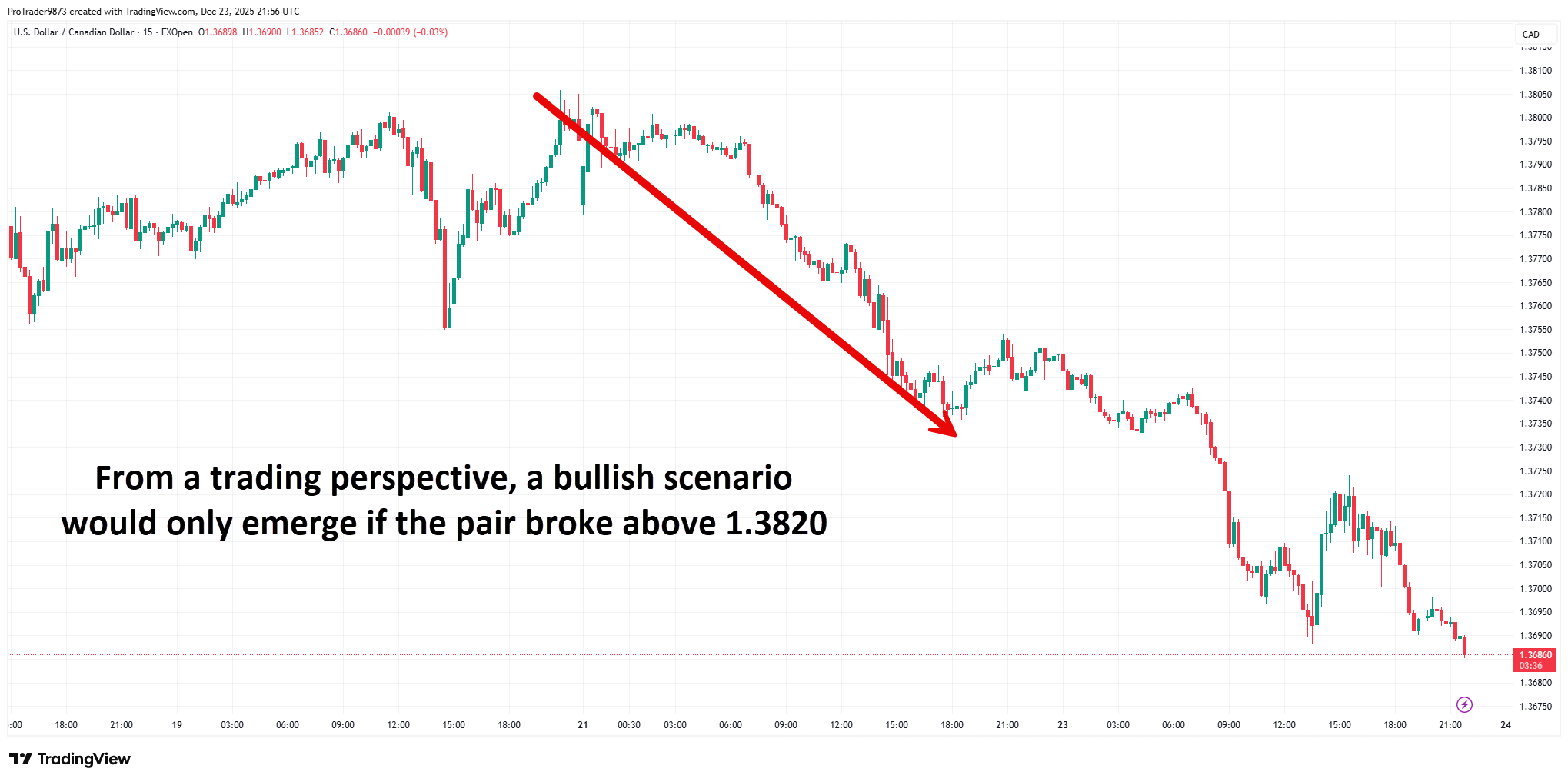
USDCAD – From a trading perspective, a bullish scenario would only emerge if the pair broke above 1.3820

oFMstDmX_o.png


USD/CAD Technical Analysis – 22nd December 2025

On 22nd December 2025, USD/CAD touched a low of 1.3735, which proved to be a significant support level. The price action on this day reflected hesitation among sellers, as the pair failed to extend losses beyond this point. The candlestick structure showed a relatively small body with a lower wick, indicating rejection at lower levels and suggesting that buyers were active near the 1.3730–1.3740 zone.

From a daily chart perspective, the moving averages provided a clear picture of the prevailing trend. The 20 day moving average was positioned around 1.3780, just above the day’s low, which reinforced the idea of short term support pressure. The 50 day moving average was located near 1.3865 and was sloping downward, confirming medium term weakness. The 200 day moving average stood at approximately 1.3650, still pointing upward, which highlighted that the long term bias remained bullish despite the short term correction. Momentum indicators supported this mixed view. The Relative Strength Index (RSI) hovered around 42, a level that reflects neutral to bearish momentum, while the MACD histogram remained negative with the signal line below zero, confirming that bearish undertones were still present in the market.

On the four hour chart, the pair showed consolidation after touching 1.3735. The stochastic oscillator was positioned near 35, which indicated oversold conditions and the possibility of a short term rebound. Momentum readings were flattening, suggesting that sellers were not able to push the pair lower with conviction. Immediate resistance was seen at 1.3780, with stronger resistance at 1.3820. Support was clearly defined at 1.3735–1.3740, with the next level of support at 1.3700. This intraday structure pointed to range bound trading conditions, with buyers defending the lower boundary.

The weekly chart provided a broader perspective. USD/CAD has been in a corrective phase since the November 2025 highs near 1.3975, characterized by lower highs and lower lows. Volatility, measured by the Average True Range (ATR), was moderate at around 0.0075, suggesting that price swings were contained but directional bias remained weak. A Fibonacci retracement drawn from the July 2025 low of 1.3200 to the November high of 1.3975 revealed important levels. The 38.2 percent retracement stood at 1.3685, the 50 percent retracement at 1.3585, and the 61.8 percent retracement at 1.3485. The low of 1.3735 was positioned just above the 38.2 percent retracement, which reinforced the idea that the market was testing a critical support zone where buyers were likely to be active.

Taken together, these signals suggest that USD/CAD faced strong support at 1.3735–1.3740. In the short term, the rejection at this level pointed to potential upside risks, with 1.3780 and 1.3820 acting as immediate resistance zones. In the medium term, the moving averages and momentum indicators indicated bearish consolidation, with the pair likely to remain under pressure unless it broke decisively above 1.3865. In the longer term, the broader uptrend remained intact as long as the pair traded above the 1.3585–1.3650 region, which coincides with the 200 day moving average and the 50 percent Fibonacci retracement.

From a trading perspective, a bullish scenario would only emerge if the pair broke above 1.3820, opening the path toward 1.3865 and potentially 1.3920. A bearish scenario would be confirmed if the pair failed to hold above 1.3735, which could lead to a decline toward 1.3685 and possibly 1.3585. A neutral scenario would involve range bound trading between 1.3735 and 1.3820, with traders focusing on short term opportunities within this narrow band.


#fxopen #forex #forexanalysis

Disclaimer: This analysis represents my own opinion only. It is not to be construed as an opinion, offer, solicitation, recommendation, or financial advice of the Companies operating under the FXOpen brand.

For in-depth analysis, please check ...
 
USDCHF Technical Analysis – 22nd DEC, 2025
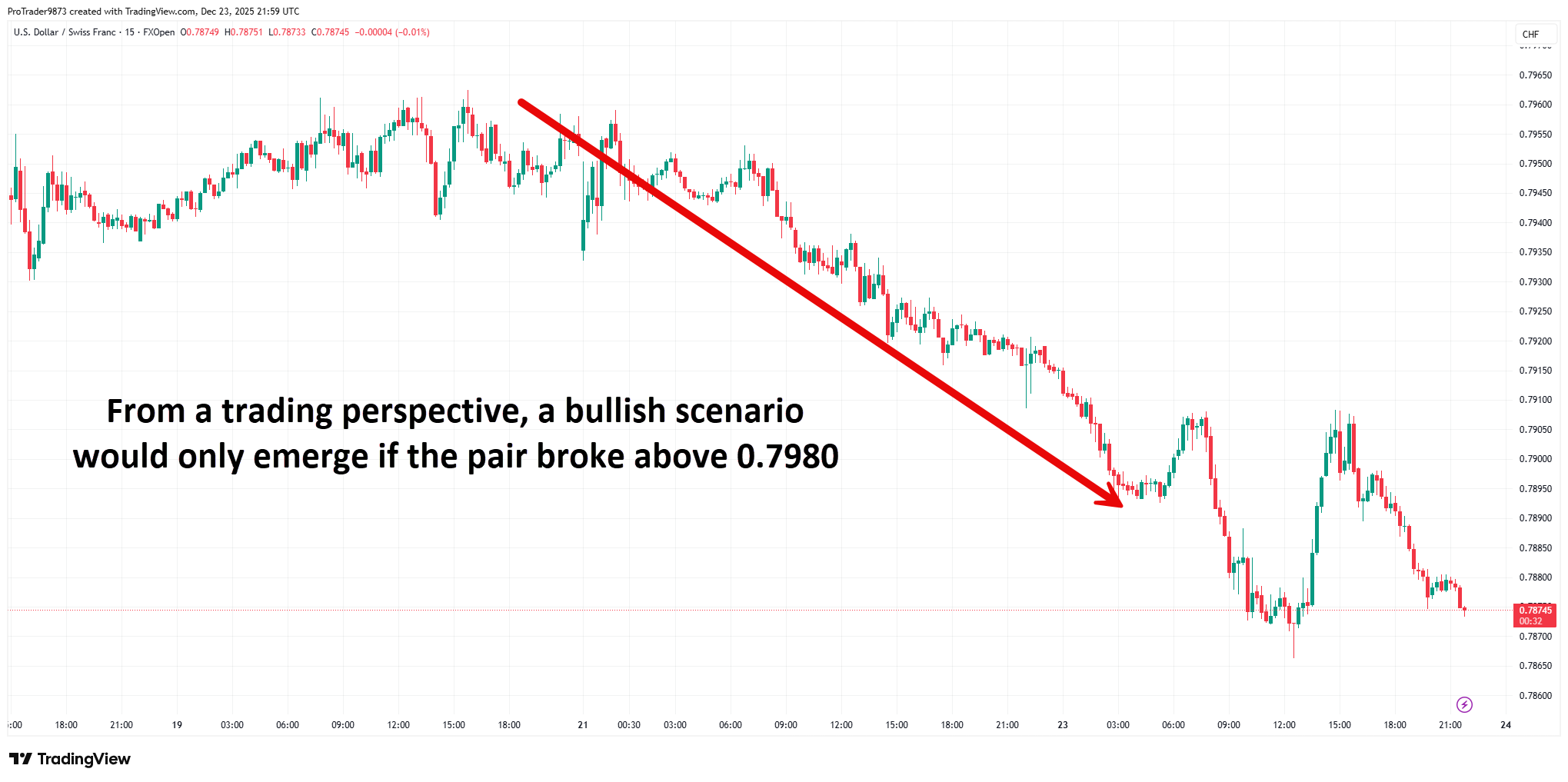
USDCHF – From a trading perspective, a bullish scenario would only emerge if the pair broke above 0.7980

4eshkCnu_o.png


USD/CHF Technical Analysis – 22nd December 2025

On 22nd December 2025, USD/CHF touched a low of 0.7904, which proved to be a significant support level. The price action on this day reflected hesitation among sellers, as the pair failed to extend losses beyond this point. The candlestick structure showed a relatively small body with a lower wick, indicating rejection at lower levels and suggesting that buyers were active near the 0.7900 psychological zone.

From a daily chart perspective, the moving averages provided a clear picture of the prevailing trend. The 20 day moving average was positioned around 0.7960, just above the day’s low, which reinforced the idea of short term support pressure. The 50 day moving average was located near 0.8055 and was sloping downward, confirming medium term weakness. The 200 day moving average stood at approximately 0.8180, also pointing downward, which highlighted that the long term bias remained bearish. Momentum indicators supported this view. The Relative Strength Index (RSI) hovered around 39, a level that reflects neutral to bearish momentum, while the MACD histogram remained negative with the signal line below zero, confirming that bearish undertones were still present in the market.

On the four hour chart, the pair showed consolidation after touching 0.7904. The stochastic oscillator was positioned near 28, which indicated oversold conditions and the possibility of a short term rebound. Momentum readings were flattening, suggesting that sellers were not able to push the pair lower with conviction. Immediate resistance was seen at 0.7945, with stronger resistance at 0.7980. Support was clearly defined at 0.7900–0.7905, with the next level of support at 0.7850. This intraday structure pointed to range bound trading conditions, with buyers defending the lower boundary.

The weekly chart provided a broader perspective. USD/CHF has been in a pronounced downtrend since the August 2025 highs near 0.8520, characterized by lower highs and lower lows. Volatility, measured by the Average True Range (ATR), was moderate at around 0.0060, suggesting that price swings were contained but directional bias remained weak. A Fibonacci retracement drawn from the August 2025 high of 0.8520 to the December low of 0.7904 revealed important levels. The 38.2 percent retracement stood at 0.8140, the 50 percent retracement at 0.8210, and the 61.8 percent retracement at 0.8280. The low of 0.7904 was positioned at the base of this retracement range, which reinforced the idea that the market was testing a critical support zone where buyers were likely to be active.

Taken together, these signals suggest that USD/CHF faced strong support at 0.7900–0.7905. In the short term, the rejection at this level pointed to potential upside risks, with 0.7945 and 0.7980 acting as immediate resistance zones. In the medium term, the moving averages and momentum indicators indicated bearish consolidation, with the pair likely to remain under pressure unless it broke decisively above 0.8055. In the longer term, the downtrend remained intact as long as the pair traded below the 0.8180–0.8210 region, which coincides with the 200 day moving average and the 50 percent Fibonacci retracement.

From a trading perspective, a bullish scenario would only emerge if the pair broke above 0.7980, opening the path toward 0.8055 and potentially 0.8140. A bearish scenario would be confirmed if the pair failed to hold above 0.7900, which could lead to a decline toward 0.7850 and possibly 0.7800. A neutral scenario would involve range bound trading between 0.7900 and 0.7980, with traders focusing on short term opportunities within this narrow band.


#fxopen #forex #forexanalysis

Disclaimer: This analysis represents my own opinion only. It is not to be construed as an opinion, offer, solicitation, recommendation, or financial advice of the Companies operating under the FXOpen brand.

For in-depth analysis, please check ...
 
USDJPY Technical Analysis – 22nd DEC, 2025
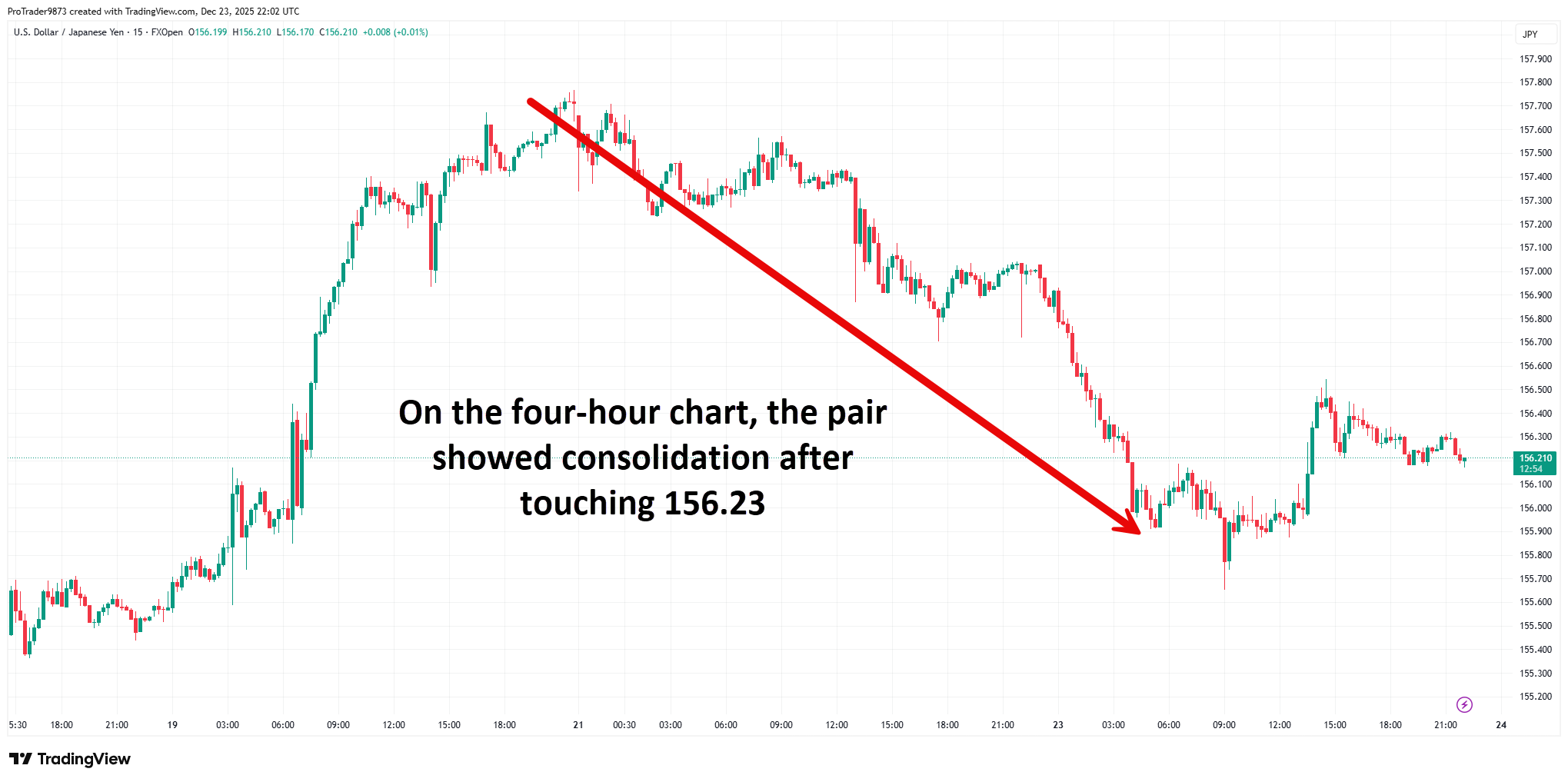
USDJPY - On the four hour chart, the pair showed consolidation after touching 156.23

8hBmHMy4_o.png


USD/JPY Technical Analysis – 22nd December 2025

On 22nd December 2025, USD/JPY touched a low of 156.23, which proved to be a significant support level. The price action on this day reflected hesitation among sellers, as the pair failed to extend losses beyond this point. The candlestick structure showed a relatively small body with a lower wick, indicating rejection at lower levels and suggesting that buyers were active near the 156.20 psychological zone.

From a daily chart perspective, the moving averages provided a clear picture of the prevailing trend. The 20 day moving average was positioned around 157.05, just above the day’s low, which reinforced the idea of short term support pressure. The 50 day moving average was located near 158.80 and was sloping downward, confirming medium term weakness. The 200 day moving average stood at approximately 154.40, still pointing upward, which highlighted that the long term bias remained bullish despite the short term correction. Momentum indicators supported this mixed view. The Relative Strength Index (RSI) hovered around 41, a level that reflects neutral to bearish momentum, while the MACD histogram remained negative with the signal line below zero, confirming that bearish undertones were still present in the market.

On the four hour chart, the pair showed consolidation after touching 156.23. The stochastic oscillator was positioned near 32, which indicated oversold conditions and the possibility of a short term rebound. Momentum readings were flattening, suggesting that sellers were not able to push the pair lower with conviction. Immediate resistance was seen at 156.80, with stronger resistance at 157.50. Support was clearly defined at 156.20–156.25, with the next level of support at 155.50. This intraday structure pointed to range bound trading conditions, with buyers defending the lower boundary.

The weekly chart provided a broader perspective. USD/JPY has been in a corrective phase since the November 2025 highs near 162.40, characterized by lower highs and lower lows. Volatility, measured by the Average True Range (ATR), was moderate at around 1.35, suggesting that price swings were contained but directional bias remained weak. A Fibonacci retracement drawn from the July 2025 low of 150.20 to the November high of 162.40 revealed important levels. The 38.2 percent retracement stood at 157.65, the 50 percent retracement at 156.30, and the 61.8 percent retracement at 155.00. The low of 156.23 coincided almost exactly with the 50 percent retracement, which reinforced the idea that the market was testing a critical support zone where buyers were likely to be active.

Taken together, these signals suggest that USD/JPY faced strong support at 156.20–156.30. In the short term, the rejection at this level pointed to potential upside risks, with 156.80 and 157.50 acting as immediate resistance zones. In the medium term, the moving averages and momentum indicators indicated bearish consolidation, with the pair likely to remain under pressure unless it broke decisively above 158.80. In the longer term, the broader uptrend remained intact as long as the pair traded above the 155.00–154.40 region, which coincides with the 200 day moving average and the 61.8 percent Fibonacci retracement.

From a trading perspective, a bullish scenario would only emerge if the pair broke above 157.50, opening the path toward 158.80 and potentially 160.00. A bearish scenario would be confirmed if the pair failed to hold above 156.20, which could lead to a decline toward 155.00 and possibly 153.50. A neutral scenario would involve range bound trading between 156.20 and 157.50, with traders focusing on short term opportunities within this narrow band.


#fxopen #forex #forexanalysis

Disclaimer: This analysis represents my own opinion only. It is not to be construed as an opinion, offer, solicitation, recommendation, or financial advice of the Companies operating under the FXOpen brand.

For in-depth analysis, please check ...
 
AUDUSD Technical Analysis – 23rd DEC, 2025
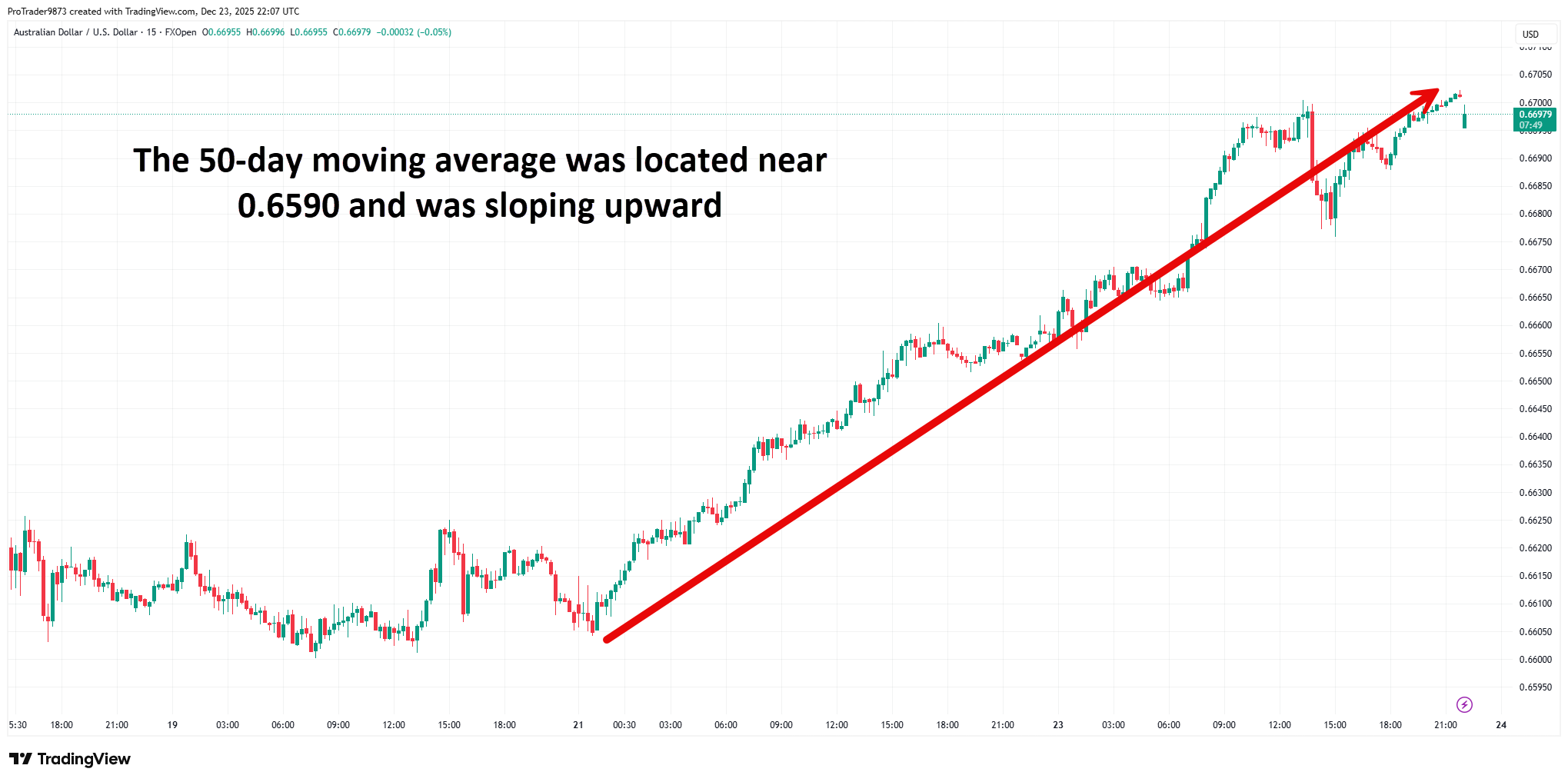
AUDUSD – The 50 day moving average was located near 0.6590 and was sloping upward

BMLtC0hT_o.png


AUD/USD Technical Analysis – 23rd December 2025
On 23rd December 2025, AUD/USD touched a high of 0.6700, which proved to be a significant resistance level. The price action on this day reflected hesitation among buyers, as the pair failed to sustain momentum beyond this point. The candlestick structure showed a relatively small body with an upper wick, indicating rejection at higher levels and suggesting that sellers were active near the 0.6700 psychological zone.

From a daily chart perspective, the moving averages provided a clear picture of the prevailing trend. The 20 day moving average was positioned around 0.6675, just below the day’s high, which reinforced the idea of short term resistance pressure. The 50 day moving average was located near 0.6590 and was sloping upward, confirming medium term bullish momentum. The 200 day moving average stood at approximately 0.6485, also pointing upward, which highlighted that the long term bias had shifted toward bullishness. Momentum indicators supported this view. The Relative Strength Index (RSI) hovered around 64, a level that reflects strong bullish momentum but also warns of potential overbought conditions. The MACD histogram remained positive with the signal line above zero, confirming that buyers were still present in the market, though momentum was beginning to flatten near resistance.

On the four hour chart, the pair showed consolidation after touching 0.6700. The stochastic oscillator was positioned near 78, which indicated overbought conditions and the possibility of a short term pullback. Momentum readings were flattening, suggesting that buyers were not able to push the pair higher with conviction. Immediate support was seen at 0.6670, with stronger support at 0.6640. Resistance was clearly defined at 0.6700–0.6710, with the next level of resistance at 0.6750. This intraday structure pointed to range bound trading conditions, with sellers defending the upper boundary.

The weekly chart provided a broader perspective. AUD/USD has been in a recovery phase since the October 2025 lows near 0.6280, characterized by higher lows and higher highs. Volatility, measured by the Average True Range (ATR), was moderate at around 0.0070, suggesting that price swings were contained but directional bias remained bullish. A Fibonacci retracement drawn from the July 2025 high of 0.6890 to the October low of 0.6280 revealed important levels. The 38.2 percent retracement stood at 0.6510, the 50 percent retracement at 0.6585, and the 61.8 percent retracement at 0.6660. The high of 0.6700 was positioned just above the 61.8 percent retracement, which reinforced the idea that the market was testing a critical resistance zone where sellers were likely to be active.

Taken together, these signals suggest that AUD/USD faced strong resistance at 0.6700–0.6710. In the short term, the rejection at this level pointed to potential downside risks, with 0.6670 and 0.6640 acting as immediate support zones. In the medium term, the moving averages and momentum indicators indicated bullish consolidation, with the pair likely to remain supported unless it broke decisively below 0.6640. In the longer term, the recovery trend remained intact as long as the pair traded above the 0.6510–0.6590 region, which coincides with the 50 day moving average and the 38.2–50 percent Fibonacci retracement levels.

From a trading perspective, a bullish scenario would only emerge if the pair broke above 0.6710, opening the path toward 0.6750 and potentially 0.6820. A bearish scenario would be confirmed if the pair failed to hold above 0.6640, which could lead to a decline toward 0.6585 and possibly 0.6510. A neutral scenario would involve range bound trading between 0.6640 and 0.6710, with traders focusing on short term opportunities within this narrow band.


#fxopen #forex #forexanalysis

Disclaimer: This analysis represents my own opinion only. It is not to be construed as an opinion, offer, solicitation, recommendation, or financial advice of the Companies operating under the FXOpen brand.

For in-depth analysis, please check ...
 
EURCHF Technical Analysis – 23rd DEC, 2025
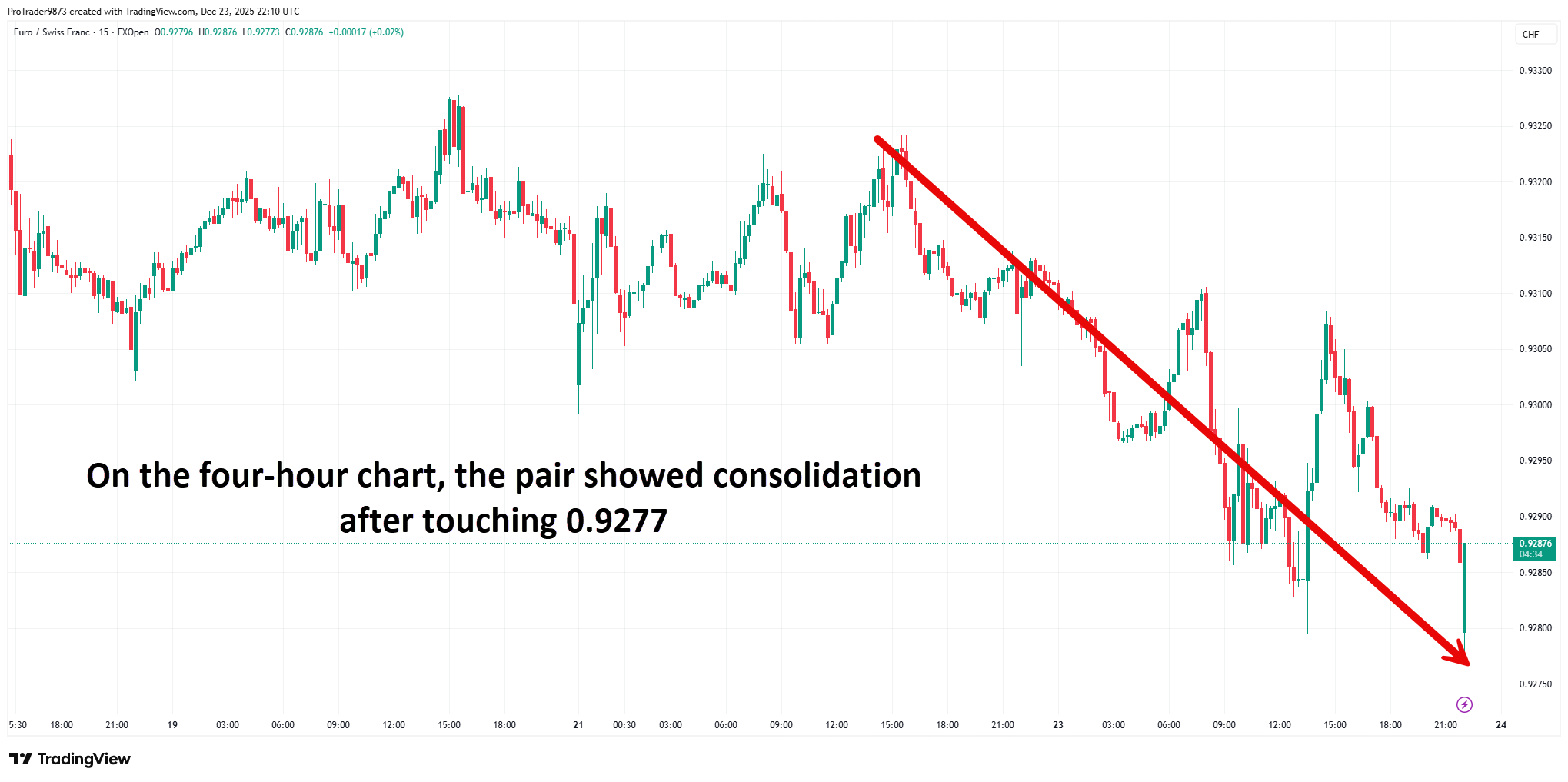
EURCHF – On the four hour chart, the pair showed consolidation after touching 0.9277

8ezZVo0x_o.png


EUR/CHF Technical Analysis – 23rd December 2025

On 23rd December 2025, EUR/CHF touched a low of 0.9277, which proved to be a significant support level. The price action on this day reflected hesitation among sellers, as the pair failed to extend losses beyond this point. The candlestick structure showed a relatively small body with a lower wick, indicating rejection at lower levels and suggesting that buyers were active near the 0.9280 psychological zone.

From a daily chart perspective, the moving averages provided a clear picture of the prevailing trend. The 20 day moving average was positioned around 0.9310, just above the day’s low, which reinforced the idea of short term support pressure. The 50 day moving average was located near 0.9440 and was sloping downward, confirming medium term weakness. The 200 day moving average stood at approximately 0.9410, also pointing downward, which highlighted that the long term bias remained bearish. Momentum indicators supported this view. The Relative Strength Index (RSI) hovered around 41, a level that reflects neutral to bearish momentum, while the MACD histogram remained negative with the signal line below zero, confirming that bearish undertones were still present in the market.

On the four hour chart, the pair showed consolidation after touching 0.9277. The stochastic oscillator was positioned near 33, which indicated oversold conditions and the possibility of a short term rebound. Momentum readings were flattening, suggesting that sellers were not able to push the pair lower with conviction. Immediate resistance was seen at 0.9300, with stronger resistance at 0.9330. Support was clearly defined at 0.9275–0.9280, with the next level of support at 0.9250. This intraday structure pointed to range bound trading conditions, with buyers defending the lower boundary.

The weekly chart provided a broader perspective. EUR/CHF has been in a long term downtrend since the mid 2025 highs near 0.9660, characterized by lower highs and lower lows. Volatility, measured by the Average True Range (ATR), was moderate at around 0.0065, suggesting that price swings were contained but directional bias remained weak. A Fibonacci retracement drawn from the November 2025 high of 0.9664 to the December low of 0.9178 revealed important levels. The 38.2 percent retracement stood at 0.9360, the 50 percent retracement at 0.9420, and the 61.8 percent retracement at 0.9480. The low of 0.9277 was positioned well below the 38.2 percent retracement, which reinforced the idea that sellers remained dominant and that the market was testing deeper support zones.

Taken together, these signals suggest that EUR/CHF faced strong support at 0.9275–0.9280. In the short term, the rejection at this level pointed to potential upside risks, with 0.9300 and 0.9330 acting as immediate resistance zones. In the medium term, the moving averages and momentum indicators indicated bearish consolidation, with the pair likely to remain under pressure unless it broke decisively above 0.9360. In the longer term, the downtrend remained intact as long as the pair traded below the 0.9420–0.9440 region, which coincides with the 50 day and 200 day moving averages.

From a trading perspective, a bullish scenario would only emerge if the pair broke above 0.9330, opening the path toward 0.9360 and potentially 0.9420. A bearish scenario would be confirmed if the pair failed to hold above 0.9275, which could lead to a decline toward 0.9250 and possibly 0.9200. A neutral scenario would involve range bound trading between 0.9275 and 0.9330, with traders focusing on short term opportunities within this narrow band.


#fxopen #forex #forexanalysis

Disclaimer: This analysis represents my own opinion only. It is not to be construed as an opinion, offer, solicitation, recommendation, or financial advice of the Companies operating under the FXOpen brand.

For in-depth analysis, please check ...
 
EURJPY Technical Analysis – 23rd DEC, 2025
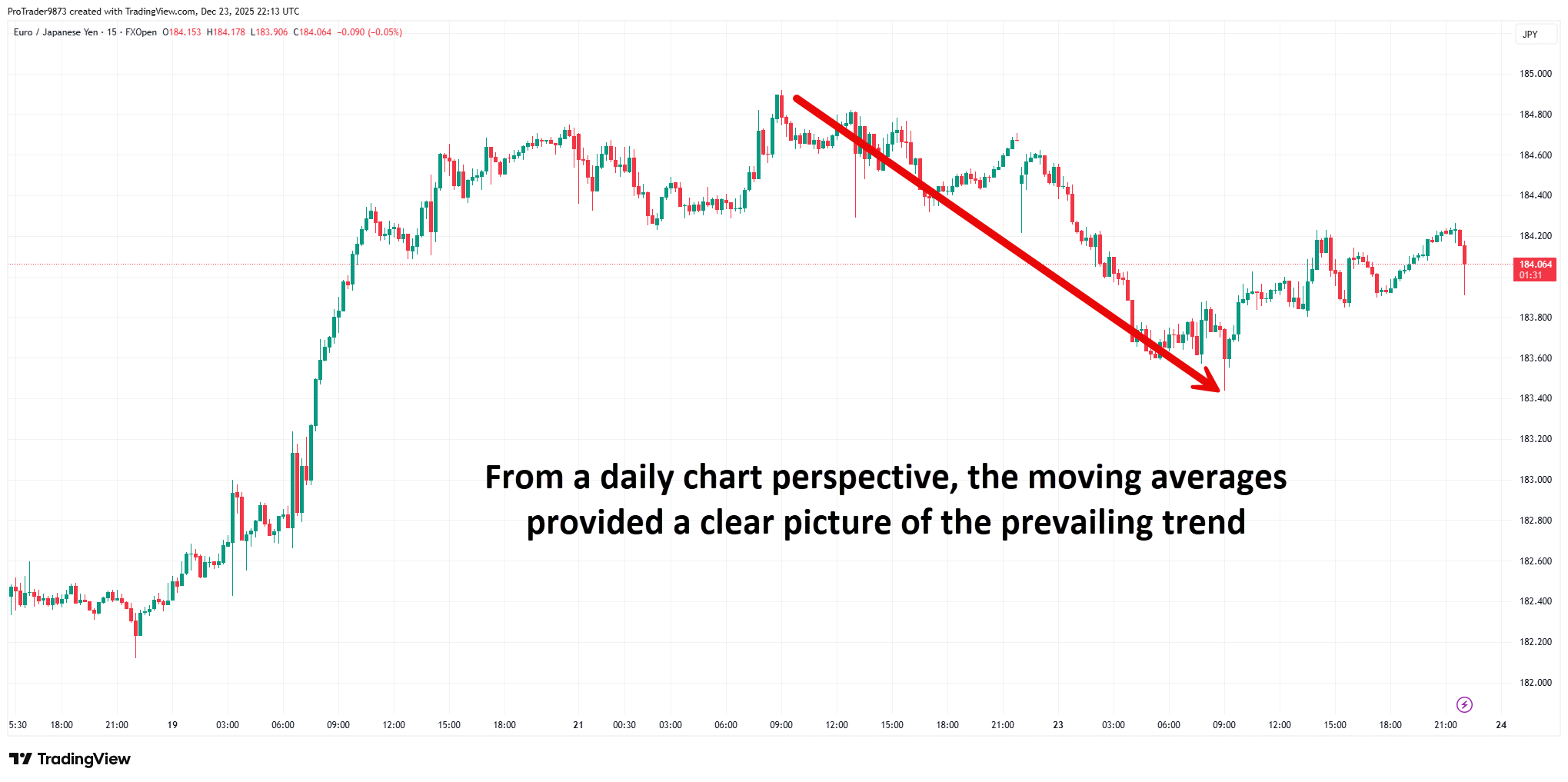
EURJPY – From a daily chart perspective, the moving averages provided a clear picture of the prevailing trend

MyUT3ew2_o.png


EUR/JPY Technical Analysis – 23rd December 2025

On 23rd December 2025, EUR/JPY touched a low of 183.43, which proved to be a significant support level. The price action on this day reflected hesitation among sellers, as the pair failed to extend losses beyond this point. The candlestick structure showed a relatively small body with a lower wick, indicating rejection at lower levels and suggesting that buyers were active near the 183.40 psychological zone.

From a daily chart perspective, the moving averages provided a clear picture of the prevailing trend. The 20 day moving average was positioned around 184.20, just above the day’s low, which reinforced the idea of short term support pressure. The 50 day moving average was located near 182.10 and was sloping upward, confirming medium term bullish momentum. The 200 day moving average stood at approximately 178.50, also pointing upward, which highlighted that the long term bias remained bullish. Momentum indicators supported this view. The Relative Strength Index (RSI) hovered around 44, a level that reflects neutral to bearish momentum, while the MACD histogram remained slightly negative with the signal line close to zero, confirming that bearish undertones were present but not dominant.

On the four hour chart, the pair showed consolidation after touching 183.43. The stochastic oscillator was positioned near 35, which indicated oversold conditions and the possibility of a short term rebound. Momentum readings were flattening, suggesting that sellers were not able to push the pair lower with conviction. Immediate resistance was seen at 184.00, with stronger resistance at 184.70. Support was clearly defined at 183.40–183.45, with the next level of support at 182.80. This intraday structure pointed to range bound trading conditions, with buyers defending the lower boundary.

The weekly chart provided a broader perspective. EUR/JPY has been in a strong uptrend since the September 2025 lows near 174.50, characterized by higher lows and higher highs. Volatility, measured by the Average True Range (ATR), was moderate at around 1.20, suggesting that price swings were contained but directional bias remained bullish. A Fibonacci retracement drawn from the July 2025 high of 189.40 to the September low of 174.50 revealed important levels. The 38.2 percent retracement stood at 180.20, the 50 percent retracement at 181.95, and the 61.8 percent retracement at 183.70. The low of 183.43 coincided almost exactly with the 61.8 percent retracement, which reinforced the idea that the market was testing a critical support zone where buyers were likely to be active.

Taken together, these signals suggest that EUR/JPY faced strong support at 183.40–183.70. In the short term, the rejection at this level pointed to potential upside risks, with 184.00 and 184.70 acting as immediate resistance zones. In the medium term, the moving averages and momentum indicators indicated bullish consolidation, with the pair likely to remain supported unless it broke decisively below 182.80. In the longer term, the uptrend remained intact as long as the pair traded above the 181.95–182.10 region, which coincides with the 50 day moving average and the 50 percent Fibonacci retracement.

From a trading perspective, a bullish scenario would only emerge if the pair broke above 184.70, opening the path toward 186.00 and potentially 188.00. A bearish scenario would be confirmed if the pair failed to hold above 183.40, which could lead to a decline toward 182.80 and possibly 181.95. A neutral scenario would involve range bound trading between 183.40 and 184.70, with traders focusing on short term opportunities within this narrow band.


#fxopen #forex #forexanalysis

Disclaimer: This analysis represents my own opinion only. It is not to be construed as an opinion, offer, solicitation, recommendation, or financial advice of the Companies operating under the FXOpen brand.

For in-depth analysis, please check ...
 
EURUSD Technical Analysis – 23rd DEC, 2025
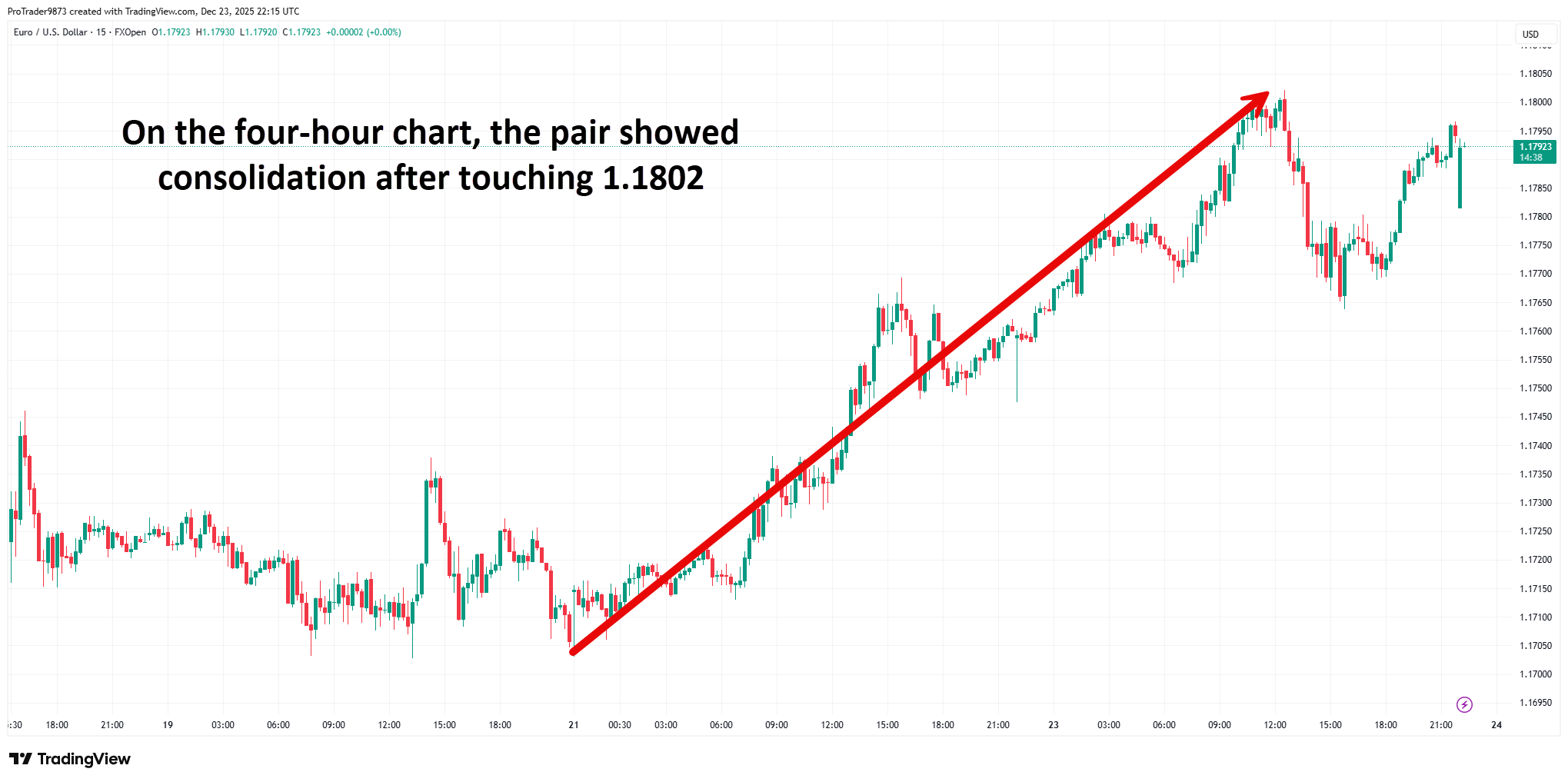
EURUSD – On the four hour chart, the pair showed consolidation after touching 1.1802

q6y1zRAK_o.png


EUR/USD Technical Analysis – 23rd December 2025

On 23rd December 2025, EUR/USD touched a high of 1.1802, which proved to be a significant resistance level. The price action on this day reflected hesitation among buyers, as the pair failed to sustain momentum beyond this point. The candlestick structure showed a relatively small body with an upper wick, indicating rejection at higher levels and suggesting that sellers were active near the 1.1800 psychological zone.

From a daily chart perspective, the moving averages provided a clear picture of the prevailing trend. The 20 day moving average was positioned around 1.1760, just below the day’s high, which reinforced the idea of short term resistance pressure. The 50 day moving average was located near 1.1690 and was sloping upward, confirming medium term bullish momentum. The 200 day moving average stood at approximately 1.1590, also pointing upward, which highlighted that the long term bias had shifted toward bullishness. Momentum indicators supported this view. The Relative Strength Index (RSI) hovered around 66, a level that reflects strong bullish momentum but also warns of potential overbought conditions. The MACD histogram remained positive with the signal line above zero, confirming that buyers were still present in the market, though momentum was beginning to flatten near resistance.

On the four hour chart, the pair showed consolidation after touching 1.1802. The stochastic oscillator was positioned near 80, which indicated overbought conditions and the possibility of a short term pullback. Momentum readings were flattening, suggesting that buyers were not able to push the pair higher with conviction. Immediate support was seen at 1.1765, with stronger support at 1.1730. Resistance was clearly defined at 1.1800–1.1810, with the next level of resistance at 1.1850. This intraday structure pointed to range bound trading conditions, with sellers defending the upper boundary.

The weekly chart provided a broader perspective. EUR/USD has been in a recovery phase since the October 2025 lows near 1.1450, characterized by higher lows and higher highs. Volatility, measured by the Average True Range (ATR), was moderate at around 0.0065, suggesting that price swings were contained but directional bias remained bullish. A Fibonacci retracement drawn from the July 2025 high of 1.1975 to the October low of 1.1450 revealed important levels. The 38.2 percent retracement stood at 1.1655, the 50 percent retracement at 1.1715, and the 61.8 percent retracement at 1.1775. The high of 1.1802 was positioned just above the 61.8 percent retracement, which reinforced the idea that the market was testing a critical resistance zone where sellers were likely to be active.

Taken together, these signals suggest that EUR/USD faced strong resistance at 1.1800–1.1810. In the short term, the rejection at this level pointed to potential downside risks, with 1.1765 and 1.1730 acting as immediate support zones. In the medium term, the moving averages and momentum indicators indicated bullish consolidation, with the pair likely to remain supported unless it broke decisively below 1.1730. In the longer term, the recovery trend remained intact as long as the pair traded above the 1.1655–1.1690 region, which coincides with the 50 day moving average and the 38.2 percent Fibonacci retracement.

From a trading perspective, a bullish scenario would only emerge if the pair broke above 1.1810, opening the path toward 1.1850 and potentially 1.1900. A bearish scenario would be confirmed if the pair failed to hold above 1.1730, which could lead to a decline toward 1.1655 and possibly 1.1600. A neutral scenario would involve range bound trading between 1.1730 and 1.1810, with traders focusing on short term opportunities within this narrow band.

#fxopen #forex #forexanalysis

Disclaimer: This analysis represents my own opinion only. It is not to be construed as an opinion, offer, solicitation, recommendation, or financial advice of the Companies operating under the FXOpen brand.

For in-depth analysis, please check ...
 
GBPJPY Technical Analysis – 23rd DEC, 2025
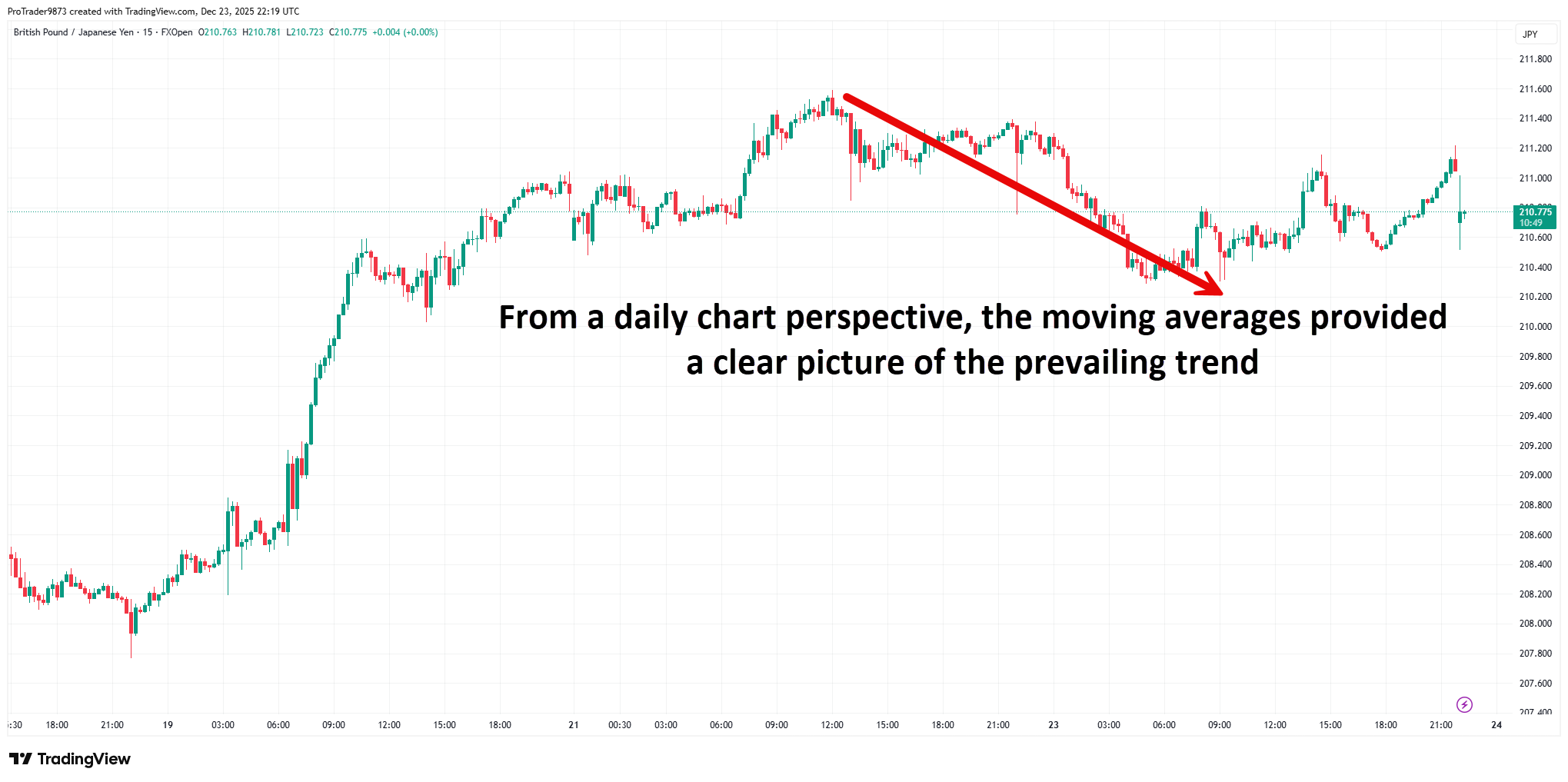
GBPJPY – From a daily chart perspective, the moving averages provided a clear picture of the prevailing trend

m04btpAU_o.png


GBP/JPY Technical Analysis – 23rd December 2025

On 23rd December 2025, GBP/JPY touched a low of 210.28, which proved to be a significant support level. The price action on this day reflected hesitation among sellers, as the pair failed to extend losses beyond this point. The candlestick structure showed a relatively small body with a lower wick, indicating rejection at lower levels and suggesting that buyers were active near the 210.30 psychological zone.

From a daily chart perspective, the moving averages provided a clear picture of the prevailing trend. The 20 day moving average was positioned around 210.95, just above the day’s low, which reinforced the idea of short term support pressure. The 50 day moving average was located near 208.10 and was sloping upward, confirming medium term bullish momentum. The 200 day moving average stood at approximately 202.80, also pointing upward, which highlighted that the long term bias remained bullish. Momentum indicators supported this view. The Relative Strength Index (RSI) hovered around 43, a level that reflects neutral to bearish momentum, while the MACD histogram remained slightly negative with the signal line close to zero, confirming that bearish undertones were present but not dominant.

On the four hour chart, the pair showed consolidation after touching 210.28. The stochastic oscillator was positioned near 36, which indicated oversold conditions and the possibility of a short term rebound. Momentum readings were flattening, suggesting that sellers were not able to push the pair lower with conviction. Immediate resistance was seen at 210.80, with stronger resistance at 211.50. Support was clearly defined at 210.25–210.30, with the next level of support at 209.50. This intraday structure pointed to range bound trading conditions, with buyers defending the lower boundary.

The weekly chart provided a broader perspective. GBP/JPY has been in a strong uptrend since the September 2025 lows near 197.20, characterized by higher lows and higher highs. Volatility, measured by the Average True Range (ATR), was moderate at around 2.05, suggesting that price swings were contained but directional bias remained bullish. A Fibonacci retracement drawn from the July 2025 high of 215.40 to the September low of 197.20 revealed important levels. The 38.2 percent retracement stood at 204.25, the 50 percent retracement at 206.30, and the 61.8 percent retracement at 208.35. The low of 210.28 was positioned above the 61.8 percent retracement, which reinforced the idea that the market was testing a support zone within the broader uptrend.

Taken together, these signals suggest that GBP/JPY faced strong support at 210.25–210.30. In the short term, the rejection at this level pointed to potential upside risks, with 210.80 and 211.50 acting as immediate resistance zones. In the medium term, the moving averages and momentum indicators indicated bullish consolidation, with the pair likely to remain supported unless it broke decisively below 209.50. In the longer term, the uptrend remained intact as long as the pair traded above the 206.30–208.10 region, which coincides with the 50 day moving average and the 50 percent Fibonacci retracement.

From a trading perspective, a bullish scenario would only emerge if the pair broke above 211.50, opening the path toward 213.00 and potentially 215.00. A bearish scenario would be confirmed if the pair failed to hold above 210.25, which could lead to a decline toward 209.50 and possibly 208.35. A neutral scenario would involve range bound trading between 210.25 and 211.50, with traders focusing on short term opportunities within this narrow band.


#fxopen #forex #forexanalysis

Disclaimer: This analysis represents my own opinion only. It is not to be construed as an opinion, offer, solicitation, recommendation, or financial advice of the Companies operating under the FXOpen brand.

For in-depth analysis, please check ...
 
GBPUSD Technical Analysis – 23rd DEC, 2025
GBPUSD – On the four hour chart, the pair showed consolidation after touching 1.3518

ENYYuWSe_o.png


GBP/USD Technical Analysis – 23rd December 2025

On 23rd December 2025, GBP/USD touched a high of 1.3518, which proved to be a significant resistance level. The price action on this day reflected hesitation among buyers, as the pair failed to sustain momentum beyond this point. The candlestick structure showed a relatively small body with an upper wick, indicating rejection at higher levels and suggesting that sellers were active near the 1.3520 psychological zone.

From a daily chart perspective, the moving averages provided a clear picture of the prevailing trend. The 20 day moving average was positioned around 1.3470, just below the day’s high, which reinforced the idea of short term resistance pressure. The 50 day moving average was located near 1.3385 and was sloping upward, confirming medium term bullish momentum. The 200 day moving average stood at approximately 1.3265, also pointing upward, which highlighted that the long term bias remained bullish. Momentum indicators supported this view. The Relative Strength Index (RSI) hovered around 67, a level that reflects strong bullish momentum but also warns of potential overbought conditions. The MACD histogram remained positive with the signal line above zero, confirming that buyers were still present in the market, though momentum was beginning to flatten near resistance.

On the four hour chart, the pair showed consolidation after touching 1.3518. The stochastic oscillator was positioned near 81, which indicated overbought conditions and the possibility of a short term pullback. Momentum readings were flattening, suggesting that buyers were not able to push the pair higher with conviction. Immediate support was seen at 1.3480, with stronger support at 1.3440. Resistance was clearly defined at 1.3515–1.3520, with the next level of resistance at 1.3560. This intraday structure pointed to range bound trading conditions, with sellers defending the upper boundary.

The weekly chart provided a broader perspective. GBP/USD has been in a recovery phase since the October 2025 lows near 1.3100, characterized by higher lows and higher highs. Volatility, measured by the Average True Range (ATR), was moderate at around 0.0095, suggesting that price swings were contained but directional bias remained bullish. A Fibonacci retracement drawn from the July 2025 high of 1.3750 to the October low of 1.3100 revealed important levels. The 38.2 percent retracement stood at 1.3345, the 50 percent retracement at 1.3425, and the 61.8 percent retracement at 1.3505. The high of 1.3518 was positioned just above the 61.8 percent retracement, which reinforced the idea that the market was testing a critical resistance zone where sellers were likely to be active.

Taken together, these signals suggest that GBP/USD faced strong resistance at 1.3515–1.3520. In the short term, the rejection at this level pointed to potential downside risks, with 1.3480 and 1.3440 acting as immediate support zones. In the medium term, the moving averages and momentum indicators indicated bullish consolidation, with the pair likely to remain supported unless it broke decisively below 1.3440. In the longer term, the recovery trend remained intact as long as the pair traded above the 1.3345–1.3385 region, which coincides with the 50 day moving average and the 38.2 percent Fibonacci retracement.

From a trading perspective, a bullish scenario would only emerge if the pair broke above 1.3520, opening the path toward 1.3560 and potentially 1.3620. A bearish scenario would be confirmed if the pair failed to hold above 1.3440, which could lead to a decline toward 1.3425 and possibly 1.3345. A neutral scenario would involve range bound trading between 1.3440 and 1.3520, with traders focusing on short term opportunities within this narrow band.


#fxopen #forex #forexanalysis

Disclaimer: This analysis represents my own opinion only. It is not to be construed as an opinion, offer, solicitation, recommendation, or financial advice of the Companies operating under the FXOpen brand.

For in-depth analysis, please check ...
 
Back
Top