| |||||||
| |||||||
DMI Indicator
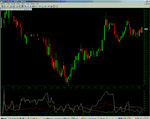
This is a discussion on DMI Indicator within the Indicators forums, part of the Technical Analysis category; Here are a couple of recent examples, which I think illustrate the “mechanics” of DMI quite well. ADX (yellow) shows ...
![]() |
| |||
|
| | LinkBack | Thread Tools |
| | #33 |
| Senior Member Join Date: Nov 2001 Location: Weald of Kent Posts: 493
| Re: DMI Indicator
Here are a couple of recent examples, which I think illustrate the “mechanics” of DMI quite well. ADX (yellow) shows the strength of the trend and so the higher the line the stronger the trend. The +DI (green) and –DI (red) shows the direction of the trend. Basically, buy signals are generated when +DI (green) goes above –DI (red) and conversely, sell signals are generated when –DI (red) goes above +DI (green). The height of the ADX (yellow) line shows the strength of directional movement in the prevailing direction, which can be either up or down. If the ADX falls below the +D and –D lines, then the trend is flat and neither up nor down. The colour codes are simply how I’ve set them up. HTH Cheers Mayfly
__________________ Life is for living, if only for a day. |
| |
| | #34 |
| Veteran Member Join Date: Feb 2003 Posts: 918
|
Great illustrations!
__________________ Rognvald |
| |
| | #35 |
| Legendary Member | Re: DMI Indicator
Yep, what I'm querying is the way people are using the crossing of + or - DI by ADX to make the signal, when what you've basically got in the ADX is an EMA of the change in DI.. there are a whole series of EMAs going into each step of these indicators - and what it all boils down to is EMA'ing running totals from higher highs and lower lows... a falling ADX in itself signals a trend strength reduction, therefore I contend that the exit for a long trade should be 'the ADX is falling, indicating the uptrend is dying, plus the price has dropped by X from the high' or there's an engulfing pattern, or something to suggest that the signal is correct to call the top. I don't see why confirmation would be taken to be 'indicator line A' crossing 'indicator line B' when indicator A is actually derived from indicator B - it makes more sense to confirm by an independent source where possible. A lot of readers would see these posts as offering a decent trading system, and I'm not decrying it for one moment, but many readers would quite likely be unaware that the different lines all originate from the same info - difference in highs, difference in lows - I am therefore suggesting that it might be a good idea to confirm via a second indicator that is not derived from the high1-high2 etc, or by visual confirmation from the price chart itself... if you are trading an uptrend, and this indicator says 'trend is ending' then I'd have thought it was a fairly simple matter to check the bar/candle chart and decide for yourself if that signal was good... or at least a distinct possibility. Dave |
| |
| | #36 | |
| Member Join Date: Jan 2003 Location: London Posts: 94
| Re: DMI Indicator Quote:
Having said which, the fact that the ADX is falling, or that the +DI has started to fall, are quite good reminders to look straight at the evidence, when deciding whether to close a position. Because you cannot tell in advance when the line is going to reach a maximum (or a minimum, you cannot do the same thing when deciding whether to start a trade, as it is always too late. That is presumably why the +DI/-DI crossover signal was invented, despite the demonstrable fact that the timing is always off. And, of course, I don't decry people's success in using this indicator to make money, though I suspect success shows more about them than about the indicator. | |
| |
| | #37 |
| Legendary Member | Re: DMI Indicator
An excellent final point, that you make money from the system suggests you're pretty good and giving the system more credit than you should for what is actually your own ability! I'd also like to stress that coming onto a board and offering an idea is in itself a character reference in my book - my comments are intended to be helpful, not critical! |
| |
| | #38 | |
| Junior Member Join Date: Apr 2004 Location: USA Posts: 47
| Re: DMI Indicator Quote:
Now to address some of the comments that have been discussed: Obviously the indicators within DMI/ADX are based off the same data it all makes up one indicator. Also I think that all indicators in theory are lagging, there is no price chart I know of that will tell you definitively what will happen next, they are all based on previous data. What we are trying to do in reading charts is move the odds into our favor as much as possible. There is definitely a price determination as well as a falling ADX in my exits, otherwise I would probably never be able to take the longer .10+ moves. ADX falling implies the "call" weakening. Futures falling (or rising in the case of a short, we can't forget shorts thats about 40% of my trades) when ADX is also falling is a good sign that the call is reversing and it is time to exit. As I said I have been trading for 7+years and this method for the past 2+years. There will be a learning curve in any strategy. Nobody should expects to jump right in get the same results I am getting. I've been doing this a long time. I do suggest maybe you take a look, because this DMI/ADX indicator is the best ( and easiest) I have found and may it may help alot of people go to the "next level". | |
| |
| | #39 |
| Veteran Member | Re: DMI Indicator
To add a little to the above, readers may be interested in the following from the Metastock manual. It goes on to agree with crossing above/below and then follows: "These simple trading rules are qualified with the 'extreme point rule'. This rule is designed to prevent whipsaws and reduce the number of trades. The extreme point rule requires that on the day that the +DI and -DI cross, you note the 'extreme price'. If you are long, the extreme price is the low price on the day the lines cross. If you are short, the extreme price is the high price on the day the lines cross. The extreme point is then used as a trigger point at which you should implement the trade. For example, after receiving a buy signal (the+DI rose above the -DI), you should then wait until the security's price rises above the extreme point (the high price on the day the the +DI and -DI lines crossed) before buying. If the price fails to rise above the extreme point, you should continue to hold your short position." "Wilder's book suggests the system works best on securities that have a high Commodity Selection Index value. As a rule of thumb the system will be profitable on commodites that have and ADXR value above 25. When the ADXR drops below 20, then do not use a trend -following system" This is not an indicator I use, so I have no personal experience to comment further as to the reliability or otherwise. John |
| |
| | #40 |
| Content Editor Join Date: Jan 2003 Location: UK Posts: 6,363
| Re: DMI Indicator
bigtimetrader, What is the duration of a typical trade ? also what is the longest and shortest time you have been in a trade ? Paul |
| |
![]() |
| Currently Active Users Viewing This Thread: 1 (0 members and 1 guests) | |
| Thread Tools | |
| |
Similar Threads | ||||
| Thread | Thread Starter | Forum | Replies | Last Post |
| CCI Indicator | Rob McCoy | Forex Discussion | 4 | May 13, 2009 2:51am |
| Help with an Indicator please | Chorlton | MetaStock | 4 | Aug 4, 2006 2:59am |
| DMI indicator | wezzley | Forex Discussion | 4 | Jun 7, 2006 6:42am |
| Not exactly an indicator but,... | TheBramble | Indicators | 15 | Jun 6, 2006 2:25am |
| CQG Indicator | raypaladino | US Indices | 0 | Apr 1, 2006 6:42pm |
| New To Site? | Need Help? |
All times are GMT -4. The time now is 10:55pm.
Copyright © 2001-2010 Trade2Win.
Pending NFA Registration (Member ID 0402027). Please be aware that off-exchange retail foreign currency (forex) trading involves significant risk of loss and is not suitable for all investors. Increasing leverage increases risk. Before deciding to trade forex, you should carefully consider your financial goals, level of experience and risk appetite. Any opinions, news, research, analysis, prices or other information contained does not constitute investment advice.